

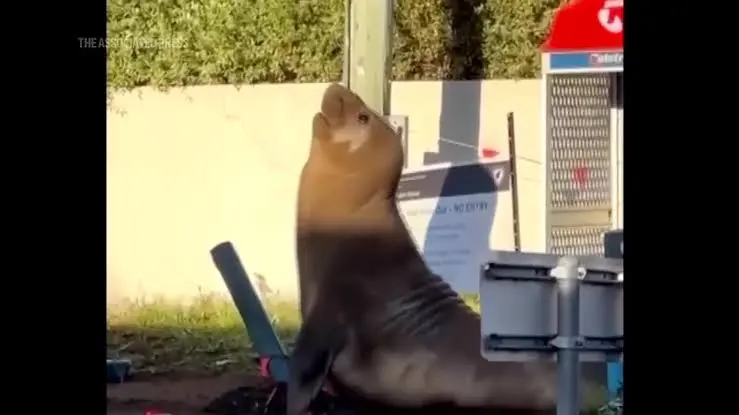
“It’s Neil’s world and we’re just living in it,” one local said about a male elephant seal that weighs as much as a small car and has a social media following double Tasmania’s human population.
WELLINGTON, New Zealand — A giant elephant seal named Neil has returned to the Australian coastline where he was born, but unlike most animals that quietly revisit their birthplace, his arrival has become a public spectacle. Weighing around 2,200 pounds (1,000 kilograms), the five-year-old marine mammal has gained widespread attention for his enormous size, playful behavior, and the trail of damaged property he often leaves behind.
Each year, Neil spends months feeding in the ocean before coming ashore twice to rest, molt, and recover. During his latest visit in June, he wandered through several seaside communities in Tasmania, where his presence quickly disrupted everyday life.
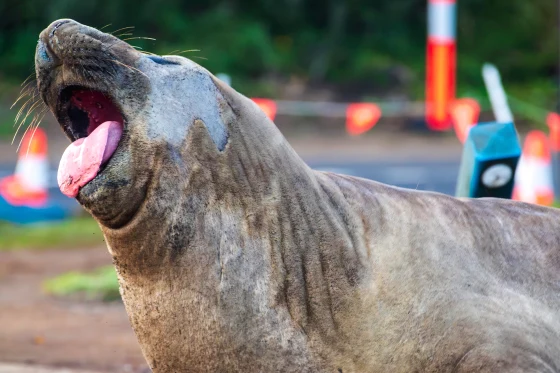
Now as heavy as a compact car, Neil has accidentally flattened traffic bollards, knocked down warning signs, and even destroyed a fence while attempting to climb over it. When he is not exploring, he often chooses unusual places to rest, including the middle of roads, forcing traffic to stop until wildlife officers can safely redirect vehicles around him.
Despite his calm nature, authorities are becoming increasingly concerned about the attention he receives from the public. Officials say the greatest risk is not Neil himself, but people who approach him too closely in hopes of taking photos or videos for social media.
Neil is currently the only known male southern elephant seal regularly visiting Tasmania, making him especially unique. His popularity has exploded online, with his TikTok account attracting approximately 1.4 million followers—far more than Tasmania’s human population.
Many of his viral videos show him pushing parked cars, knocking over barriers, or stubbornly occupying roads and sidewalks. These incidents have led some internet users to jokingly celebrate him as a rebellious local icon. However, wildlife experts explain that his behavior is perfectly normal for a young male elephant seal.
According to elephant seal researcher Sophia Volzke from the University of Tasmania, juvenile males naturally practice the aggressive movements they will need later in life when competing for mates. Adult elephant seals establish dominance by lifting themselves upright and slamming their chests into rivals. Since Neil has no other young males nearby to spar with, he ends up testing his strength against inanimate objects—sometimes including parked Toyota vehicles.
Tasmania’s Department of Natural Resources and Environment has warned that Neil’s internet fame presents a serious challenge. Department representative Kris Carlyon described the situation as “a double-edged sword,” explaining that while public interest helps raise awareness about wildlife, it also encourages dangerous interactions.
Officials have witnessed visitors carrying small children close to Neil simply to capture photographs for social media platforms such as Instagram. They are asking residents and tourists not to reveal Neil’s exact location online in order to discourage large crowds from gathering around him.
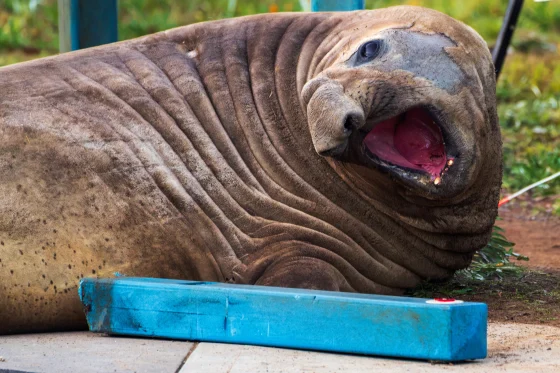
Wildlife officers fear that if too many people surround the seal, they may eventually be forced to relocate him—a difficult and stressful operation for both the animal and those involved.
Carlyon also referenced the case of Freya, a walrus in Norway that became an international internet sensation before being euthanized in 2023 after officials concluded that growing public interest had created an unacceptable safety risk. He warned that excessive attention could ultimately have similar consequences for Neil if people fail to respect his space.
Returning to the place of birth is a normal part of an elephant seal’s life cycle. These animals regularly come ashore twice each year to rest, fast, and shed their old fur before returning to sea. Many species also travel surprisingly far inland during these visits, occasionally appearing in coastal towns.
Neil’s situation is unusual because male elephant seals rarely haul out on Tasmania itself. Most breeding colonies are located on remote sub-Antarctic islands south of the state. Researchers believe Neil’s mother likely traveled from one of these islands to give birth before returning to sea.
Female elephant seals have occasionally been seen on Tasmanian beaches as well, but because they remain significantly smaller than adult males, they generally attract less attention and cause far fewer disturbances.
Scientists believe Neil’s appearances could indicate that elephant seals are gradually re-establishing themselves in habitats where they once lived before historical hunting dramatically reduced their numbers. Researchers say this possibility highlights the importance of learning how humans and wildlife can successfully coexist.
As Neil continues to grow, managing his visits may become even more difficult. Adult male elephant seals can reach lengths of approximately 16 feet (5 meters) and weigh more than three times Neil’s current size. However, researchers note that only about 10 percent of males survive long enough to reach breeding age, which is usually around ten years old.
For the moment, Neil seems perfectly content lounging on sidewalks, resting beside puddles, or entertaining himself by nudging an orange traffic cone—behavior that continues to delight millions of followers online. Even after wildlife rangers encourage him to move elsewhere, he often returns to the exact same location.
As Carlyon observed, Neil appears to have decided that one particular puddle, surrounded by flattened bollards, is exactly where he wants to be.
Local residents remain divided. Some find the disruptions frustrating, while others have embraced the enormous visitor as a hometown celebrity.
One resident, Dale Creamer, summed up the community’s feelings with a smile, saying that Neil has become one of Tasmania’s biggest attractions and joking that everyone else is simply living in Neil’s world.