

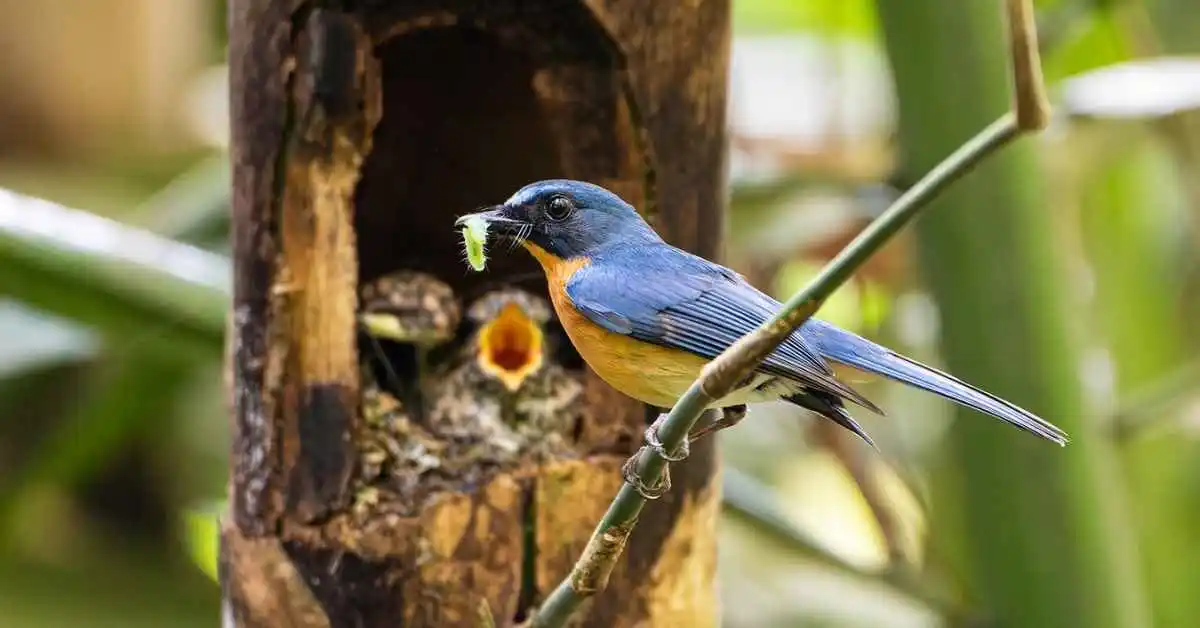
Years ago, Parman knew the Menoreh Hills of Central Java as a good place to catch songbirds.
As a young man living in Donorejo village, he would search for nests, collect young birds before they could fly and raise them until they were ready to sell.
“Most buyers came from outside the area, especially Yogyakarta and Magelang,” Parman said. “They’d ask local people to catch them, and we’d sell them — for a pretty good price.”
At the time, colorful species such as the Javan blue flycatcher were common enough to encounter regularly.
That has changed dramatically.
The Javan blue flycatcher is now considered critically endangered, with hunting for the songbird trade among the major reasons for its decline.
According to a 2022 species assessment, tens of thousands of the birds may live in captivity while fewer than 1,000 are thought to remain in the wild.
For Parman, the decline eventually became impossible to ignore.
“It became really difficult to find birds here,” he said. “So that’s why we stopped, and chose to focus on raising goats instead.”
But when local hunters stopped trapping birds, people from outside the area began arriving to take their place.
That helped change the way Parman viewed the landscape he had once hunted.
Today, he is among a small but growing number of former bird hunters in Java who are becoming conservationists.
Rather than removing birds from the forest, they are now helping protect the habitat those species need to survive.
One important part of the effort involves creating and preserving wildlife corridors — connected areas of vegetation that allow birds and other animals to move between fragmented pieces of habitat.
Village authorities in Donorejo have also introduced a ban on songbird hunting after residents noticed populations continuing to decline.
Since the restrictions were introduced around two years ago, locals say sightings of Javan blue flycatchers may be beginning to increase.
Residents are also planting fruit trees, nectar-producing flowers and crops such as sorghum to provide additional food for local bird populations.
In neighboring Pandanrejo village, conservationists are paying particular attention to natural springs.
Those water sources are important not only for people but also for birds that use them for drinking and foraging.
“We don’t have the authority, so all we can do is coordinate,” local conservationist Adhita Virya Akmilius Lala said. “We also ensure that trees containing nests are protected and monitored.”
Community members have also started mapping bird habitats throughout the Menoreh Hills.
The goal is to identify important nesting areas and determine which pieces of habitat need protection or restoration.
“At least now there are efforts by residents to build bird corridors to maintain bird diversity and populations,” conservation organizer Tegar Cahaya Putra said.
Much of the land in the area remains privately owned, making cooperation with residents especially important.
Conservation groups have been working directly with landowners to explain which parts of their property provide critical habitat.
“For example, the landowners of the upland there already know that their area is a nesting ground for Javan blue flycatchers, so they won’t clear-cut the hill,” conservation worker Arif Rudiyanto said.
The work carries cultural significance as well.
Nearby Borobudur, the famous ninth-century Buddhist temple complex, contains thousands of stone carvings depicting birds and other animals.
But despite that long connection between birds and the region, Parman remembers the Menoreh Hills becoming noticeably quieter about five years ago.
Fewer birds seemed to be nesting there.
He now hopes local conservation work can reverse at least some of that loss.
Together with other residents, Parman has helped form a grassroots group that records bird sightings and maps where different species are found.
Their observations have revealed that many birds gather around local springs.
Five of those water sources are now considered to be in critical condition because of declining water levels.
Protecting and restoring them could therefore benefit both wildlife and surrounding communities.
“This data will be our material for rehabilitating the bird corridor here,” Parman said.
For someone who once made money removing birds from the forest, the mission is now completely different.
Parman and other former hunters are trying to make sure the songs that once filled the Menoreh Hills don’t disappear for good.