

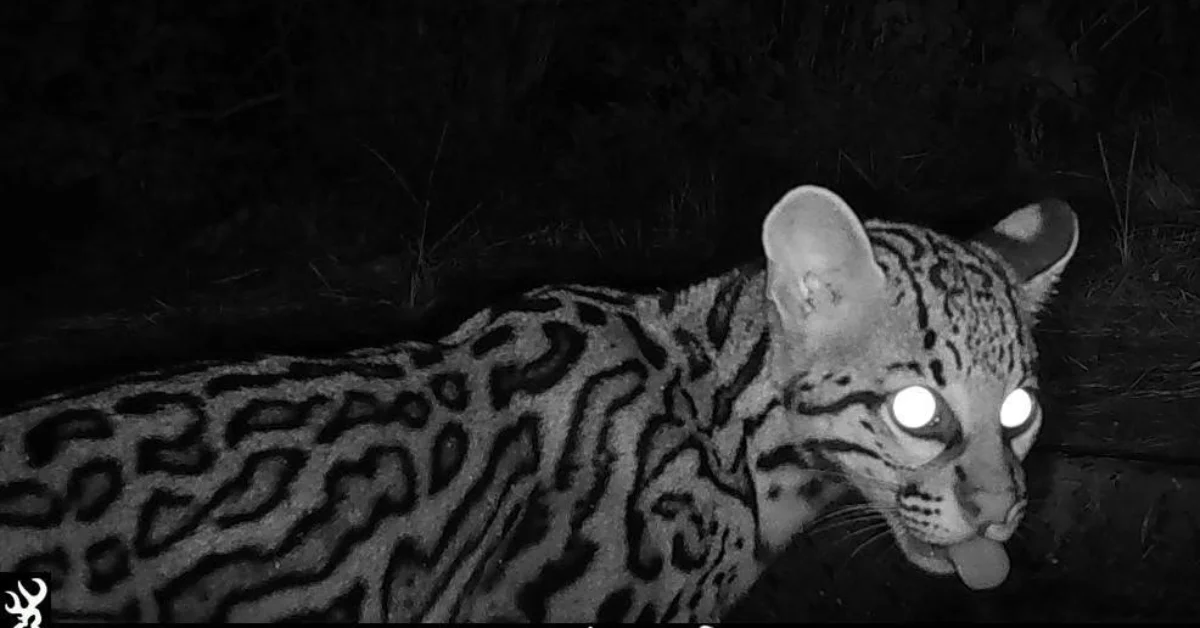
Ocelots once ranged widely across much of the American Southwest.
Today, however, their presence in the United States has become extraordinarily rare. According to Defenders of Wildlife, fewer than 100 wild ocelots are believed to remain in the country.
One of the biggest threats facing the spotted cats is habitat fragmentation.
Roads, agriculture and development have divided the dense brushland ocelots rely on, forcing animals to move through increasingly dangerous landscapes.
One of their most important remaining strongholds is Laguna Atascosa National Wildlife Refuge in Texas’ Lower Rio Grande Valley.
Although the refuge protects roughly 120,000 acres, ocelots still need to move between different areas of habitat — and that often means encountering roads.
For the small remaining population, those crossings can be deadly.
To reduce the danger, Texas began developing a series of wildlife underpasses along FM 106 in 2013, including sections of road running through and beside the refuge.
Construction began in 2015, and all eight crossings were completed by the summer of 2019.
The tunnels were designed to allow wildlife to move underneath the roadway instead of crossing directly through traffic.
Then, only months after construction finished, cameras captured exactly what conservationists had hoped to see.
On January 25, 2020, a remote trail camera recorded an ocelot using one of the underpasses.
The animal was identified as OM331, a 5-year-old male wearing a tracking collar as part of a long-term research project.
“OM331 … crossed beneath the FM106 roadway, perhaps starting the dispersal process or maybe just exploring his range’s boundaries,” the U.S. Fish and Wildlife Service reported.
Interestingly, OM331 had already been photographed approaching the tunnel eight days earlier.
He apparently needed some time before deciding the unfamiliar structure was safe.
When he finally entered, he crossed beneath the road without ever stepping onto the pavement.
That behavior matches findings from a 2024 study of wildlife crossing structures, which found that animals may need significant time to become comfortable using newly built crossings.
That means the effectiveness of these structures can actually increase as local wildlife becomes more familiar with them.
For ocelots, providing a safer alternative to the road is especially important.
Vehicle collisions are estimated to account for around 40 percent of ocelot deaths in the region.
Researchers have suggested that additional fencing around crossing areas could make the tunnels even more effective by guiding animals toward the safer routes and preventing them from entering traffic.
The early success of the crossings encouraged Texas transportation officials to expand their efforts.
In 2023, the Texas Department of Transportation applied for funding through the Federal Highway Administration’s Wildlife Crossings Pilot Program.
Texas ultimately received $1.8 million to support additional wildlife crossings aimed in part at reducing collisions involving ocelots.
Laguna Atascosa was among the first projects in the country to receive funding through the program.
The effort has continued to grow.
The Texas Department of Transportation has now constructed dozens of animal crossings across the state, including more than 20 locations in South Texas designed with ocelot conservation in mind.
That work is especially important because Laguna Atascosa supports one of the last remaining breeding populations of ocelots in the United States.
And the tunnels are helping far more than one species.
“TxDOT has been monitoring results and found that the crossings are successful in allowing multiple wildlife species to cross our roads,” TxDOT environmental specialist John Young Jr. said in a statement.
Cameras have documented as many as 26 different species using Texas wildlife crossings, including mountain lions, bobcats, coyotes, alligators, raccoons, beavers, snakes and, most importantly for this project, ocelots.
For a species with so few individuals remaining in the country, every safe journey between patches of habitat matters.
A concrete tunnel beneath a highway may look simple, but for Texas’ endangered ocelots, it could mean the difference between reaching the other side safely and becoming another casualty of the road.