

For decades, studying the movements of wild animals has required researchers to overcome one major obstacle: catching the animals before they can attach tracking devices. But scientists in Norway have developed a new technique that could make this difficult and often stressful process a thing of the past.
Researchers at the Norwegian University of Life Sciences (NMBU) have demonstrated a system called Capture-Free Telemetry (CFT), which allows free-roaming animals to acquire GPS collars themselves by interacting with specially designed, baited devices in their natural surroundings.
The proof-of-concept research, published in BioScience, could offer a less invasive way to monitor wildlife while giving scientists access to more detailed information about animal movements and behavior.
Why traditional tracking methods can be problematic
Wildlife telemetry has traditionally depended on physically capturing animals, restraining them and fitting them with tracking equipment.
Although this approach has helped researchers understand countless species, it comes with considerable challenges. Capturing wild animals can be expensive, time-consuming and dangerous. The experience may cause severe stress, physical injuries or even death, while researchers can also face risks during the process.
These difficulties often limit studies to relatively small numbers of animals. Researchers may also need to compromise on how frequently they collect GPS data to preserve battery life and make expensive tracking devices last longer.
Richard Bischof, a professor at NMBU and the scientist behind the new system, believes that allowing animals to fit themselves with tracking equipment could address several of these problems.
“By allowing animals to fit themselves with tracking devices, we may improve animal welfare while also removing a potentially important source of bias in wildlife research,” he explained.
He points out that capturing and immobilizing an animal can temporarily alter its behavior, physical condition and overall fitness. This creates a potential problem for researchers whose main objective is to understand how animals behave naturally.
A gentler approach to wildlife research
Bischof describes the concept as “finer-touch telemetry.” Rather than keeping individual animals fitted with tracking devices for long periods, researchers could monitor a larger proportion of a population over shorter periods.
This approach could provide broader population coverage and more detailed movement information while reducing the disruption associated with traditional capture methods.
Instead of chasing, trapping or sedating an animal, the system relies on specially designed deployment stations that encourage it to interact with a baited device.
How animals put on their own tracking collars
The technology uses autonomous equipment adapted to the physical characteristics and behavior of different species.
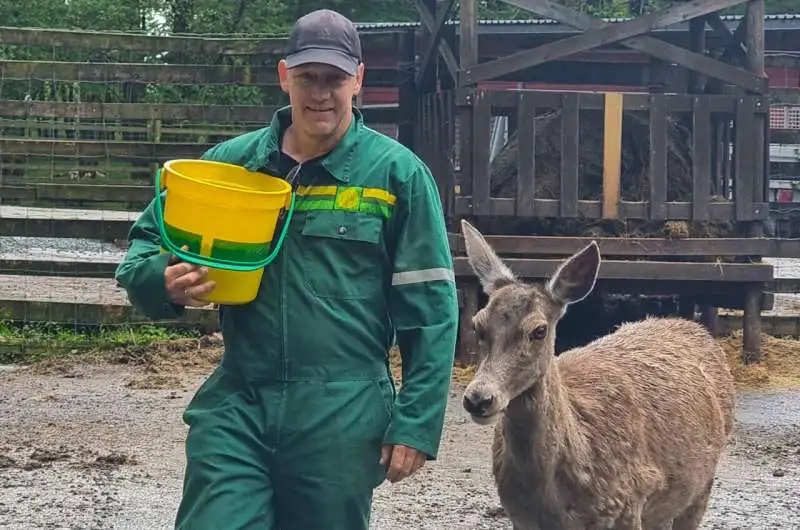
During field trials in Norway, Bischof demonstrated working prototypes for two groups of wildlife: red deer (Cervus elaphus) and red foxes (Vulpes vulpes).
The deer experiments took place at the Norwegian Deer Centre, a national institution specializing in deer and other wild ungulates.
Animal welfare was an important consideration in the system’s design. The collars automatically adjust to the animal’s neck size and are intended to detach after several weeks or a couple of months.
They also contain specially designed weak points that allow them to separate if an animal becomes uncomfortable or gets entangled.
These safeguards are intended to reduce the risks associated with wearing tracking equipment without requiring researchers to handle the animals directly.
An idea inspired by decades of overlooked research
Although Capture-Free Telemetry may sound like a completely new concept, its origins go back much further than the current study.
Before joining NMBU, Bischof worked as a wildlife biologist for the Nebraska Game and Parks Commission in the United States. During that time, he worked alongside professional trappers and gained practical experience with trapping techniques used in wildlife research and management.
Those experiences inspired him to consider whether snare-based mechanisms could be adapted to mark animals without requiring people to physically handle them.
His interest eventually led him to older scientific publications from the 1950s, 1960s and 1970s. These largely forgotten studies had already explored different approaches to automatic animal marking, providing an early foundation for the modern system.
Snare-based equipment, however, has a complicated history. Although such devices have been used in wildlife research for generations, they can also cause serious harm when poorly designed or improperly deployed. They are particularly controversial because of their association with indiscriminate trapping and illegal poaching.
Bischof sees an interesting contradiction in adapting this technology for conservation research.
“There is an interesting paradox here. A method often viewed as controversial may ultimately help reduce the need to capture and handle animals for research,” he said.
What comes next for capture-free tracking?
The initial trials demonstrate that animals can be fitted with tracking devices through an autonomous system, but further research will be needed before the technique can be widely adopted.
Bischof and colleagues from Europe and the United States are now working to develop and test the technology further. One of their priorities is to compare the behavioral effects of capture-free tracking with those of conventional methods.
They also hope to investigate whether the approach can be adapted for additional wildlife species.
If future testing proves successful, Capture-Free Telemetry could give researchers a valuable new way to study animal movements without putting wildlife through the stress and risks of physical capture. It may also help scientists gather more representative data about populations while allowing animals to remain closer to their natural routines.