

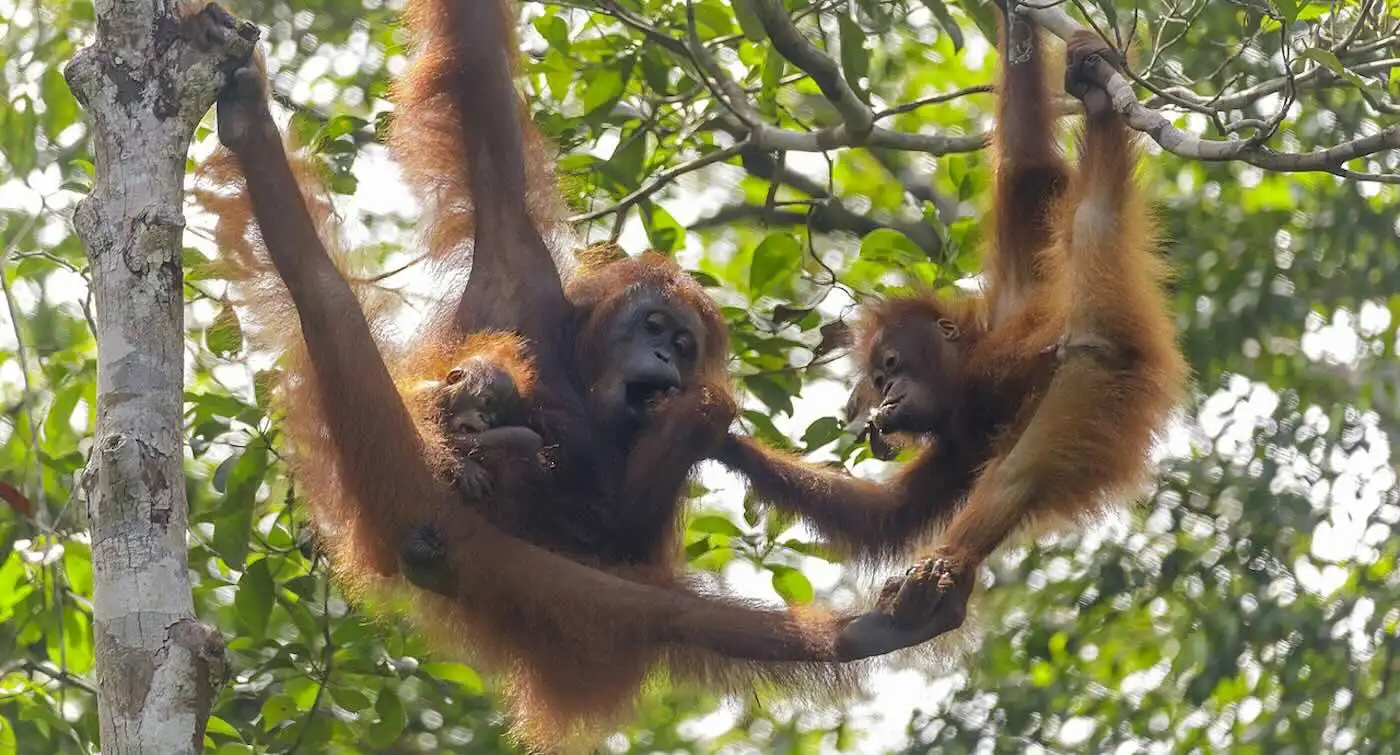
Fifteen years ago, conservationists began an ambitious effort in Sumatra: releasing rehabilitated orangutans into a protected forest where no established population of their species was living.
Many of the animals had difficult histories. Some had been orphaned and raised in human care, while others had been rescued from captivity or conflict situations and required months or even years of rehabilitation.
Today, those second chances are beginning to multiply.
The released orangutans are not only surviving in the wild — they are raising young of their own and slowly creating a new population of critically endangered Sumatran orangutans.
A Second Chance in Jantho
The effort is taking place in the Jantho Pine Forest Nature Reserve in Indonesia’s Aceh province.
The protected landscape offered conservationists something especially valuable: a large forest where rehabilitated orangutans could begin new lives away from some of the immediate dangers they faced elsewhere.
But releasing an orangutan is far more complicated than simply opening a cage and letting the animal go.
Orangutans Have to Learn How to Be Wild
Young orangutans normally spend years with their mothers.
During that time, they learn an enormous range of survival skills, including which foods are safe to eat, where to find fruit during different seasons, how to move through the forest canopy and how to construct sleeping nests high in the trees.
Orangutans that lose their mothers too early may never have had the chance to learn those lessons naturally.
That is why rehabilitation can take so long.
Only the Most Prepared Animals Are Released
Before conservationists consider an orangutan ready for the wild, the animal must show that it can live independently.
That means being able to climb confidently, locate food, build nests and navigate the forest without relying heavily on people.
Once those abilities are demonstrated, the next challenge is finding a suitable and protected place for release.
For many rescued Sumatran orangutans, Jantho became that place.
Then Something Remarkable Happened
Over time, some of the released females began giving birth.
Those newborns represented something different from the animals that had originally arrived in the reserve.
They had not been rescued from captivity or transported there by people.
They were born wild.
That distinction marks an important step in the creation of a self-sustaining population.
Mothers Are Teaching the Next Generation
The new mothers are now doing what orangutan mothers have done for generations: teaching their young how to survive.
Their babies are learning directly from them how to move through trees, find food and navigate life in the forest.
That is especially significant because Sumatran orangutans reproduce very slowly.
Females generally raise one infant for many years before having another, giving the species one of the longest intervals between births among mammals.
As a result, population growth takes time.
Every Birth Matters
At least 10 babies have now been confirmed as having been born in the reserve.
Each birth is meaningful because the Sumatran orangutan remains critically endangered and cannot quickly replace lost numbers.
A single newborn may seem like a small step, but in a species with such a slow reproductive cycle, every successful birth contributes to long-term recovery.
Nearly 200 Orangutans Have Been Brought to Jantho
Since 2011, conservationists with the Sumatran Orangutan Conservation Program have brought nearly 200 rehabilitated orangutans to Jantho.
What began as a release site for rescued individuals is gradually becoming something much larger.
Some of those animals have now established territories, formed social connections and started families of their own.
Rehabilitation Is Becoming Restoration
Wildlife rehabilitation is often judged by whether one rescued animal can return to the wild successfully.
Jantho shows what can happen when that process continues beyond the first release.
The original rescued orangutans are now creating a second generation that was born free.
In that sense, the project is no longer only about rehabilitation.
It is becoming a story of restoration — one in which individual animals given another chance are helping rebuild a population that did not exist there before.
A New Future Growing in the Forest
The work is far from finished, and Sumatran orangutans remain under serious pressure across their range.
But in Jantho, conservationists are seeing something deeply encouraging.
Animals once dependent on human care are now living independently, raising young and passing survival skills to a new generation.
Fifteen years after the first releases began, the forest is no longer simply a refuge for rescued orangutans.
It is becoming their home.