

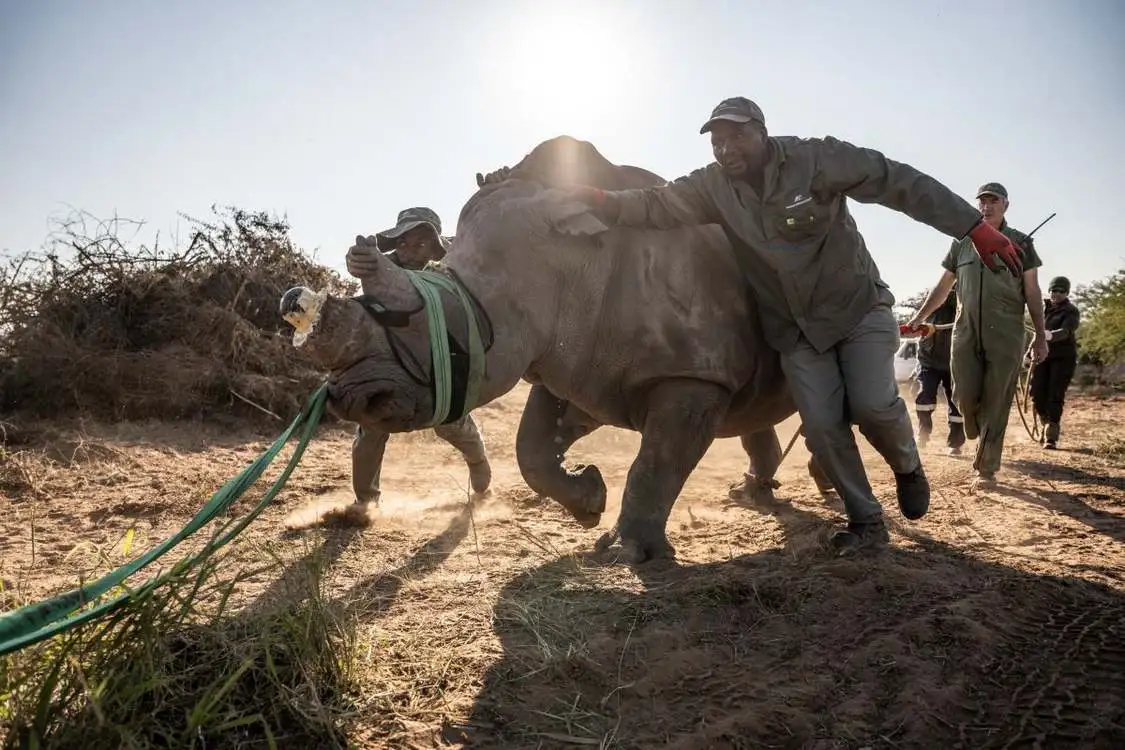
Nine female white rhinos have been released into Zinave National Park in southern Mozambique, continuing one of the country’s most ambitious wildlife restoration projects.
For many years, Mozambique’s wildlife suffered devastating losses. During the civil war that lasted from 1977 to 1992, poaching increased, protection systems collapsed in many rural areas and several large animals disappeared from places where they had once lived. Rhinos were among the species that vanished locally during that period.
Now, conservationists are working to bring them back.
Over the past decade, Zinave National Park has slowly rebuilt its rhino population through reintroductions from South Africa. The park is now home to both white and black rhinos, and the animals are already beginning to breed. One important success has been the birth of a black rhino calf, a hopeful sign for a species that remains critically endangered.
The newly arrived white rhinos will live inside a specially protected sanctuary within the park. This secure area is supported by trained rangers, monitoring technology, surveillance systems and other anti-poaching measures designed to give the animals the best possible chance of survival.
For Mozambique’s conservation officials, the rhinos’ return is a powerful symbol of progress. Their presence helps restore an important species to the landscape while also supporting the wider health of the ecosystem. Officials also hope the project will create new opportunities for wildlife tourism, strengthen local communities and show what can happen when conservation partners work together.
Zinave National Park lies along the Limpopo River, near Mozambique’s border with Zimbabwe. The park is managed with support from Peace Parks Foundation, an organization involved in conservation and sustainable development across major protected landscapes in southern Africa.
For years, Zinave was sometimes called a “silent park” because so many of its animals had been lost during wartime. But since 2016, that silence has gradually been replaced by the sounds of returning wildlife.
More than 2,500 animals from 16 different species have been moved into the park, helping rebuild its natural balance. Along with white and black rhinos, Zinave has welcomed elephants, giraffes, zebras, sable antelope, impalas, hyenas, leopards, reedbuck, waterbuck and buffalo.
The arrival of the nine female white rhinos is another major step in Zinave’s transformation.
What was once a park marked by loss is now becoming a place of recovery — a landscape where Mozambique’s missing wildlife is finally finding its way home.