

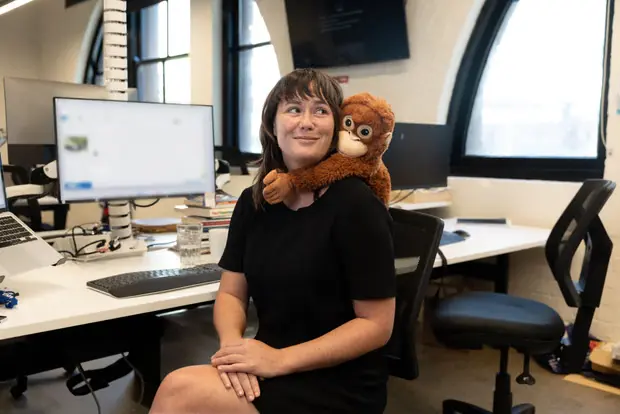
After nearly 24 hours of flight delays, all I wanted was to collapse on my living room floor. Instead, I found myself standing in line at Ikea’s click-and-collect counter, waiting for a giant plush orangutan.
Punch, a young Japanese macaque at Ichikawa City Zoo, has gone viral after videos showed him clinging tightly to the stuffed orangutan inside his enclosure. Reportedly abandoned by his mother and struggling to integrate with older macaques, Punch appears to grip the toy for comfort.
The internet responded immediately — with sympathy, sadness and shopping carts.
According to eBay Australia, listings for Djungelskog jumped by 650% in just one month. Ikea Australia reported sales rising more than 200% in a week, with nearly 1,000 sold nationwide. The toy even began appearing online for wildly inflated resale prices.
When I arrived to collect mine, it was sold out.
Securing My Own Djungelskog
The next morning, I returned early. An Ikea employee walked one out to my car, smiling.
“Everyone has bought one,” she said. “We had to call other stores. Then I saw the videos and thought — I need one.”
I buckled the plush orangutan into the passenger seat. I felt ridiculous — and strangely soothed.
The toy is oversized, impossibly soft, with wide, vacant eyes. Carrying it into work felt like escorting a celebrity. Colleagues gathered. What would I name it? It sat beside my computer all morning, silently staring ahead.
It was charming. Comforting, even.
But watching footage of Punch with his own Djungelskog stirred something heavier.
The Sadness Behind the Cuteness
There’s something about a baby animal clutching a toy that pulls at human instincts. It’s impossible not to see ourselves in it — vulnerability, loneliness, childhood comfort.
Yet that instinct can blur reality.
Punch is a wild animal. His toy is not a companion; it’s a substitute.
The viral story reminded me of Keiko, the orca who starred in Free Willy. After years in captivity, a global campaign worked to release him back into the wild. But having grown up around humans, he struggled to integrate with wild pods. He died at 27, still dependent on human contact.
In Punch’s case, the details are less clear. I don’t know why he was rejected by his mother, or what his long-term future holds. But the intensity of social media’s reaction carries a familiar tone: we project human narratives onto animals because it makes their stories easier to understand.
A monkey hugging a plush toy looks heartbreakingly human. It invites rescue fantasies and emotional investment.
But it is not the same as human loneliness.
What We’re Really Responding To
When I returned home that evening, my dog greeted me with unfiltered excitement. Tail wagging. Real warmth. Real connection.
Djungelskog, for all its softness, offers a different kind of comfort — quiet, symbolic, transactional. It can’t meet my eyes or respond.
The internet’s embrace of Punch — and the rush to buy his toy — says something about us. We crave stories of comfort in a chaotic world. We latch onto symbols that make pain feel manageable. We anthropomorphize because it bridges emotional gaps.
But beneath the viral wave lies a more complicated truth: Punch is not a child who needs a teddy bear. He is a wild animal navigating captivity.
And while a plush orangutan might soothe us for a moment, it cannot resolve the deeper discomfort that made us reach for it in the first place.