

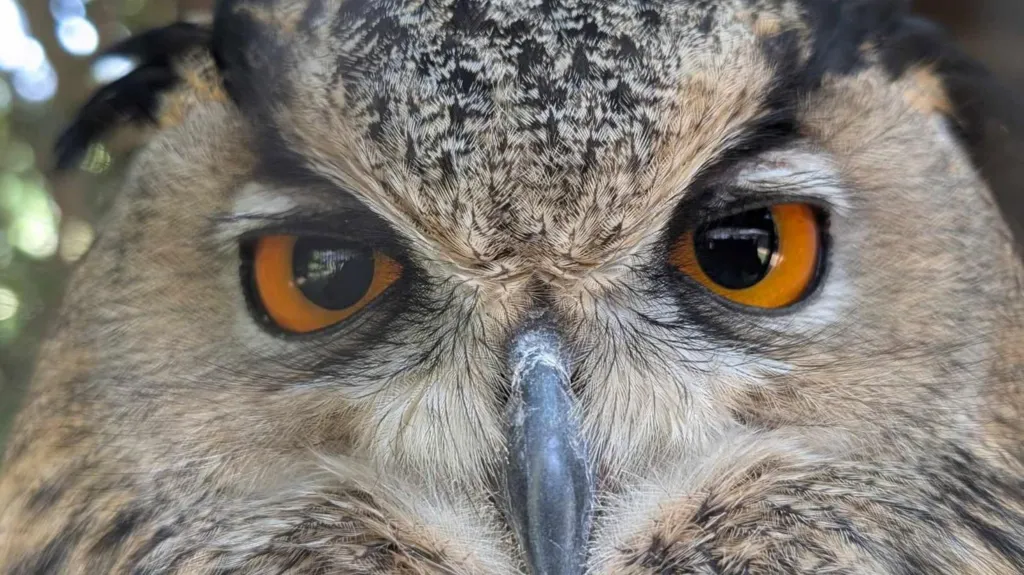
Residents across West Sussex are being urged to keep a sharp lookout for an unusually large feathered escapee — a 2-foot-tall (60 cm) eagle owl who slipped out of his enclosure earlier this week.
The owl, named Buddy, vanished on Monday morning from West Sussex Falconry in Compton. With an impressive 5-foot (1.5 m) wingspan and striking orange eyes, Buddy is hard to miss — and his disappearance has prompted a widespread search effort.
Sally Buckland, who owns and operates the bird of prey centre, said her heart “dropped into a blind panic” when she discovered the door to Buddy’s aviary wide open, its latch broken. She suspects Buddy may have forced the door open himself during one of his enthusiastic attempts to pounce at pigeons that frequently taunt him from outside the enclosure.
Although an eagle owl on the loose may sound alarming, Ms Buckland reassured locals that Buddy is unlikely to pose a threat to their pets. “No one needs to bolt their doors or hide their rabbits,” she said with a nervous laugh. Still, she admitted that Buddy is naturally an “opportunistic” species. “Any bird of prey has the capability to take something small, but his instincts lean more toward mice or rats.”
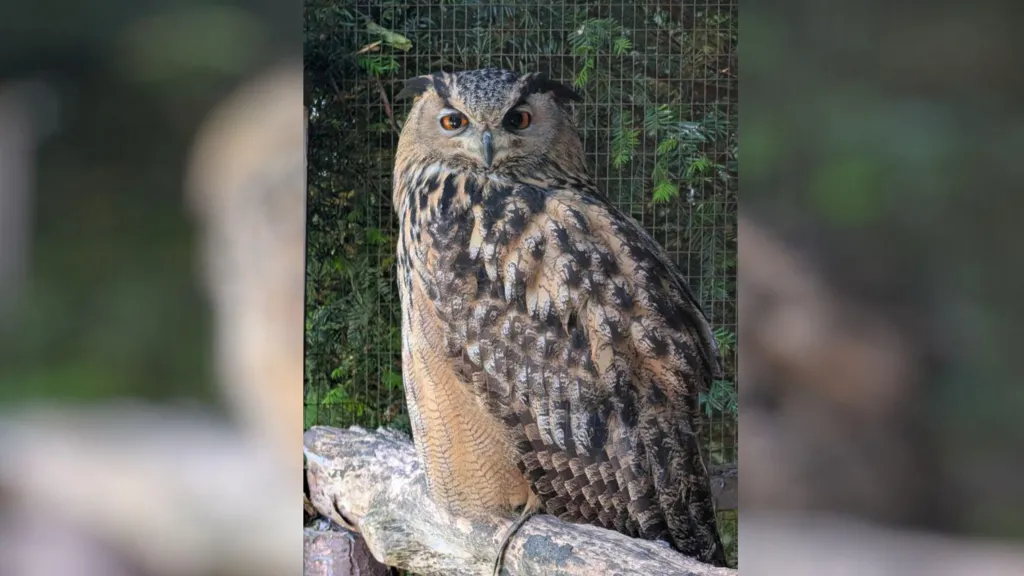
‘Like trying to find a needle in a haystack’
Buddy has been with Ms Buckland for six years, and she said trying to guess his whereabouts is nearly impossible. “It’s anybody’s guess where he’s gone. It really is a needle-in-a-haystack job,” she told the BBC. The one advantage she has, she added, is Buddy’s size — he’s far too large to be mistaken for a common tawny owl.
“People who spot him are going to look twice. He’s not subtle,” she said.
But the biggest uncertainty — what she calls the “million-dollar question” — is whether Buddy knows how to fend for himself. Because he was born and raised in captivity, his hunting skills are untested. If he does manage to learn to feed himself, Ms Buckland fears she may never get him back. “If he becomes self-sufficient, he won’t feel the need to return,” she said.
What Buddy looks like
Buddy is easy to identify:
- bright, vivid orange eyes
- tufted “ear” feathers that stick out from his head
- a mottled pattern of browns, blacks, greens, and ochre
- and a red ID ring on one leg — though it may be partly hidden by his thick feathering
Public asked not to approach
Ms Buckland stressed that anyone who spots him should avoid approaching. Eagle owls, she noted, can spook easily, and attempting to get close could scare him deeper into the countryside.
Instead, she is asking the public to contact her immediately with any sightings so she can attempt a safe recovery.
“You could be the one person who helps bring him home,” she said.