

“Not garbage. Not harmless.”
A walk along a Florida beach nearly turned into a painful lesson for Elise Grandizio after she mistook a dangerous sea creature for a piece of trash.
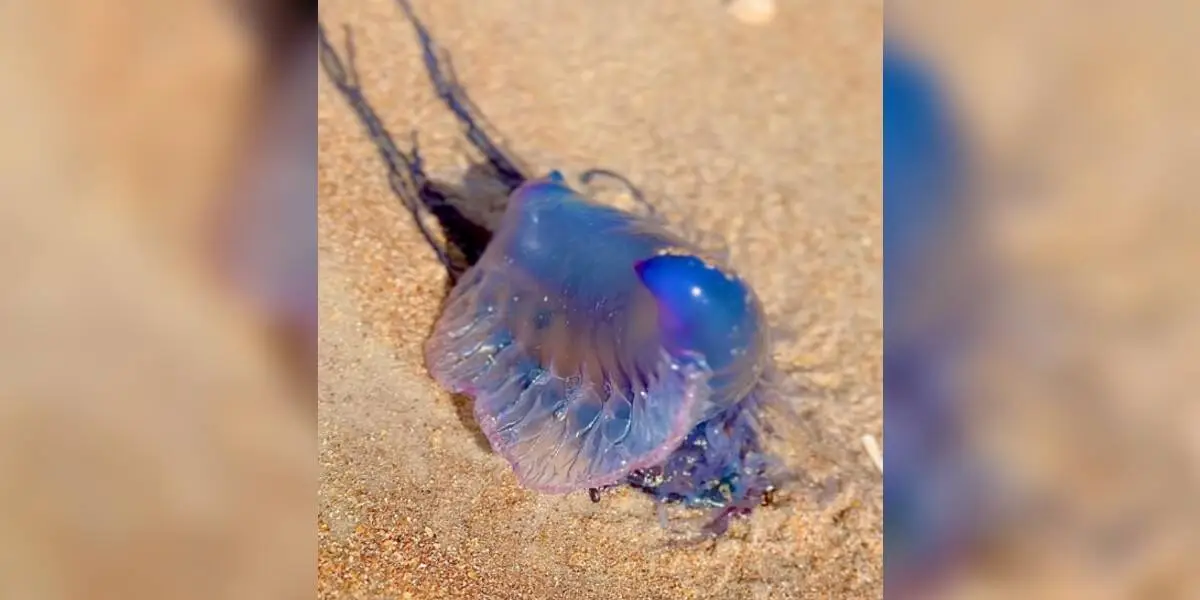
Earlier this spring, Grandizio was exploring the shoreline in Key West when she noticed a bright blue object resting in the shallow surf. From a distance, it resembled a deflated balloon with strands hanging underneath it, so she assumed someone had left garbage behind.
Planning to clean up the beach, she moved closer and prepared to pick it up.
Then the object suddenly moved.
That small motion made Grandizio stop and take a closer look. What she had thought was plastic was actually a living creature with a transparent blue body and soft purple coloring that reflected the sunlight.
After researching what she had found, Grandizio realized she had encountered a Portuguese man o’ war.
Despite its jellyfish-like appearance, the Portuguese man o’ war is a different type of marine animal. It is commonly found in warm tropical and subtropical waters, where it feeds on small fish, crustaceans and other marine organisms.
One of its most recognizable features is the gas-filled float that rests above the surface of the ocean. Instead of swimming under its own power, the animal relies on wind and ocean currents to carry it across the water.
That sail-like structure also inspired its unusual name, since its appearance resembles historic sailing warships that depended heavily on the wind.
The beautiful blue float, however, hides a much more dangerous feature below the surface.
Portuguese men o’ war possess long tentacles filled with microscopic stinging cells. These tentacles can stretch extraordinary distances through the water and are difficult to see, allowing the animal to capture prey that passes nearby.
When the stinging cells make contact, they release venom capable of immobilizing small marine animals. Humans can also be stung, often resulting in intense pain and raised marks across the skin. In rare situations, especially when a serious allergic reaction occurs, the encounter can become medically dangerous.
Fortunately, Grandizio recognized the creature before touching it.
Instead of attempting to remove it from the beach, she kept her distance and admired its unusual appearance safely. What had initially looked like abandoned litter became one of the most memorable wildlife encounters of her trip.
The experience also served as an important reminder that unfamiliar objects found along the shoreline should be approached carefully. In nature, something delicate and beautiful can sometimes carry risks that are not immediately obvious.