

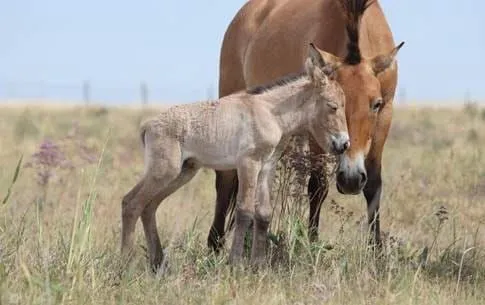
A newborn Przewalski’s horse has marked an important step in efforts to restore one of the world’s rarest wild horses to the open steppes of Kazakhstan.
The foal was born as part of a long-term reintroduction programme designed to rebuild a healthy wild population.
Within minutes of birth, he was already standing, following his mother and beginning to nurse.
A Special First for His Mother
The foal’s mother, Tessa, is seven years old.
She arrived in Kazakhstan in 2024 as part of the first group of Przewalski’s horses brought into the programme.
This is her first foal.
Before entering the wider reintroduction effort, the horses spent around a year adapting to their new surroundings.
A Species Once Lost From the Wild
Przewalski’s horses disappeared from the wild during the 20th century.
For years, the species survived only because of carefully managed breeding programmes and zoo populations.
Those efforts eventually made it possible to begin returning the horses to parts of their historic range.
Returning Horses to the Steppe
Kazakhstan’s vast grasslands once formed part of the natural home of these wild horses.
Conservation teams are now working to help the species establish itself there once again.
The birth of a healthy foal is an encouraging sign that the animals are adjusting well to the environment.
A New Generation Begins
Every successful birth is important for the future of the population.
More foals could help increase the size and genetic strength of the herd over time.
The ultimate goal is for the horses to live and reproduce in the wild without needing constant human support.
The Herd Will Be Closely Monitored
Conservation teams will continue watching the foal and the rest of the herd.
They will monitor their health, behaviour and ability to adapt to life on the open steppe.
This information will help guide future releases and conservation work.
A Hopeful Moment for Wildlife Recovery
The birth shows what long-term conservation efforts can achieve.
A species that once disappeared completely from the wild is now producing a new generation in its former habitat.
For the young foal, it is simply the beginning of life on the steppe.
For conservationists, it represents another promising step toward restoring Przewalski’s horses to the wild.