

Many animals have a sense of quantity, but they don’t count or do math the way humans do.
🧠 Numerosity: The Animal Sense of Quantity
Across the animal kingdom, many species — from bees and frogs to lions and birds — can distinguish between quantities. This isn’t “counting” in the human sense, but it’s an ability known as approximate number sense (ANS).
- Honeybees count landmarks to navigate to flowers.
- Spiders monitor how many insects are in their webs.
- Frogs engage in “chuck” contests — adding calls to outdo rivals.
- Lionesses gauge rival group size by counting roars.
- Carrion crows can vocalize specific numbers of caws in response to cues (up to four).
This intuitive ability helps animals survive: more food, more allies, fewer enemies.
🔢 How Animal Number Sense Works
The ANS isn’t about specific numbers like “3” or “7.” Instead, it’s about estimating and comparing.
- Distance effect: It’s easier to tell apart 4 vs. 8 than 6 vs. 8.
- Size effect: It’s easier to tell 2 vs. 4 than 12 vs. 14 — even though both pairs differ by two.
- These patterns follow Weber’s law: quantity differences are perceived by ratios, not exact amounts.
Even newly hatched chicks show these number instincts, suggesting ANS is innate, not learned.
👩🏫 True Counting: A Human (and Rare Animal) Skill
Only a few exceptional animals have come close to actual counting:
- Alex the African grey parrot: Identified numerals (1–8), added small quantities.
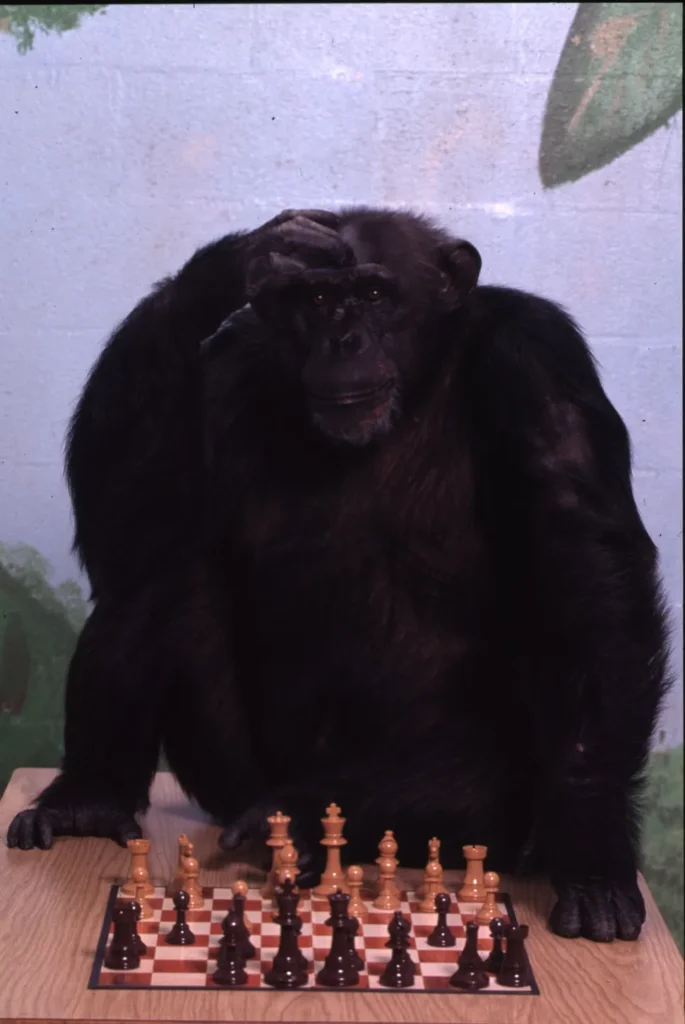
- Chimps Sheba and Ai: Recognized symbols for numbers, placed them in order.
True counting requires:
- Recognizing numerals as symbols.
- Understanding their exact value.
- Knowing their order and applying them across contexts.
This kind of symbolic reasoning takes humans years to develop — and is rare even among intelligent nonhumans.
➕ Can Animals Do Math?
A handful of species can perform basic arithmetic under controlled experiments.
- Parrots, pigeons, chimps, stingrays, honeybees, and cichlid fish have shown the ability to:
- Add or subtract one or two
- Use color-coded or symbol-based cues to solve simple problems (e.g., “blue = add 1”)
But:
- These skills apply only to small numbers
- Complex operations (like long division or algebra)? No evidence yet.
🧮 So, Can Animals Do Math?
✅ Estimate quantities
✅ Use number sense
✅ Add/subtract small numbers (some)
❌ Count like humans
❌ Do complex math
As psychologist Michael Beran puts it: animals don’t “count” in the way we think — but they understand “more” vs. “less”, and some can even perform simple math-like tasks with the right training.
🌍 Why It Matters
Understanding animal math helps us:
- Learn about evolution of cognition
- Improve animal training and welfare
- Rethink how we define intelligence
And maybe, just maybe, respect our fellow creatures a little more.