

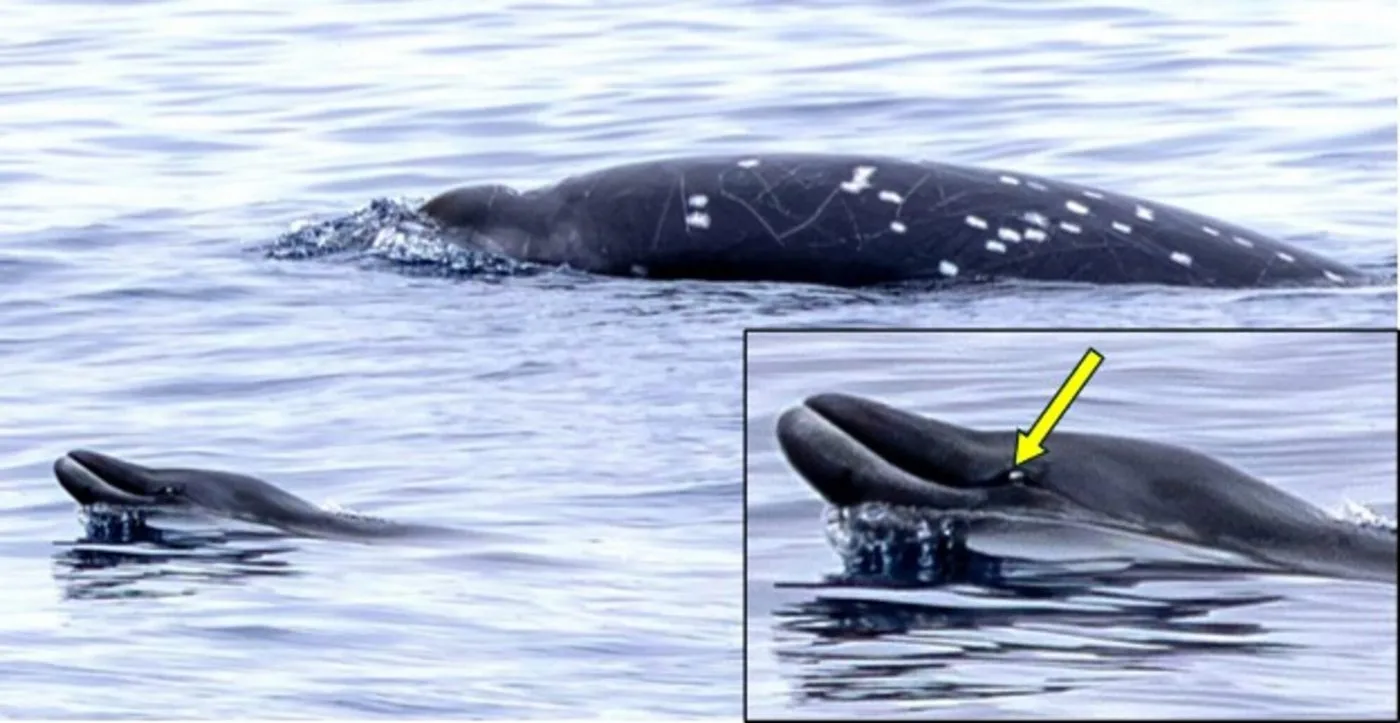
A whale researcher with decades of experience recently saw something he had never witnessed before—a living pair of gingko-toothed beaked whales in their natural environment.
The encounter marks a major step forward in beaked whale science. Not only did it allow scientists to confirm the species’ full genome, but it also connected the whales to a distinctive acoustic signal long known as BW43. With this link, researchers can now use the call to map where these rare whales live and help protect them from threats such as naval sonar.
In 2024, a team set out along the coast of northwestern Baja California, Mexico, hoping to identify the species behind the mysterious BW43 echolocation pulse, which had been recorded in that region and other parts of the North Pacific. Oregon State University researcher Robert Pitman led the mission, initially assuming the sound came from Perrin’s beaked whale.
For hours, the OSU research vessel drifted, scanning the water. Then, through high-powered binoculars, several whales surfaced off the starboard side. The animals appeared to be young and dove quickly, making visual identification difficult. To confirm the species, Pitman used a specialized crossbow to collect a tiny sample of skin and blubber—about the size of a pencil eraser—attached to a corded bolt.
As the sample was reeled in, the team held their breath, worried seabirds might snatch it away. But once secured, excitement erupted on deck. They had successfully collected DNA from the whales producing the BW43 call.
The results were a surprise. The whales weren’t Perrin’s beaked whales—they were gingko-toothed beaked whales, a species that, like Perrin’s, had never been observed alive in the wild.
Elizabeth Henderson, a researcher at the U.S. Navy’s Naval Information Warfare Center and lead author of the Marine Mammal Science paper on the discovery, recalled the moment:
“I can’t even describe the feeling… Everyone on the boat was cheering because we’d finally done it.”
Beaked whales remain among the least-understood mammals on Earth. There are 24 known species, yet most are identified only from brief sightings or from bodies that wash ashore. Scientists know they dive deeper than any other marine mammal, fight with tusks that grow like small antlers, and hunt squid. They are highly sensitive to disturbances, rarely approach coastlines, and avoid boats.
Henderson had been trying to track down the origin of BW43 since 2020. The team had visited the same site three times before—using rented fishing boats—but only in 2024, when Henderson partnered with OSU and Pitman, did they make the breakthrough. The discovery also added to Pitman’s extraordinary record: he has now sighted 90 of the planet’s 94 known whale species.
Curiously, almost all known gingko-toothed whales have stranded on the opposite side of the Pacific, in places like Japan and Australia. Only two strandings have ever been recorded along North America’s west coast.
“Those earlier cases were thought to be oddities—maybe sick or drifting animals,” Henderson told The Guardian. “Now we know they weren’t anomalies. These whales actually live in these waters year-round.”