

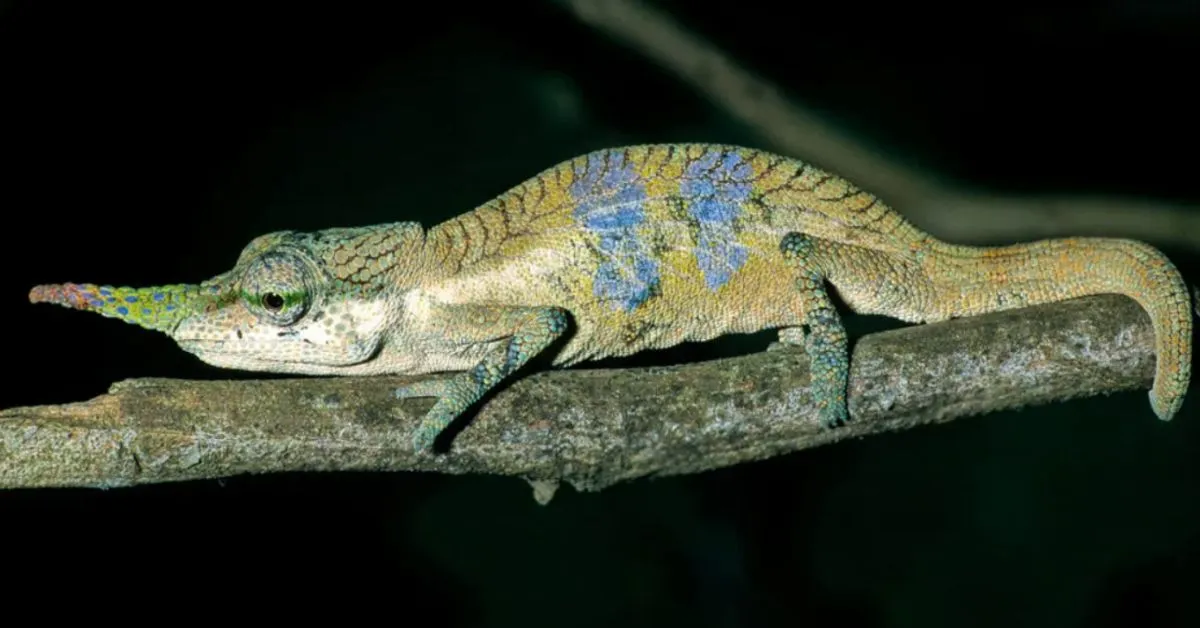
Calumma gallus, a tiny chameleon native to eastern Madagascar, has long been a puzzle for scientists. Though the species has been known for years, researchers have struggled to clearly understand its diversity — until now.
A new study, led by German herpetologist Frank Glaw and published on October 30 in Salamandra: The German Journal of Herpetology, has brought fresh clarity to the mysterious reptiles. Glaw’s team discovered that two chameleons previously grouped within the Calumma gallus species complex had been misidentified for decades.
To uncover the truth, the researchers turned to the past. By analyzing DNA from historic museum specimens, they were surprised to learn that C. nasutum — a chameleon lacking the group’s signature long, nose-like projection — actually belongs within the C. gallus lineage. Meanwhile, the animals that had long been called C. nasutum were found to represent a completely distinct species. These lizards now have an official name: Calumma hofreiteri, or Hofreiter’s chameleon.
The study also identified another new species from northern Madagascar: Calumma pinocchio, which differs genetically from its relatives and sports a long, smooth nasal appendage.
This dramatic nose extension is what earned the new species its nickname. Pinocchio chameleons display a thin, elongated nasal structure that immediately calls to mind the fictionally growing nose of Carlo Collodi’s famous wooden puppet. Glaw and his team noted humorously that, unlike Pinocchio’s, this chameleon’s impressive nose may serve as an honest signal used by males in communication or courtship.
Distinguishing the three species is largely a matter of examining these unusual facial features:
- Calumma gallus has a serrated, thorn-like appendage with small projections.
- Calumma pinocchio features a long, smooth nose extension.
- Calumma hofreiteri sports a more rounded and blunt nasal structure.
According to Glaw, the genetic results make it clear that these chameleons have “tricked” researchers for many years, hiding their true identities in plain sight. The study also found that the shape, size, and coloration of the nasal appendages evolve rapidly, likely driven by female mate preferences.
When it comes to conservation, however, the research team warned that much remains unknown. They stated that assigning official IUCN Red List statuses is difficult because the species’ full ranges and population numbers are still unclear.
Based on current knowledge, Hofreiter’s chameleon may inhabit a relatively broad area — but most of its known sites are small, isolated forests under threat from logging and land clearing. Because of this, it may eventually qualify as Vulnerable.
Pinocchio chameleons, meanwhile, seem to prefer forest edges but still rely on intact forest to survive. In northern central eastern Madagascar, low-elevation rainforest is heavily fragmented and shrinking due to slash-and-burn agriculture. For that reason, C. pinocchio may require Endangered status.
The researchers emphasized that Madagascar’s nose-chameleon species are evolving quickly and may represent only part of a larger, still unknown diversity. Additional fieldwork will be required to determine how many distinct species truly exist and how they relate to one another.
Remarkably, one of the key clues in unlocking the mystery came from a chameleon collected nearly two centuries ago, in 1836. Study co-author Miguel Vences highlighted how modern genetic tools allow scientists to uncover the identity of long-collected specimens, especially in complicated species groups.
Thanks to this blend of historical samples and modern science, the secret lives of Madagascar’s nose-chameleons are becoming clearer — and conservationists now have a better foundation for protecting them in the future.