

Deep within the forests of Lomami National Park in the Democratic Republic of the Congo, scientists have officially identified a previously unknown monkey species that had managed to remain hidden despite decades of research.
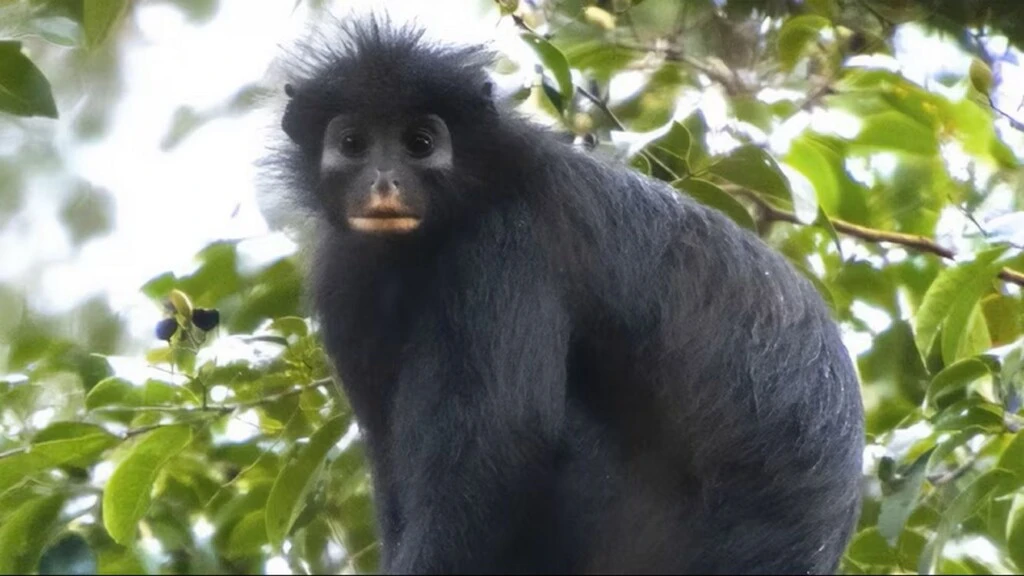
The newly described primate, Colobus congoensis, is known locally as “Likweli.” With its jet-black fur, striking orange lips, and gentle expression, the monkey is unlike any other known colobus species.
Its discovery highlights just how many secrets the Congo Basin still holds.
A Mystery That Began With a Single Photograph
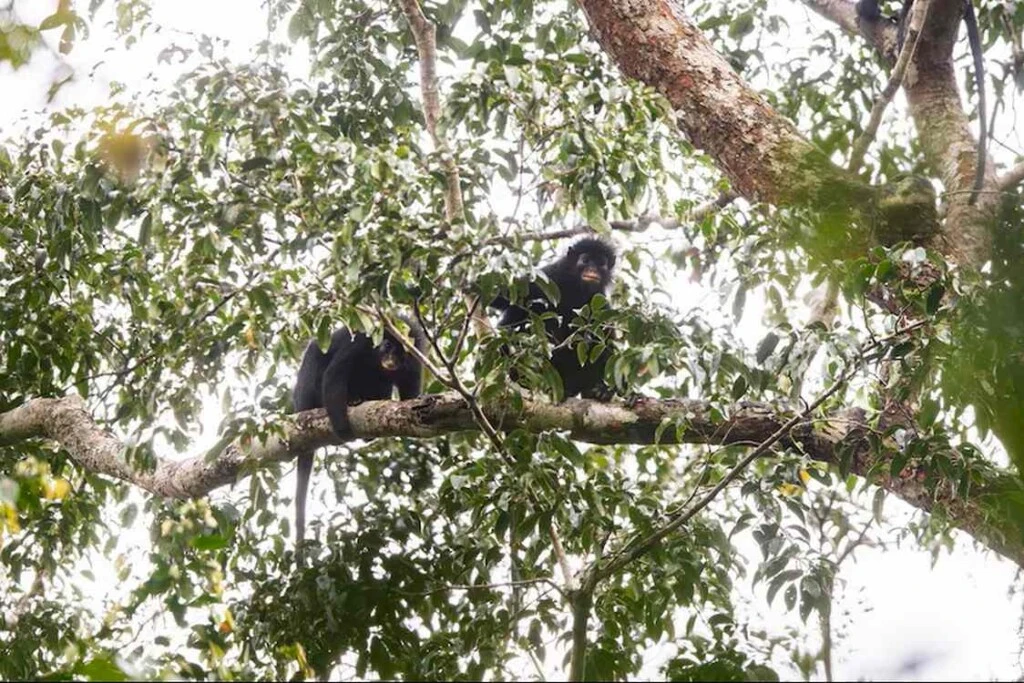
The journey to identifying the new species began in 2008, when researchers captured a partially obscured photograph of an unfamiliar monkey during fieldwork.
The image hinted that they had encountered something unusual, but there wasn’t enough evidence to draw any conclusions.
Nearly ten years later, scientists spotted the mysterious primate again and finally obtained clear photographs, prompting a full scientific investigation.
Confirming a New Species
Researchers carried out detailed genetic, anatomical, and acoustic analyses to determine whether the monkey was truly unique.
The results confirmed that Colobus congoensis represents a completely distinct evolutionary lineage.
Scientists estimate that it split from its closest known relative—the black colobus monkey—between 4 and 5 million years ago, evolving independently ever since.
“This discovery is both exciting and deeply personal, highlighting the extraordinary biodiversity of my homeland and how much remains undocumented,” said Congolese scientist Junior Amboko, a co-author of the study.
Small Monkey With Distinctive Features
The newly identified monkey is smaller than most related colobus species, weighing around 15 pounds (7 kilograms).
It stands out thanks to several unique physical characteristics, including:
- Glossy black fur that reflects light.
- Bright orange lips.
- Long black facial hair.
- Large folded ears.
- Distinctive white markings beneath the tail.
These traits make it easy to distinguish from other members of the colobus monkey family.
Living in a Very Small Area
Unlike many other colobus monkeys, Colobus congoensis appears to occupy an extremely limited range.
Between 2018 and 2022, researchers documented 114 sightings within an area of approximately 900 square miles.
To better understand where the monkeys live, scientists also interviewed residents in 52 nearby villages.
Only people from eight villages reported ever seeing the species, suggesting its distribution is much smaller than initially expected.
Already Facing Serious Threats
Because of its restricted habitat and low numbers, researchers believe the newly discovered monkey may already be endangered.
The scientific team has officially recommended that the species be classified as Endangered.
Local communities also told researchers that the monkeys are hunted by some Indigenous hunters, adding further pressure to an already vulnerable population.
Combined with habitat loss and other environmental threats, conservationists fear the species could face significant challenges unless protective measures are introduced.
A Reminder of Nature’s Hidden Wonders
The discovery of Colobus congoensis demonstrates that even today, entirely new mammal species can still be found in some of the world’s most remote forests.
For scientists, it is an exciting breakthrough.
For conservationists, it is also a race against time to ensure this newly recognized monkey survives for generations to come.
Its discovery serves as a powerful reminder that Earth’s greatest biodiversity hotspots continue to hold remarkable secrets—and that protecting these habitats is more important than ever.