

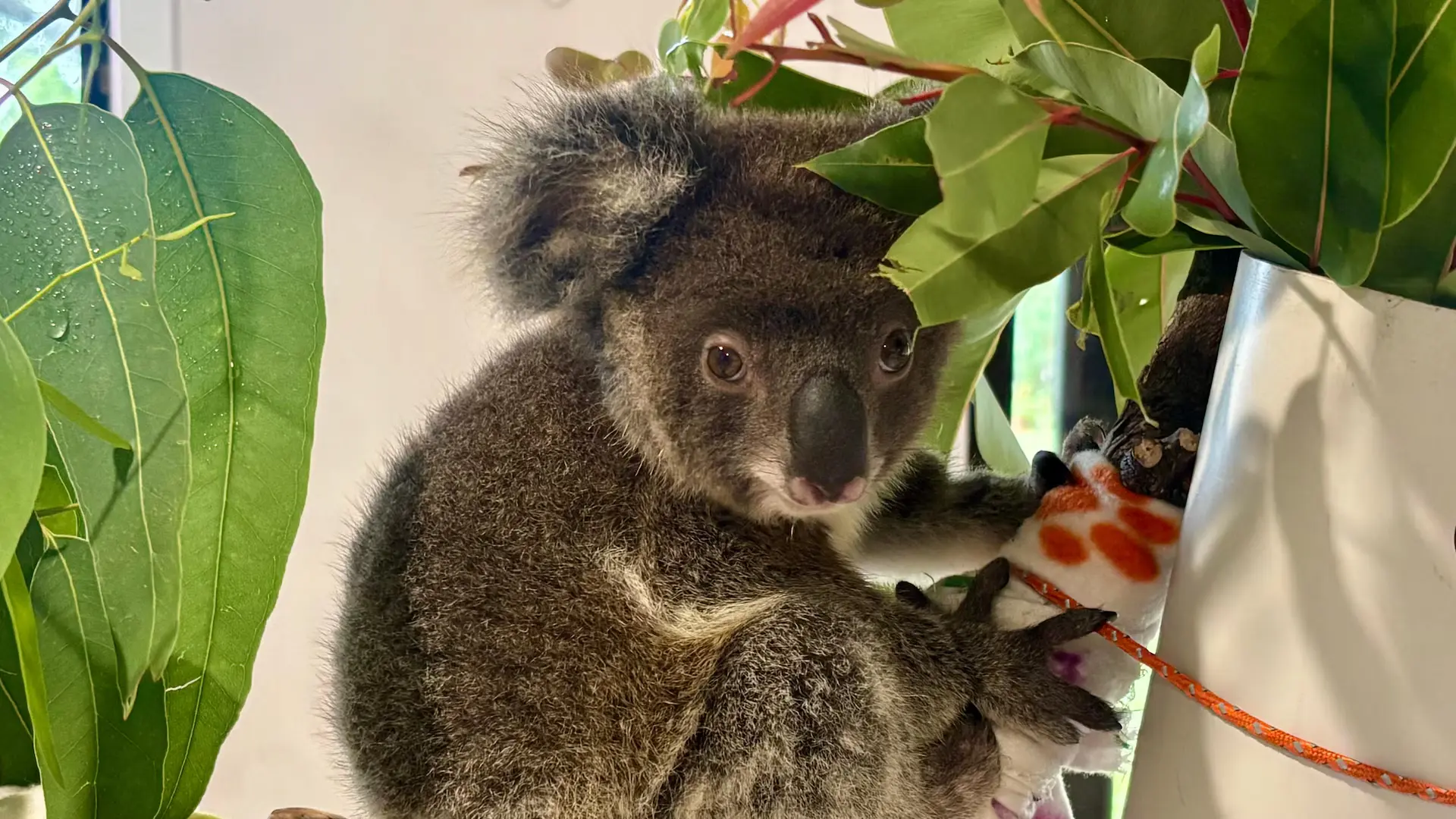
A tiny koala separated from her mother in the Australian wilderness has been given a remarkable second chance thanks to a dedicated team of wildlife rescuers. Once exhausted, vulnerable, and struggling to survive alone, the young marsupial now spends her days resting among eucalyptus branches and receiving specialized care in a safe environment.
Her recovery is heartwarming on its own, but it also represents something much bigger: a new approach to wildlife rehabilitation that could help protect koalas on North Stradbroke Island for generations to come.
A Baby Koala’s Life Takes a Frightening Turn
On North Stradbroke Island, also known as Minjerribah, off the coast of Brisbane, a young female koala found herself in a dangerous situation after being separated from her mother.
The separation occurred during an encounter involving two aggressive male koalas competing for a mate.
For a dependent joey, losing contact with her mother can be life-threatening.
Young koalas rely heavily on maternal care for protection, nourishment, and guidance as they develop the skills needed to survive independently.
Without her mother nearby, the frightened little animal faced an uncertain future.
Fortunately, wildlife rescue volunteers discovered her before it was too late.
Recognizing that she needed immediate attention, the rescuers transported the joey to the island’s only veterinary clinic, where experienced professionals could assess her condition.
It was there that she met veterinarian Dr. Thalita Calvi, who would become responsible for helping her regain her strength.
An Exhausted Joey Finally Finds Somewhere Safe to Rest
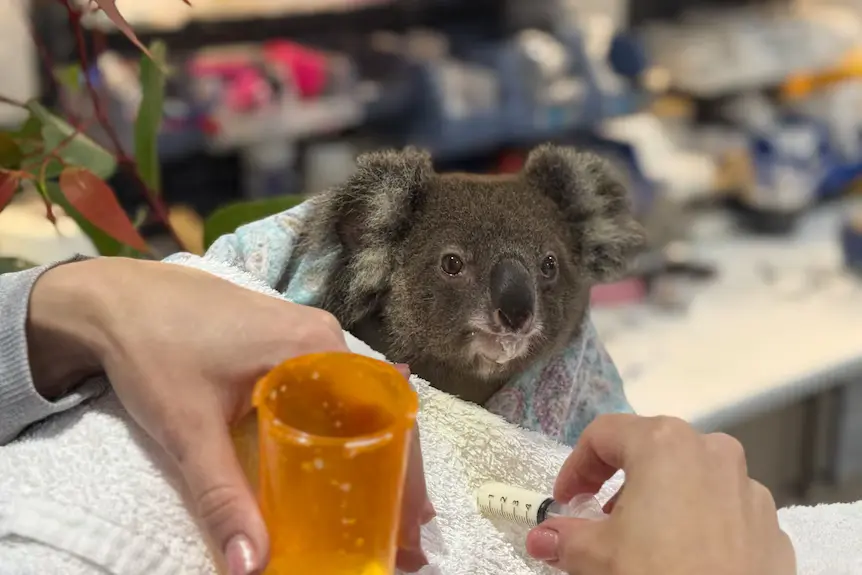
When the baby koala arrived at the veterinary clinic, she was completely exhausted.
The stressful experience of becoming separated from her mother had left her needing food, fluids, warmth, and rest.
Dr. Calvi quickly began providing the support necessary to stabilize her condition.
One particularly touching moment occurred when the veterinarian introduced the little joey to a soft teddy bear.
Almost immediately, the exhausted koala settled onto the comforting toy and fell asleep.
After receiving nourishment and fluids, she appeared ready to do little more than rest.
For such a young animal, that peaceful moment was an important beginning.
She no longer had to navigate the unfamiliar wilderness alone. Instead, she was surrounded by people who understood her needs and were determined to give her the best possible chance of survival.
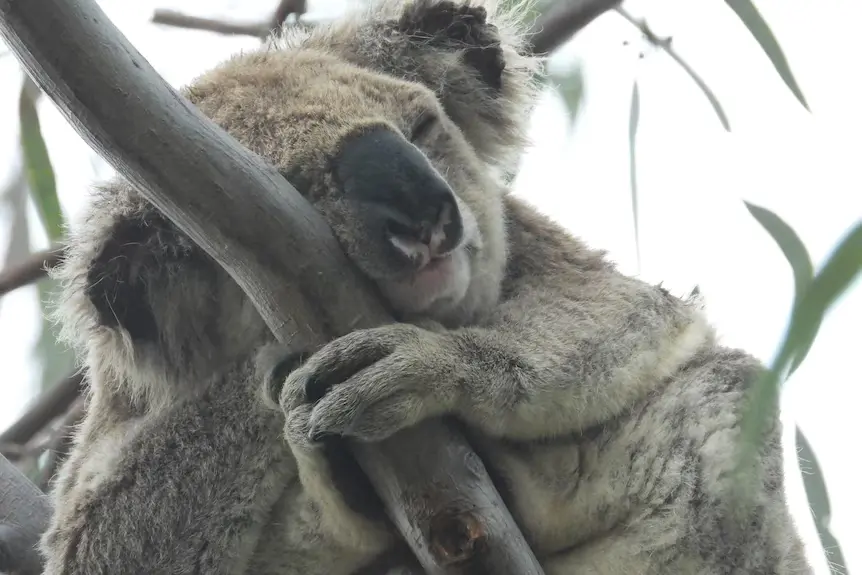
Her caregivers continued monitoring her condition while helping her regain the energy she had lost.
And before long, the little koala began showing encouraging signs of improvement.
A Makeshift Eucalyptus Forest Becomes Her Recovery Home
Rather than being sent away from the island for treatment, the joey was placed in a specialized rehabilitation environment close to where she had been rescued.
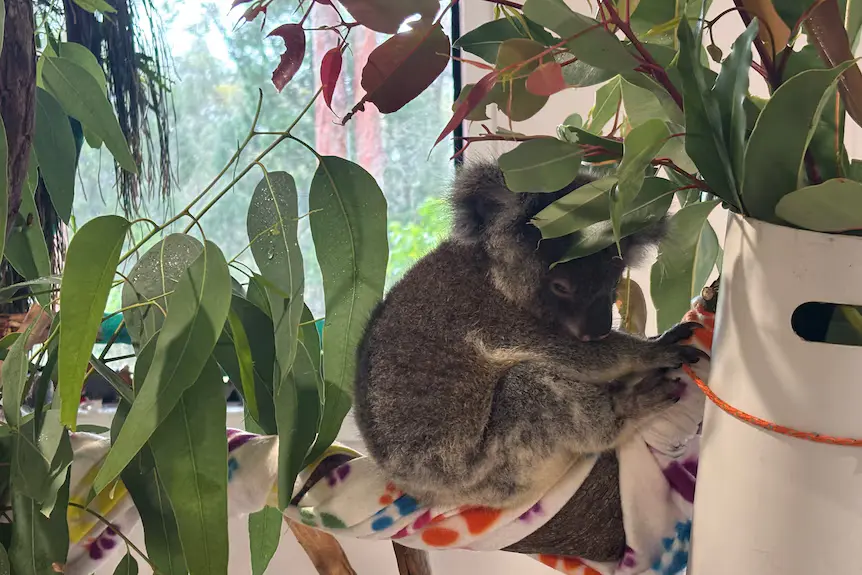
Inside a room adapted for her recovery, caregivers created a makeshift eucalyptus forest, complete with branches where she could climb, rest, and practice natural behaviors.
Fresh gum leaves were delivered every morning to provide the food she needed.
The environment allowed the joey to experience some of the familiar features of her natural habitat while remaining under veterinary supervision.
For a recovering koala, this combination of safety and appropriate environmental enrichment is particularly valuable.
Koalas spend much of their lives in trees, feeding on eucalyptus leaves and resting among branches.
By encouraging the joey to climb and move naturally, her caregivers could help prepare her for life outside the rehabilitation facility.
And the results were encouraging.
Approximately two weeks after arriving in care, the little koala was gradually gaining weight and rebuilding her strength.
Her determined personality was also becoming increasingly apparent.
Although she still needed time to recover, her progress gave Dr. Calvi hope that she would eventually be healthy enough to return to the wild.
A New Wildlife Rescue Center Changes Everything
The joey’s recovery is especially significant because, until recently, injured and orphaned koalas on North Stradbroke Island faced a difficult situation.
Animals requiring specialized treatment were often transported to veterinary facilities on mainland Australia.
While those facilities could provide essential medical care, there was a serious complication.
Because of biosecurity restrictions designed to protect the island’s relatively low-disease koala population, animals transferred to the mainland could not simply be returned to their original habitat.
Instead, rehabilitated koalas could face release outside their familiar home ranges.
This was particularly concerning because koalas may struggle to adapt when relocated to unfamiliar environments.
Differences in eucalyptus species, feeding habits, territory, and other environmental factors can influence their ability to survive.
The establishment of the Minjerribah Wildlife Veterinary and Conservation Foundation has created a new opportunity.
Founded by veterinarian Dr. Jade Patterson, who also owns the Straddie Vet clinic, the nonprofit organization supports wildlife treatment, rehabilitation, and conservation directly on the island.
Its work means that animals who can safely receive appropriate local care no longer need to be transported away simply to access rehabilitation.
For vulnerable koalas, remaining close to their natural home can make an important difference.
Why Returning Koalas to Their Home Territory Matters
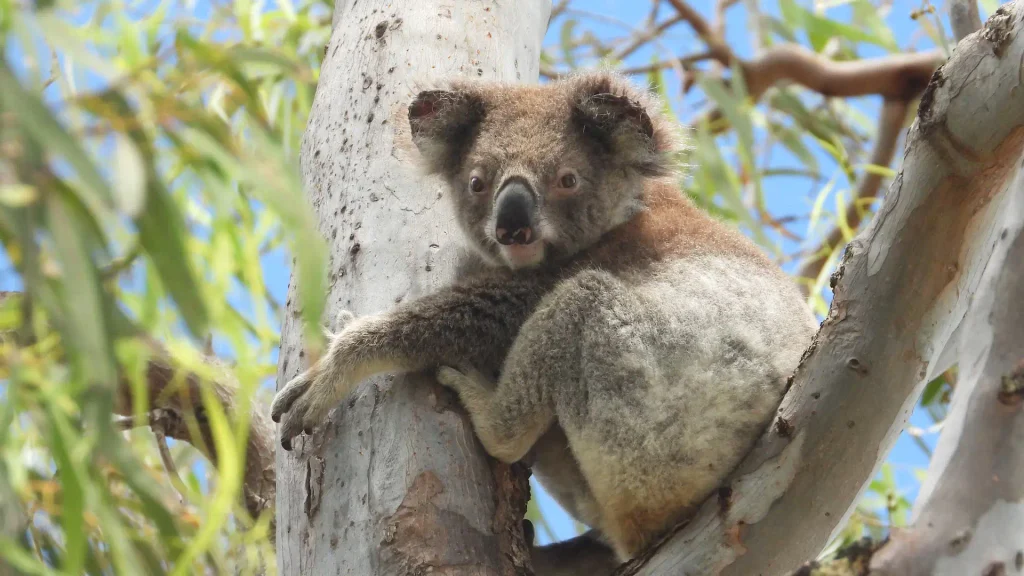
Koalas develop relationships with their surroundings, including the trees they use for feeding, shelter, and movement.
Although they may appear comfortable resting among eucalyptus branches, their survival depends on access to suitable habitat and food sources.
When koalas are relocated to unfamiliar territory, they may encounter vegetation they are less accustomed to eating.
They can also face competition from other koalas already occupying the area.
Young males, in particular, can be territorial, making an unfamiliar environment potentially challenging.
Dr. Patterson has also pointed to the possibility that differences in the animals’ gut microbiomes may influence how they adapt to new locations.
Researchers are still working to understand all the factors involved.
For North Stradbroke Island’s koalas, the ability to receive treatment locally offers a valuable alternative.
Instead of recovering far from home and facing an uncertain release location, eligible animals can now be rehabilitated with the goal of returning them to familiar island habitat.
This approach supports individual animal welfare while also helping protect the island’s distinctive koala population.
A Meaningful Victory for the Quandamooka People
The new wildlife rehabilitation program is also deeply meaningful to the Quandamooka people, the Traditional Owners of Minjerribah.
Koalas hold cultural importance within the local community, making their protection a matter of both environmental and cultural significance.
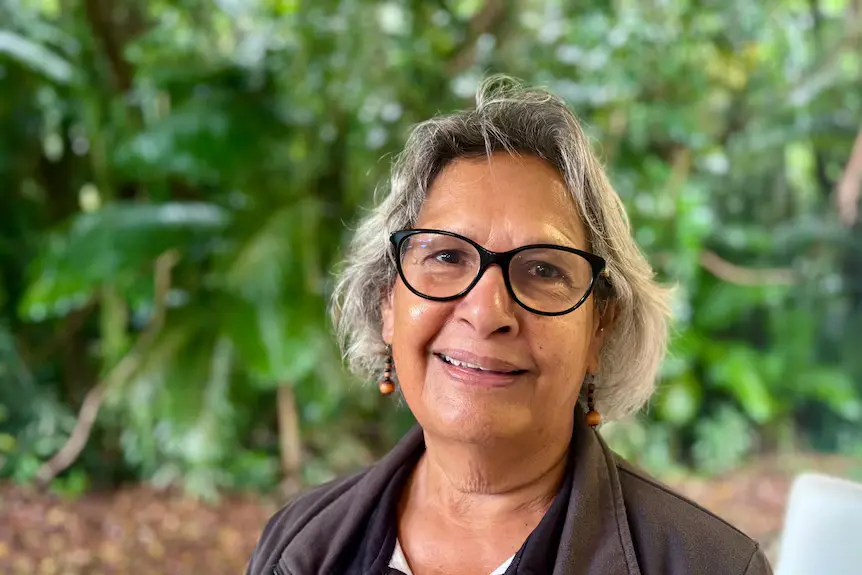
Quandamooka Elder Auntie Mary Burgess has spoken about the sadness she felt knowing that koalas taken away for medical care were previously unable to return to Country.
For years, the fate of some rescued animals remained uncertain after they left the island.
The ability to treat and release koalas locally now offers a more hopeful outcome.
Burgess has welcomed the work undertaken by Dr. Patterson and the veterinary team, including the successful release of two young koalas that had previously been abandoned by their mother.
Those releases demonstrate what the new rehabilitation system can achieve.
For the local community, seeing rescued wildlife return to its natural environment is more than a successful veterinary outcome.
It is also an important connection between conservation, culture, and Country.
Wildlife Rescuers Need More Volunteers to Save Vulnerable Animals
Despite the progress being made, the foundation faces a significant challenge.
Caring for injured and orphaned wildlife requires substantial time, specialized knowledge, and financial resources.
Animals recovering from illness, injury, or separation from their mothers may need frequent feeding, medical treatment, monitoring, and carefully managed rehabilitation.
Providing this level of care around the clock places considerable pressure on a relatively small team.
Much of the work is currently carried out by volunteers.
To address the growing demand, Dr. Patterson has begun organizing training opportunities for local residents interested in becoming wildlife caregivers.
The goal is to build a network of capable volunteers who can provide appropriate support under professional veterinary supervision.
With more trained people available, animals could receive the attention they need while allowing experienced veterinarians to focus on specialized medical treatment and conservation research.
The foundation also hopes to expand educational initiatives that help the community understand and protect the island’s wildlife.
By strengthening local participation, the organization aims to create a sustainable system that benefits both rescued animals and the wider environment.
Every Koala Returned to the Wild Is a Conservation Success
For Dr. Calvi and the other wildlife professionals involved, the young joey’s recovery represents the kind of progress that makes their demanding work worthwhile.
The little koala who arrived exhausted and barely able to stay awake is now slowly rebuilding her strength in a protected environment.
Every meal, successful climb, and small increase in weight brings her closer to independence.
Although she had not yet been released at the time of the original report, her caregivers were optimistic about the possibility of returning her to the wild near her former home.
Her story also highlights the importance of protecting individual animals as part of broader species conservation efforts.
Koalas face significant threats in parts of Australia, including habitat loss, disease, vehicle collisions, and environmental pressures.
Protecting vulnerable animals through rehabilitation is one way dedicated conservation teams can contribute to their survival.
And on North Stradbroke Island, the new wildlife foundation is demonstrating how locally based care can support that goal.
For now, the young joey continues resting among her eucalyptus branches, enjoying fresh leaves and gradually rediscovering her strength.
One day, her rescuers hope she will climb back into the island’s trees, no longer dependent on human care.
What began as a frightening separation from her mother has become a story of hope — not only for one tiny koala, but for an entire island community determined to protect its precious wildlife.