

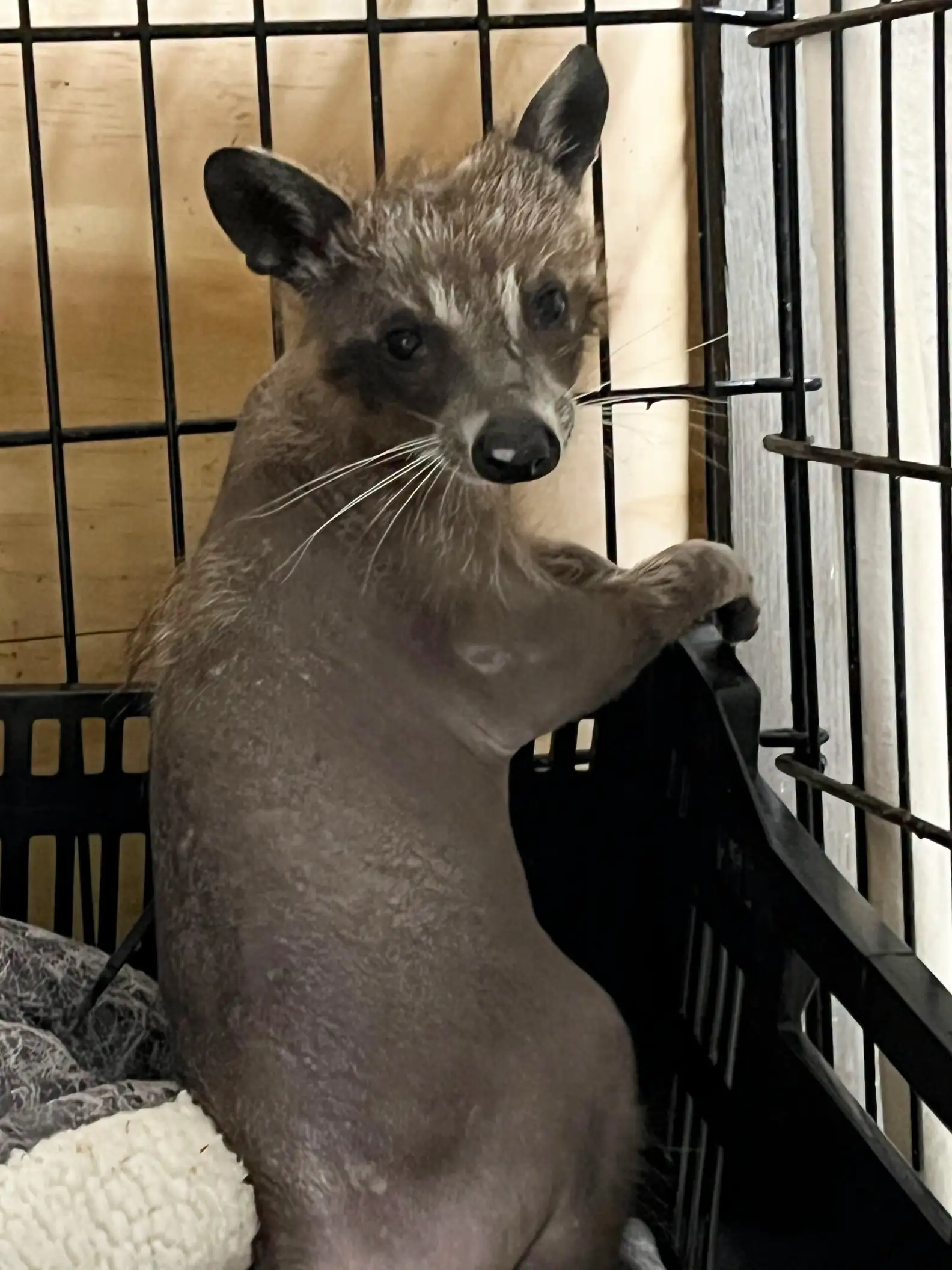
When a homeowner noticed a strange-looking animal repeatedly appearing on their porch in broad daylight, they immediately sensed that something was wrong. The unexpected visitor had the recognizable face and bushy tail of a raccoon, but the rest of his body was almost completely hairless.
His exposed skin looked shiny and unusually thick, and instead of behaving like a typical energetic raccoon, he seemed quiet, weak, and desperate for somewhere warm to rest.
What initially appeared to be a mysterious wildlife encounter soon became an urgent rescue mission. And for one severely ill raccoon, a compassionate homeowner’s decision to seek help may have changed everything.
A Strange Visitor Keeps Returning to the Same Porch
The unusual situation unfolded when a local homeowner began noticing a raccoon visiting their property during the daytime.
The animal appeared regularly, helping himself to food left outside for the family’s cats. But eating wasn’t his only reason for returning.
He also discovered an outdoor cat house and began using it as a warm place to shelter.
Although raccoons can sometimes be active during the day, this particular visitor’s appearance and behavior raised serious concerns.
Most of his body had lost its fur, leaving only his head and tail with noticeable patches of hair.
The homeowner realized that the animal might be suffering from a serious medical condition and contacted the Carolina Wildlife Conservation Center (CWCC).
After hearing the description, the wildlife rehabilitation team immediately suspected that the raccoon was suffering from an advanced case of mange.
They knew he needed help, and the sooner he received treatment, the better his chances of recovery.
Wildlife Experts Recognize a Serious Medical Problem
Mange is a skin condition caused by microscopic mites that can affect numerous wild mammals, including raccoons.
Depending on its severity, the condition can cause extensive hair loss, irritated skin, thickening of the skin, and significant physical discomfort.
For animals living outdoors, losing their protective fur can create additional problems, particularly during colder weather.
Morgan Rafael, executive director of Carolina Wildlife Conservation Center, explained that animals suffering from mange often seek warmer environments to help compensate for their loss of insulation.
This behavior can sometimes lead normally nocturnal animals to spend more time in the sunshine or seek shelter in places they might otherwise avoid.
The raccoon’s repeated visits to the outdoor cat house suddenly made sense.
He wasn’t simply searching for an easy meal. He was also taking advantage of a place where he could stay warm.
Recognizing the urgency of his condition, the CWCC team recommended that the homeowner use a humane trap so the animal could be safely transported for medical treatment.
The Raccoon’s Unusual Behavior Worries His Rescuers
Because the raccoon had been visiting the property consistently, rescuers hoped the humane trapping process would be straightforward.
To everyone’s surprise, the animal entered the trap overnight.
When the wildlife team arrived to collect him, however, his behavior was even more concerning than expected.
Healthy wild raccoons can be defensive when approached or handled. This little animal, by contrast, remained unusually quiet.
He didn’t growl, struggle aggressively, or show much resistance.
Instead, he appeared exhausted and withdrawn.
His subdued behavior suggested that his illness had taken a considerable toll on his strength.
As rescuers prepared to transport him, they noticed another troubling symptom: a strong, yeast-like odor coming from his body.
Combined with the extensive hair loss and abnormal skin, the smell reinforced their concerns about how advanced his condition had become.
The raccoon was carefully transported to the wildlife rehabilitation facility, where the veterinary team could investigate further.
A Medical Examination Reveals Severe Mange
At Carolina Wildlife Conservation Center, staff began carefully evaluating their new patient.
Despite being in an unfamiliar environment, the raccoon remained surprisingly calm throughout his initial examination.
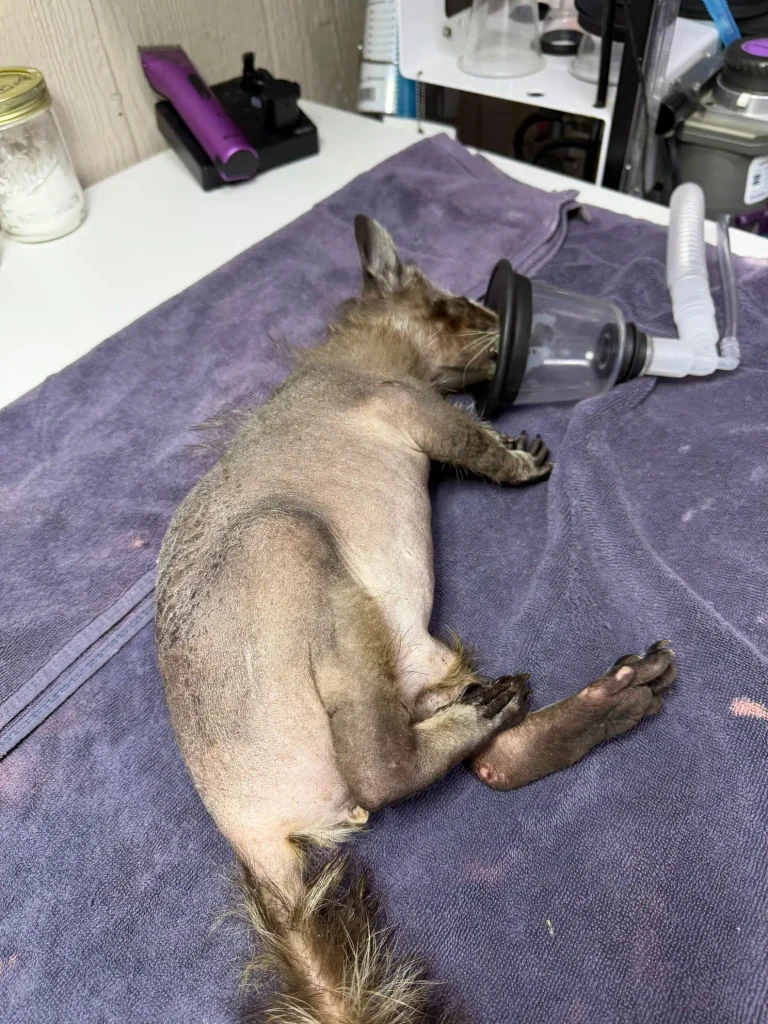
To investigate the cause of his skin condition, the team sedated him and performed a skin scraping test.
The results confirmed the presence of mites.
The raccoon was suffering from a severe case of mange, and the extensive damage to his skin indicated that he had likely been living with the condition for quite some time.
His body had lost nearly all its protective fur, and his skin had become significantly thickened.
According to the rehabilitation team, it was among the most serious cases of mange they had encountered.
Fortunately, there was one encouraging discovery.
Despite the severity of his condition, the raccoon had not developed a secondary bacterial infection.
This gave his caregivers an important reason for optimism as they began treating the mite infestation.
With the cause of his suffering finally identified, the little raccoon could begin his journey toward recovery.
A Gentle Patient Finds Comfort in Warm Blankets
As the days passed, staff discovered something particularly touching about their newest patient.
Despite everything he had endured, the raccoon had an exceptionally shy and quiet temperament.
While caregivers administered medication and monitored his progress, he rarely made a sound.
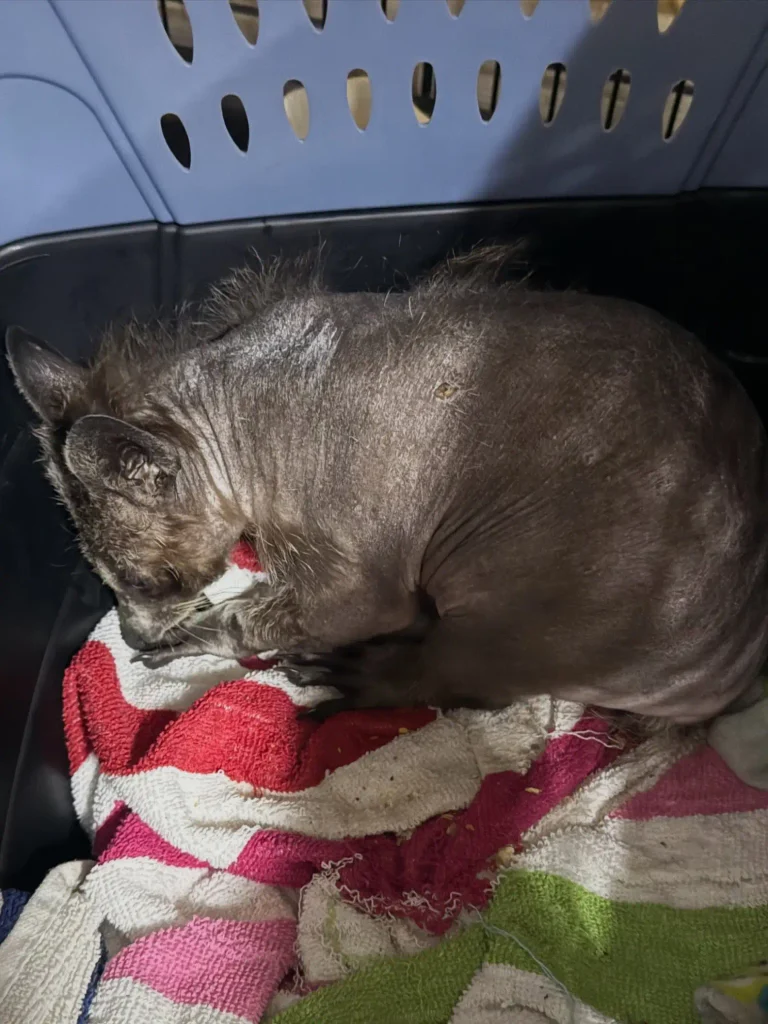
Rather than reacting defensively, he often lowered his head and curled up in his blankets.
His gentle demeanor left a lasting impression on the people caring for him, although they understood that his weakness and illness could contribute to his unusually subdued behavior.
The raccoon was placed in quarantine to prevent the mites from spreading to other animals at the center.
There, he received ongoing treatment, close observation, and a warm environment where his exposed skin would be protected from harsh temperatures.
For an animal who had previously been struggling outdoors, the shelter offered something essential: an opportunity to recover without constantly searching for warmth and safety.
Gradually, the rehabilitation team began noticing encouraging improvements.
A New Chapter of Recovery Is Finally Within Reach
Although the raccoon’s condition was severe, his caregivers remained optimistic about his future.
With continued medical treatment and supportive care, he began showing signs of feeling better.
The next milestone would be eliminating the mite infestation so he could safely transition out of quarantine.
Once that happened, the team hoped to introduce him to other raccoons undergoing rehabilitation at the center.
Being housed with compatible animals could allow him to socialize and share warmth during the colder months.
However, his missing fur remained a significant concern.
Until his natural coat grew back, the team planned to keep him protected from the intense winter cold.
The process would take time, but every improvement would bring him closer to regaining the strength and independence he needed.
For his rescuers, watching the raccoon gradually return to health was already an encouraging reward.
Rescuers Hope to See Him Return to the Wild
While the little raccoon has received plenty of attention from his caregivers, the ultimate goal has always been to return him to his natural habitat.
Wildlife rehabilitation centers work to restore injured and sick animals to health so they can survive independently.
For this particular raccoon, that means recovering from mange, regrowing his protective fur, and becoming healthy enough to handle life outdoors.
When those milestones are achieved, the team hopes to release him into the same area where he was originally discovered.
At the time of the rescue organization’s update, he remained in rehabilitation, and his release had not yet been confirmed.
Still, the progress he had already made offered reason to hope.
The nearly hairless animal who once sought shelter in a stranger’s outdoor cat house was finally receiving the medical care he desperately needed.
A Small Act of Kindness Makes an Extraordinary Difference
The raccoon’s remarkable rescue began with a homeowner who noticed something unusual and chose not to ignore it.
Instead of approaching the sick animal or attempting to treat him without professional guidance, the homeowner contacted experienced wildlife rehabilitators.
That simple decision set an important chain of events in motion.
The raccoon was safely captured, examined, diagnosed, and given the treatment he needed to begin recovering.
His story also illustrates how difficult it can be for wild animals to cope with serious illnesses when they have no protection from the elements.
For this little raccoon, the search for warmth eventually led him to the very people who could save him.
Today, his journey toward recovery continues under the supervision of a dedicated wildlife team.
And if everything goes according to plan, his rescuers will one day watch him return to the wild, fully furred, healthy, and ready to explore his familiar surroundings again.
Sometimes, the most meaningful wildlife rescues begin not with a dramatic emergency, but with someone noticing an animal in need and caring enough to help.