

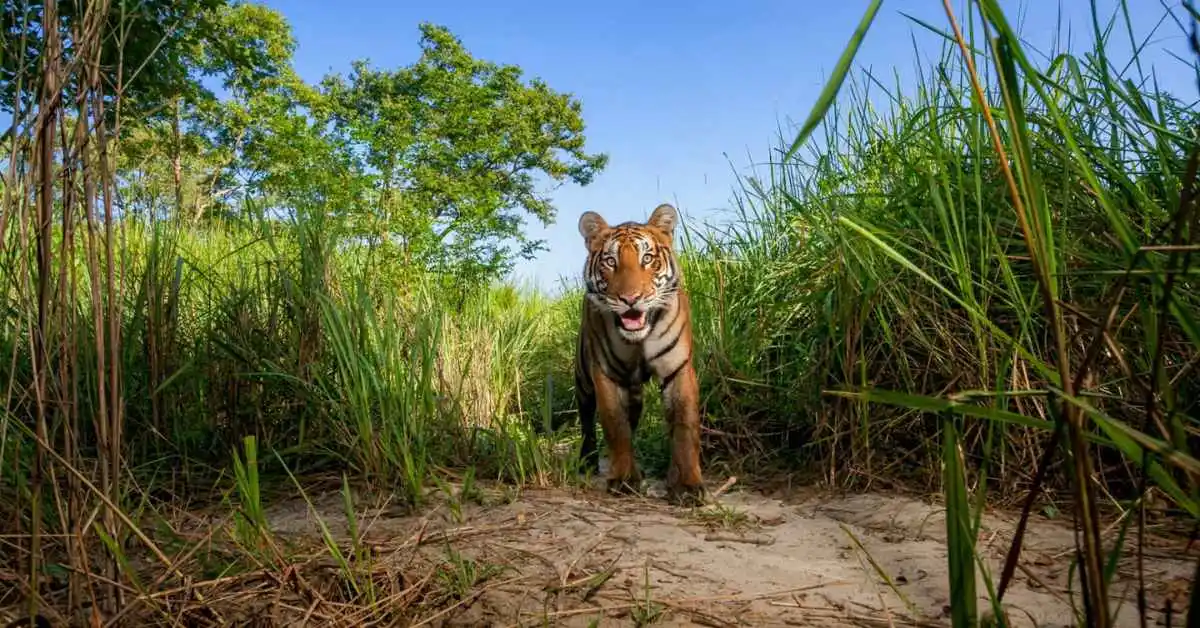
India’s success in rebuilding its Bengal tiger population has created a new conservation challenge. As tiger numbers rise, more of the big cats are leaving protected reserves in search of territory, food and mates — often moving through landscapes filled with highways, railways, farms, towns and villages.
To give wildlife safer ways to travel, India has invested heavily in corridors, underpasses and overpasses designed to reconnect habitats divided by infrastructure.
These crossings are becoming increasingly important as expanding tiger populations push beyond the boundaries of protected areas. Yet conservationists warn that wildlife bridges alone cannot solve the problem if forests continue to disappear and the habitats at either end of those crossings are degraded.
A Highway Crossing Built for Wildlife
In Rajaji Tiger Reserve in northern India, the Teen Pani underpass runs beneath National Highway 72.
Stretching for roughly 1,300 feet, the structure allows wildlife ranging from small mammals to elephants to move beneath the busy road instead of attempting to cross through traffic.
It may also provide a safe route for T8, a Bengal tiger transferred from Corbett Tiger Reserve to Rajaji in May 2025.
T8 is one of five tigers relocated to the reserve and now travels widely through a landscape where human activity and wildlife habitat frequently overlap.
The highway above the crossing opened in 2021, replacing an older route connecting Delhi with Haridwar and Dehradun.
Although traffic remains a constant presence, just a short distance from the road the noise quickly fades into the surrounding forest.
More Tigers Need More Space
India is building modern transport infrastructure at the same time that its tiger conservation programme is producing increasingly successful results.
That creates an unusual dilemma.
Tigers require large territories, and younger animals naturally disperse as they mature. As populations grow in established reserves, some animals must move elsewhere to establish territories of their own.
Roads, railways and urban development can make those journeys dangerous.
For some wildlife, a major highway can act almost like a physical fence. For larger animals such as elephants and big cats, roads can also become routes they attempt to cross — sometimes with fatal consequences.
India’s National Tiger Conservation Authority has identified several major tiger landscapes where wildlife corridors are considered essential.
These pathways allow animals to travel between populations, find water and prey, reproduce and maintain genetic diversity.
India Has Invested Heavily in Wildlife Crossings
India has constructed more wildlife mitigation structures by total length than any other Asian country, according to Wildlife Institute of India scientist Bilal Habib.
Since 2017, the country has created what are described as the world’s 10 largest wildlife underpasses and overpasses.
These projects represent a significant financial commitment to reducing the impact of transport infrastructure on wildlife.
But their success depends on more than engineering.
A crossing can only help wildlife if healthy habitat remains on both sides of it.
Tigers Are Built to Wander
Tigers are naturally territorial animals.
A male tiger can occupy a home range covering as much as 77 square miles, although the exact size depends on prey availability, habitat and the number of other tigers nearby.
Females generally occupy smaller ranges, but they are territorial as well.
Rajaji Tiger Reserve illustrates how difficult movement can become even inside a protected landscape.
Highways, a railway, canals, towns and other human disturbances divide the forest at the western end of the Terai Arc.
The wider Terai Arc stretches for almost 20,000 square miles along the Himalayan foothills and into Nepal.
Its protected areas are linked by a network of wildlife corridors, several of which conservationists say are already under substantial pressure.
Sometimes these corridors are little more than narrow bands of forest weaving around settlements, agricultural fields and roads.
Yet those strips of habitat may be the only connection between larger areas capable of supporting breeding wildlife populations.
India’s Tiger Population Has Rebounded
India’s tiger recovery is one of the world’s major large-carnivore conservation successes.
Estimates suggest the country’s tiger population has more than doubled since the early 1970s, rising from roughly 1,827 animals to around 3,682 in the 2022 census.
The Terai Arc has experienced particularly strong growth.
The landscape, centred on Corbett Tiger Reserve, now supports approximately 560 tigers — more than three times the population recorded there two decades earlier.
Corbett also has an important place in Indian conservation history. It was there that Prime Minister Indira Gandhi launched Project Tiger in 1973, an initiative widely credited with helping prevent the disappearance of tigers from the country.
India today represents the most important remaining stronghold for wild Bengal tigers.
Success Is Uneven Across the Country
Despite the national recovery, tiger numbers are not distributed evenly.
Some reserves have high densities of animals, while others contain very few or possibly none.
Experts estimate that approximately 35% of India’s wild tigers already live outside officially protected areas.
That makes connectivity increasingly important.
Young tigers leaving their mothers need somewhere to go. If populations become trapped within isolated pockets of habitat, animals face greater risks of inbreeding, territorial conflict and declining genetic diversity.
But once they move into landscapes dominated by people, new dangers appear — including poaching, roads, railway lines and conflict with communities.
Human-Tiger Conflict Is Growing in Some Areas
Chandrapur district in Maharashtra provides a striking example of what can happen when tiger populations expand alongside dense human settlement.
The region includes Tadoba Tiger Reserve but is also an important centre for industry and mining.
Tiger numbers there have climbed dramatically, from roughly 30 to 40 animals in 2006 to somewhere between 220 and 300 today.
At the same time, around 2.5 million people live in the district.
The consequences of close contact can be severe for both humans and wildlife.
Between 2021 and May 2025, 150 people in the region were killed by tigers.
In May 2026, a female tiger was struck and killed by a freight train in Chandrapur. She was reportedly one of at least 19 tigers killed along the same railway route within three years.
Poaching and Habitat Loss Remain Serious Threats
India’s growing tiger population does not mean the species is free from danger.
Poaching remains a persistent problem and has reportedly increased in states including Maharashtra and Madhya Pradesh.
Some tigers are also killed by illegal electric fencing installed by farmers hoping to keep deer and wild boar away from crops.
Meanwhile, forests continue to be lost or degraded by mines, roads and other infrastructure projects.
Even land surrounding protected areas is vulnerable.
Mining and other developments have received approval in ecologically sensitive zones and wildlife corridors, raising concerns among conservationists about whether infrastructure expansion is undermining the same habitats India is trying to reconnect.
Development Is Putting Some Corridors Under Pressure
In several states, conservation groups have raised objections to projects affecting important wildlife habitat.
In Odisha, forest maps used by elephants and occasionally tigers were reportedly redrawn to make land available for bauxite mining.
In Maharashtra’s Gadchiroli district, an approved mining development would divert several square miles of forest from a tiger corridor.
The controversial Ken-Betwa river-linking project would also submerge a substantial area of forest inside Panna Tiger Reserve.
The project has faced opposition from wildlife advocates and local communities, including families who would need to relocate.
These pressures strengthen the argument that corridors cannot compensate for the continued loss of core habitat.
Wildlife Crossings Are Only Part of the Solution
Tiger expert Ullas Karanth argues that India still has significant potential habitat available for the species.
He estimates that roughly 155,000 square miles of former tiger range may still be capable of supporting the animals, although only a small portion currently contains breeding populations.
Connecting this habitat requires conservation planning across entire landscapes.
Large wildlife bridges and tunnels may be impressive, but animals need a reason to use them.
If the habitat beyond a crossing has been cleared, heavily disturbed or depleted of prey, the structure alone offers little conservation value.
Karanth argues that securing strong core habitats must remain the first priority.
With sufficient protection, he believes India could potentially support far more tigers than it does today.
Engineers and Ecologists Need to Work Together
Road agencies and conservationists have historically approached landscapes from very different perspectives.
Engineers tend to focus on transport efficiency and construction, while wildlife scientists examine ecological connectivity, animal movement and habitat quality.
Increasingly, experts argue that those disciplines must be integrated from the beginning of major infrastructure projects.
Wildlife biologist Ravi Chellam cautions against thinking of corridors as narrow, clearly defined lines on a map.
Animals do not necessarily follow the boundaries that people draw for them.
Instead, they move through a broader patchwork of forests, farmland, villages and other available habitats.
That means conservation planning must account for entire landscapes rather than protecting only thin strips labelled as corridors.
Cooperation Between Agencies Is Essential
Conservation organisations can play an important role in connecting government departments that otherwise operate separately.
Transport agencies, forest departments, local governments and conservation organisations may all view the same landscape differently.
Yet effective wildlife management often requires them to coordinate.
As tigers increasingly move through places shared with people, conservationists say governments also need strategies for managing coexistence and reducing conflict.
Central India Holds a Huge Share of the Country’s Tigers
Central India is particularly important for the future of the species.
Its forests contain approximately 40% of India’s estimated 3,682 wild tigers.
But those forests are becoming increasingly fragmented.
Research examining six important tiger reserves found that forest cover declined by roughly 5% between 2005 and 2015 while agricultural land and settlements expanded.
One especially significant region is the Kanha-Pench corridor between Madhya Pradesh and Maharashtra.
The corridor connects Kanha Tiger Reserve, which has more than 100 tigers, with Pench Tiger Reserve, which supports dozens more.
Evidence shows that tigers not only travel through the surrounding Balaghat forests but also breed there.
Maintaining that connection is therefore important for the long-term genetic health of both populations.
Highways Can Be Redesigned Around Wildlife
National Highway 44 passes through Pench Tiger Reserve and has become one of India’s best-known examples of wildlife-friendly road design.
Nine wildlife crossings were constructed along the highway to help animals move safely between habitats.
Such crossings are particularly important because research suggests individual tiger populations in central India may not remain genetically viable over the long term if they become completely isolated.
Maintaining movement between reserves could therefore be just as important as protecting the reserves themselves.
Tigers Are Returning to Places Where They Disappeared
As populations recover, tigers are increasingly being recorded in areas where they have not been seen for generations.
In 2023, one was detected at an elevation of around 7,000 feet in Binsar Wildlife Sanctuary in the Himalayas.
Rather than entering entirely new territory, many of these animals are recolonising parts of their historic range.
A century ago, tigers were thought to have been far more widespread across India.
But many former habitats have since been transformed into farms, towns, roads and cities.
The human population surrounding some tiger reserves has increased dramatically over the same period.
Some Tigers Travel Extraordinary Distances
Individual tigers can cover remarkable distances while searching for territory.
In January 2024, one animal travelled roughly 77 miles from Sariska Tiger Reserve in Rajasthan to agricultural land on the outskirts of India’s vast National Capital Region around Delhi.
The tiger injured two people during its journey.
Officials nevertheless decided not to capture it because data from its radio collar indicated that it was already heading back toward the reserve.
Other tigers have since left Sariska, highlighting the reality that dispersal cannot simply be stopped.
Road Building Could Become a Conservation Opportunity
Despite the dangers posed by infrastructure, some scientists believe new roads can also provide an opportunity to improve wildlife connectivity.
Habib argues that transport development is inevitable, but roads can be designed in ways that reduce damage and even restore connections previously severed by older infrastructure.
When poorly designed roads are replaced or upgraded with large wildlife underpasses, sections of landscape can effectively be returned to animals.
Indian states are also beginning to cooperate more closely as elephants and tigers increasingly cross administrative boundaries.
For wide-ranging species, conservation cannot stop at a state border.
Asia’s Longest Wildlife Underpass Offers a Glimpse of the Future
One of India’s most ambitious examples lies beneath the newly opened Delhi-Dehradun Expressway.
The approximately 7.5-mile wildlife underpass, described as the longest in Asia, opened in April 2026.
Leopards, elephants, deer and antelope have already been recorded using it.
T8, the male tiger roaming Rajaji, had not yet passed through at the time of reporting.
But another tiger crossed the area during construction in 2023 while making a journey spanning hundreds of kilometres and several states.
The forests on the opposite side of the new crossing are extensive enough to potentially support more than 150 additional tigers.
Researchers hope that as Rajaji’s tiger population grows, young animals will eventually use the underpass when dispersing into new territory.
India’s Next Tiger Challenge Is Coexistence
India has demonstrated that tiger populations can recover when strong conservation measures are put in place.
The next challenge may prove even more complicated.
More tigers mean more animals leaving crowded reserves and entering landscapes where people live, farm, travel and work.
Wildlife crossings can reduce some of the risks, but they must be supported by healthy forests, functioning corridors and communities prepared to coexist with large predators.
The return of tigers to parts of their former range brings genuine dangers, but it also represents an opportunity.
If India can combine modern infrastructure with large-scale habitat protection, its tiger recovery could become not only a story about saving a species, but about rebuilding ecological connections across some of the country’s most heavily transformed landscapes.