

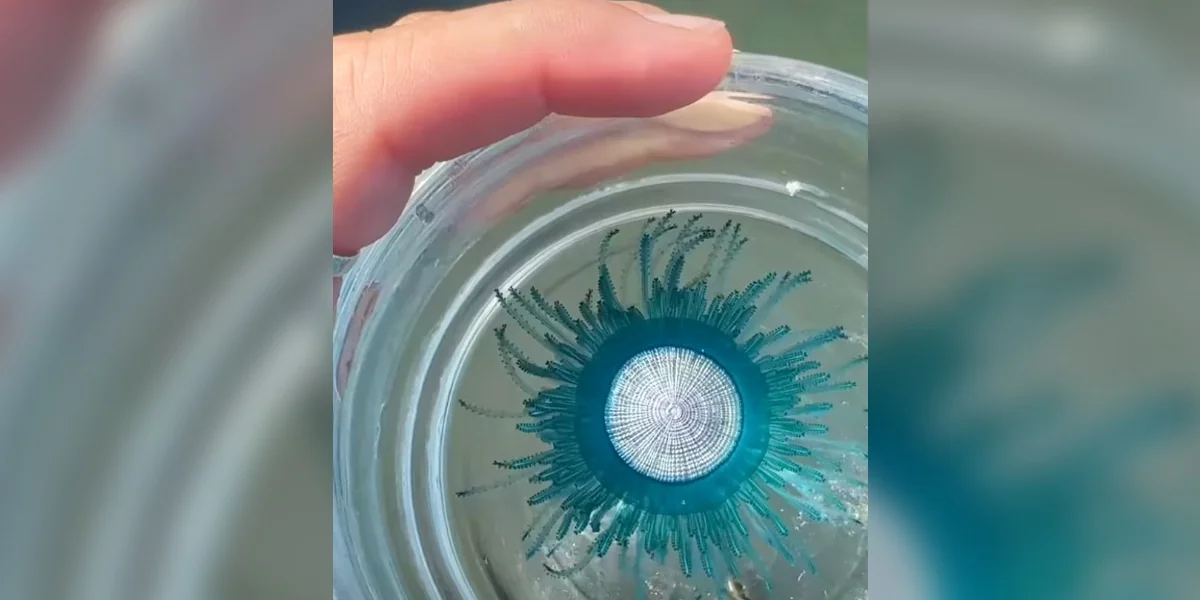
It’s called a blue button.
Strange Blue “Jellyfish” Spotted Off North Carolina Coast Is Actually Something Much Weirder
Marine science communicator Jillian Daly was walking along the North Carolina coast when something bright blue in the water caught her attention.
The unusual creature looked like a tiny jellyfish, but Daly immediately knew she was looking at something far stranger.
It was a Porpita porpita, commonly known as a blue button.
It Looks Like a Jellyfish — But It Isn’t One
At first glance, blue buttons can easily be mistaken for jellyfish because of their circular bodies, vivid blue coloring and dangling tentacle-like structures.
But unlike a true jellyfish, a blue button is not one individual animal.
Instead, it is a colony made up of numerous tiny organisms called hydroids that live and function together as one unit.
Daly explained that while a jellyfish is a single animal, a blue button is essentially a community of miniature creatures working together.
Hundreds of Tiny Animals Form One Colony
The blue button’s unusual biology becomes even more fascinating when viewed up close.
Its central floating structure keeps the colony near the ocean’s surface, while specialized organisms around the edges help with feeding, movement and other essential functions.
Rather than each body part belonging to one animal, the different sections are made up of many individual organisms cooperating with one another.
In effect, what appears to be one tiny sea creature is actually an entire living colony.
Daly Brought Some Back to the Lab
Because Daly works as a marine science communicator and has access to laboratory equipment, she decided to carefully collect a few of the blue buttons for a closer look.
Under a microscope, their complexity became even more obvious.
She watched the tiny organisms moving and functioning together, creating the appearance of a single coordinated animal.
The sight left her fascinated.
Daly said the unusual creatures seemed almost alien and described them as among the most beautiful animals in the ocean.
Their Bright Blue Color Comes With a Warning
Although blue buttons are not true jellyfish, they do share one important feature with them.
They possess stinging cells called nematocysts.
These cells are located around their tentacle-like structures and help the colony capture food and defend itself.
The sting is not considered deadly to humans, but touching a blue button can cause skin irritation or painful welts.
For that reason, anyone who spots one along the shore is better off admiring it without picking it up.
Blue Buttons Drift Wherever the Ocean Takes Them
Blue buttons can be found across parts of the Atlantic, Pacific and Indian Oceans.
Unlike animals that actively swim toward a destination, they largely depend on wind and ocean currents to move.
That means large numbers can suddenly appear along a coastline and disappear again just as quickly.
Their movements are often unpredictable, making encounters with them relatively brief in many locations.
A Rare Sight Along North Carolina’s Coast
Daly said she usually sees blue buttons in North Carolina waters for only a few days each year.
That made discovering them during her walk particularly exciting.
For a marine biologist accustomed to studying ocean life, even a familiar species can feel extraordinary when conditions bring it close to shore.
One of the Ocean’s Strangest Little Communities
From a distance, a blue button might look like nothing more than a colorful jellyfish drifting across the water.
Up close, however, it reveals something much more remarkable: hundreds of tiny animals living together so closely that they appear to function as one.
For Daly, spotting the unusual colony was a reminder that some of the ocean’s most fascinating creatures can also be among its smallest.