

Across Alaska’s North Slope, researchers are investigating a question that could reshape how scientists understand survival in a warming world: can different species adapt to climate change not only individually, but together as part of an interconnected ecosystem?
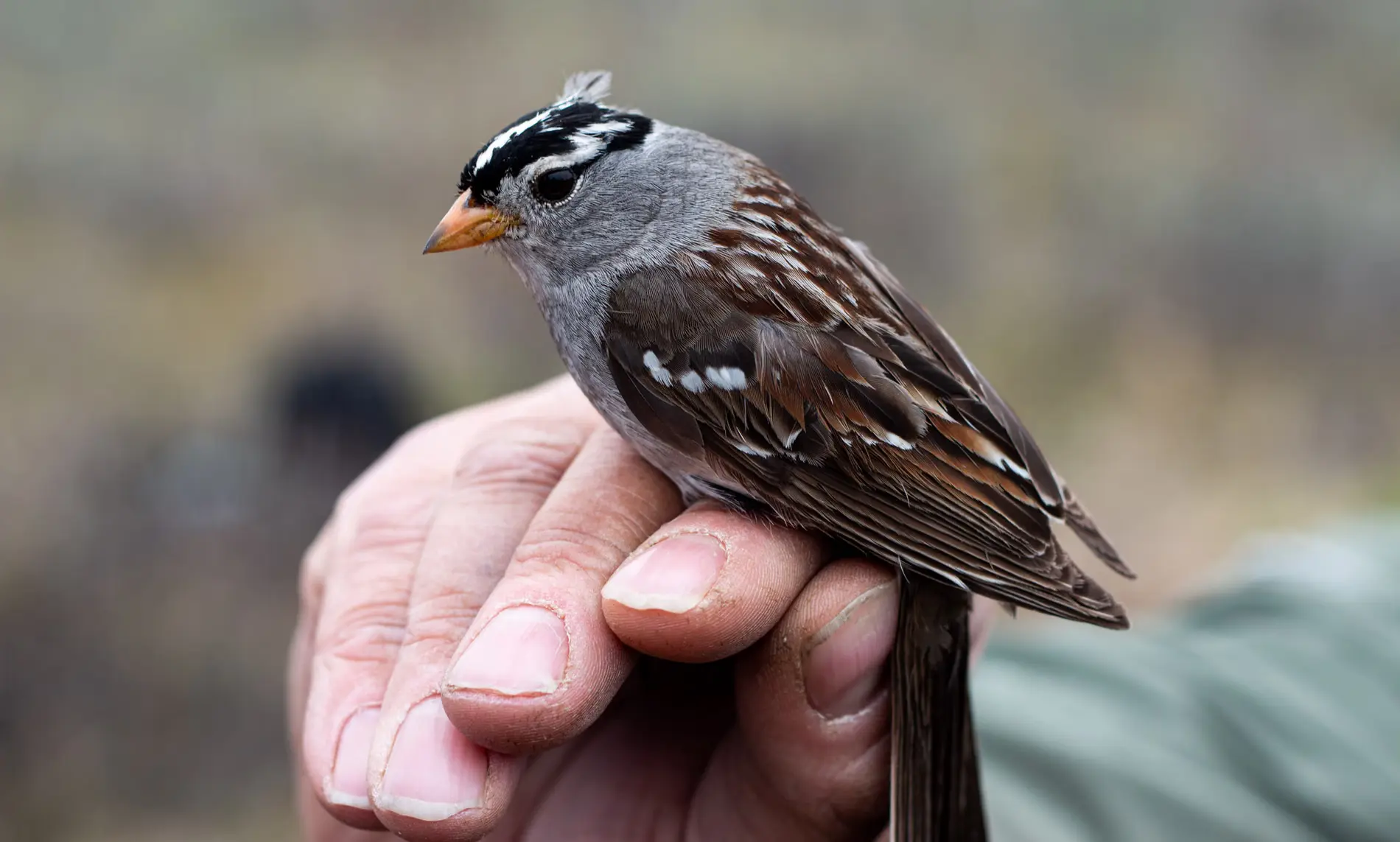
During the brief Arctic summer, scientists work along streams flowing from Alaska’s Brooks Range and across the surrounding tundra. One of their study subjects is the white-crowned sparrow, a migratory bird that arrives from warmer regions each year to breed.
The birds have only a short window to establish territories, reproduce and raise their young before Arctic conditions change again. Their chicks depend heavily on insects, so researchers are collecting blood, feathers and fecal samples from captured birds to determine exactly what they eat throughout the season.
A major question is how important insects emerging from nearby streams are to the birds.
Aquatic insects such as mayflies and stoneflies may become increasingly affected as shrubs expand along Arctic waterways. This spread of woody vegetation, often described as shrubification, is changing the physical environment surrounding northern streams.
More shrubs can create additional shade over the water, reducing the sunlight available for algae to grow. Because algae provide food for several aquatic insects, changes at the level of vegetation may eventually influence insects, fish and birds as well.
At the same time, the Arctic’s seasonal water cycle is becoming less predictable.
Spring snow is melting earlier, producing large amounts of runoff at the beginning of the season. Later in summer, however, some creeks can become unusually shallow or even break into isolated pools.
That creates problems for Arctic grayling, a cold-water fish closely related to salmon. Grayling migrate between deeper lakes, where they spend the winter, and smaller streams used during warmer months. When water levels fall too far, fish may be unable to return to the lakes they rely on for winter survival.
The same insects affected by vegetation and stream conditions are also an important source of food for these fish.
This network of relationships is exactly what scientists involved in the Evolving Meta-Ecosystems Institute, or Evome, hope to understand.
The six-year research effort, supported by roughly $15 million from the US National Science Foundation, brings together specialists in ecology, evolution, biology, physiology and genetics.
Rather than studying species in isolation, the project examines how changes in one organism may influence the ability of others to survive.
Researchers are focusing especially on five components of the Arctic ecosystem: white-crowned sparrows, feltleaf willows, Arctic grayling, aquatic mayflies and a species of ground beetle.
The underlying idea is that climate adaptation might operate across ecological relationships.
A species could evolve because temperatures are changing, for example, but it may also face new pressures because another species has already changed its behavior, abundance, timing or physical characteristics.
In this way, evolution may ripple through an entire ecosystem.
Linda Deegan of the Woodwell Climate Research Center, who leads the project, describes ecosystems as networks rather than collections of independent organisms. An animal or plant responds to environmental pressure individually, but it also lives among predators, prey, competitors and other organisms.
Researchers therefore want to know whether these ecological connections might provide some protection as temperatures rise.
Alaska offers an especially valuable setting for answering that question.
The Arctic is warming extremely quickly, while its tundra and freshwater habitats contain relatively simple ecological networks compared with many tropical or temperate systems. That gives researchers an opportunity to closely track a manageable group of organisms and the relationships among them.
Although the fieldwork is taking place in the far north, the results could have wider implications for ecosystems ranging from mountain environments to tropical regions.
Much of the work is concentrated around the Dalton Highway, which stretches north toward Alaska’s oil-producing region.
Scientists use the road as an access route to approximately 15 research locations spread across nearly 190 miles. Around 50 researchers from American institutions participate in field activities across this area.
Evidence of research can be found throughout the landscape.
Insect traps emerge from the tundra. Acoustic devices record bird activity. Temperature sensors monitor cold streams. Researchers collect willow leaves, sample water and examine aquatic organisms.
The nearby oil pipeline also serves as a visible reminder of the broader human activities connected to a changing climate.
One important part of the project examines how expanding willow shrubs may transform streams.
Additional shade can reduce photosynthesis and therefore reduce algae production. That could affect insects such as mayflies and caddisflies that depend on those resources.
Yet increased willow growth could create benefits for other organisms.
When more leaves fall into streams, insects that consume decomposing plant material, including some stoneflies, may gain access to additional food.
The ecological outcome is therefore complicated.
One insect population may decline while another increases. The next question is whether fish and birds can change their feeding patterns quickly enough to benefit from whichever organisms become more abundant.
Timing also matters.
Mayflies may emerge in large numbers, producing concentrated food supplies for predators. Stoneflies, by contrast, usually emerge earlier and do not necessarily create the same enormous swarms.
If the seasonal timing of these insects changes, predators must adjust as well.
Scientists already know that individual species have several ways to respond to changing environmental conditions.
One possibility is behavioral adjustment. Migratory birds, for example, can alter where or when they travel.
Another possibility is physiological acclimatization. Plants may temporarily change processes such as photosynthesis when faced with drought or heat.
The third possibility is genetic evolution.
If certain inherited characteristics improve survival or reproduction, those traits can spread through future generations. Under intense environmental pressure, this process can sometimes occur surprisingly quickly.
Researchers refer to one important version of this process as evolutionary rescue.
A population approaching extinction may recover if useful genetic changes arise or already exist within the population and spread quickly enough.
Previous research involving organisms such as scarlet monkeyflowers has shown that rapid evolution can help populations survive severe environmental stress, including prolonged drought.
For the Alaska project, however, researchers are interested in something broader.
They want to know whether evolutionary adaptation in one species can preserve the ecological functions provided by many other species.
For instance, if a fish population adapts rapidly enough to warmer conditions, its survival does more than preserve the fish itself. It can also help maintain nutrient movement, predator-prey relationships and the productivity of the stream ecosystem.
Understanding whether this can happen requires detailed genetic information.
Researchers are therefore mapping genetic variation within each of the project’s major study species.
A population containing greater useful genetic diversity may have more possibilities for adapting to changing environmental conditions. Populations with limited variation may have fewer evolutionary options.
Scientists are also attempting to connect particular genetic differences with traits that matter in different environments.
The relationship between genes and adaptation is unlikely to be simple.
Rather than finding a single gene responsible for survival in warmer environments, researchers expect many important traits to be influenced by large numbers of genes acting together.
Among all the species involved in the project, Arctic grayling have become especially important.
These striking fish, known for their large dorsal fins and shimmering appearance, connect lakes and streams as they migrate throughout the watershed.
Their movement also transports nutrients between different aquatic environments.
But their dependence on cold water makes them particularly vulnerable to climate change.
Grayling need sufficiently cool temperatures during development. They also feed on insects whose populations may change as shrubs spread along waterways.
Changes in stream flow create an additional threat because the fish must travel between seasonal habitats.
Researchers want to determine whether grayling populations can adjust to these new conditions.
One important mystery involves the signals that tell the fish when to migrate.
Those signals may be strongly influenced by inherited genetic programming, or they may be flexible enough to change as environmental conditions shift.
Scientists are testing these possibilities through laboratory experiments.
Researchers from the University of Alaska Fairbanks collected fertilized grayling eggs from different locations and transported them to laboratory facilities.
The process itself demonstrated how difficult Arctic field research can be. During one trip along the rough Dalton Highway, more than half of the collected eggs died before reaching the laboratory.
The surviving eggs were raised under different temperature conditions.
Researchers also collected eggs from grayling spawning near Fairbanks, where water temperatures differed considerably from those farther north.
By raising fish from different populations under the same controlled conditions, scientists can compare their responses and determine whether local populations possess distinctive adaptations.
Temperature has already shown an important trade-off.
Warmer water can accelerate fish development, but higher temperatures may also increase mortality.
Future experiments will include eggs collected from additional streams and lakes across the North Slope, allowing researchers to determine whether different populations respond differently to the same environmental conditions.
Genetics will play a central role in that investigation.
The Evome team is developing a reference genome for Arctic grayling. Once completed, it should help scientists compare genetic differences between populations and search for genes associated with temperature tolerance, migration or other locally adapted traits.
Ultimately, however, the project is about more than a single fish, bird, shrub or insect.
Scientists are combining field observations, laboratory experiments, ecological measurements and genetic research to understand how an entire Arctic landscape may respond to rapid environmental change.
They capture birds and analyze their diets. They collect insects and algae from streams. They study vegetation, monitor water chemistry, measure stream flows and sequence genetic material.
Each individual experiment provides only one part of the picture.
Together, the data may reveal whether ecological relationships strengthen or weaken the ability of species to adapt.
The traditional idea of evolution often emphasizes competition and individual survival. The Alaska research adds another possibility: survival may also depend on maintaining connections among organisms.
As temperatures rise, some species will undoubtedly adjust more successfully than others. Some populations may rapidly evolve, while others may decline. The important question is whether enough of those relationships can remain intact for the larger ecosystem to continue functioning.
Researchers do not yet know the answer.
The Arctic landscape may prove surprisingly resilient in some places and highly vulnerable in others.
What happens in Alaska’s streams and tundra could therefore provide a glimpse into a much larger question facing ecosystems around the planet: when climate change transforms the conditions of life, can interconnected species change quickly enough to survive together?