

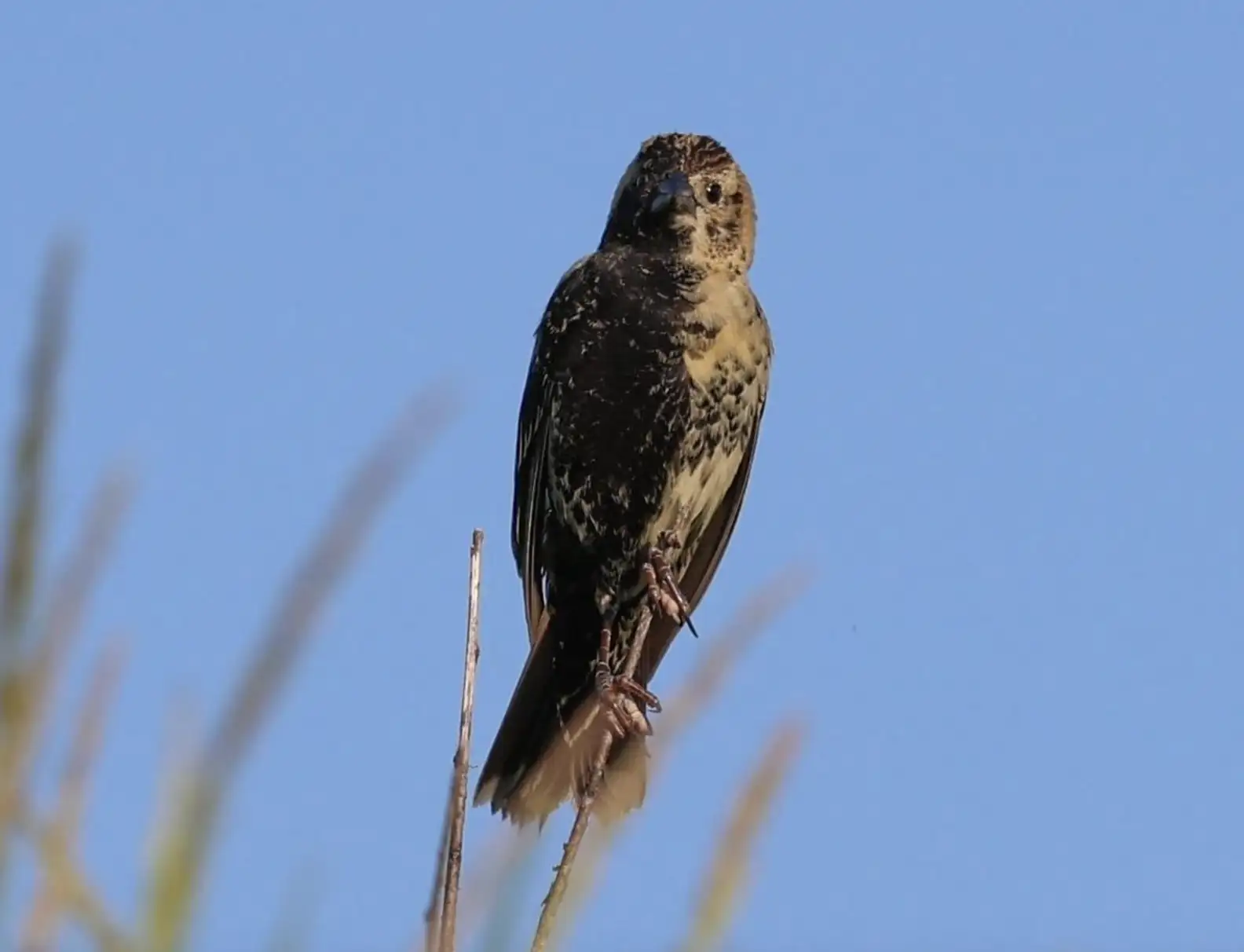
They’re a rare genetic anomaly 🤯
A routine day of birdwatching turned into an extraordinary discovery for Luke Dahlberg, who works at a nature preserve near Barrington Hills, Illinois.
A few months ago, Dahlberg noticed a flock of bobolinks at the preserve and took dozens of photographs before getting back to work. At the time, nothing seemed especially unusual.
Weeks later, while reviewing the images, one bird immediately caught his attention.
Its plumage appeared almost perfectly divided in half. One side of its body was black and white, while the other was yellow.
That was especially strange because male and female bobolinks normally look very different. Males display dark black-and-white plumage during breeding season, while females are mostly yellow and brown.
Looking closely at his photos, Dahlberg began to wonder if the bird could somehow be both male and female.
He returned to the preserve to take additional photographs and shared them with experts at Chicago’s Field Museum of Natural History.
Their conclusion confirmed just how unusual the sighting was.
The bird was a bilateral gynandromorph, an extremely rare condition in which an animal develops with both male and female characteristics divided across its body.
“Simply put, a bilateral gynandromorph is an organism that is half female (gyn-) and half male (andro-),” Field Museum conservation ecologist Cameron Rutt explained on Instagram.
The phenomenon can be especially striking in species such as bobolinks because males and females have noticeably different appearances. In this case, those differences were visible almost exactly along the center of the bird’s body.
Dahlberg eventually nicknamed the unusual bobolink “Black and Tan.”
Finding a gynandromorphic bird in the wild is exceptionally rare. Only a tiny number of such birds have ever been documented, making Dahlberg’s observation the kind of encounter most birdwatchers could spend a lifetime hoping to see.
The bird’s appearance wasn’t the only thing that fascinated observers.
Because gynandromorphic animals can possess both male and female anatomical traits, Dahlberg was curious to see how Black and Tan would behave in the wild.
His observations suggested that the bird behaved more like a male. Black and Tan was even seen pairing with a female bobolink and later producing chicks.
When Rutt learned about the discovery, he went to see the bird himself.
Watching Black and Tan in flight was an unusual experience because the bird looked dramatically different depending on which side was visible. From one angle, it appeared male. From the other, it looked female.
Eventually, the rare bobolink moved on from the area.
For Dahlberg and the others lucky enough to see it, however, the encounter was unforgettable.
“I had a better chance of photographing a unicorn,” Dahlberg told WTTW.