

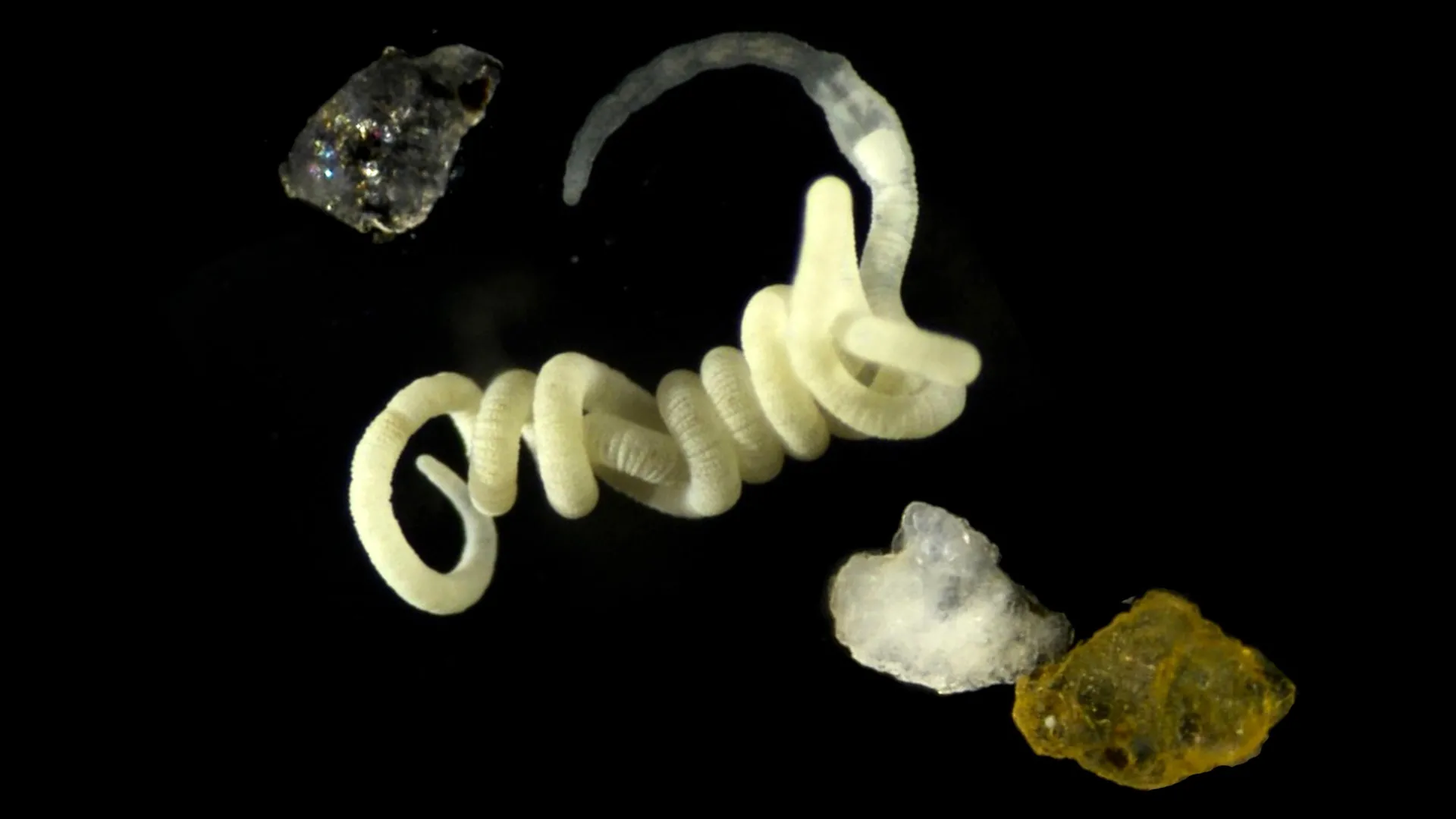
A tiny marine worm has helped overturn a long-standing assumption about how natural plastics move through ecosystems.
The worm, Olavius algarvensis, grows to only around two centimeters long and has no mouth, digestive tract or excretory system. Instead, it survives through a remarkably close partnership with bacteria living beneath its skin.
Now, scientists studying this unusual animal have discovered that it can break down polyhydroxyalkanoates, or PHAs — natural plastic-like compounds produced by microorganisms as stores of carbon and energy.
The findings suggest animals may have been consuming these microbial “bioplastics” for hundreds of millions of years without scientists realizing it.
Bacteria Were Making Bioplastics Long Before Humans
Long before people began manufacturing plastic, bacteria and archaea were already producing their own biodegradable materials.
PHAs are compounds made naturally by microorganisms when they have more carbon available than they immediately need.
The microbes store these materials inside their cells and can later use them as energy reserves.
Scientists had generally assumed that microorganisms were also the main organisms capable of breaking PHAs back down.
New research from the Max Planck Institute for Marine Microbiology in Bremen, Germany, challenges that idea.
An Unusual Worm Provided the First Clue
The investigation began with Olavius algarvensis, an extraordinary marine worm that lacks both a mouth and gut.
Instead of eating conventionally, the worm depends on symbiotic bacteria living just beneath its skin.
These microbes provide much of the nutrition the worm needs, and the animal can digest some of its bacterial partners to obtain energy.
Researchers became especially interested in one symbiotic bacterium that stores large quantities of PHA.
That raised a simple question: could the worm somehow access all of that stored energy?
Researchers Discover a PHA-Digesting Enzyme
The answer appears to be yes.
Scientists identified an enzyme produced by the worm that can break down microbial PHAs into smaller molecules that the animal can use.
High-resolution imaging showed that this enzyme is produced in the same region where the worm digests its bacterial partners.
That strongly suggests O. algarvensis can unlock the carbon and energy stored inside the bacteria’s PHA reserves.
The Ability Is Not Limited to One Species
What initially looked like a highly specialized adaptation in one unusual marine worm soon turned into something much bigger.
Researchers searched animal genomes for related enzymes and found them in more than 66 species spanning nine different animal phyla.
That means the ability may be scattered across remarkably distant branches of the animal kingdom.
Laboratory experiments strengthened the case.
Enzymes taken from animals as different as sponges, earthworms and springtails were also capable of breaking down microbial PHAs.
A Hidden Ability Across the Animal Kingdom
For the research team, this broader discovery was particularly surprising.
A process first uncovered in a gutless marine worm turned out to be shared by many unrelated animals.
The finding suggests that animals may have been tapping into microbial PHA stores for a very long time.
Rather than representing an obscure biological curiosity, PHA digestion could be part of a much wider ecological process.
What Exactly Are PHA Bioplastics?
PHAs are natural polymers produced by microorganisms.
In the wild, microbes use them as reserves of carbon and energy.
Humans have also learned to manufacture PHAs on an industrial scale by growing bacteria in fermentation tanks and supplying them with carbon-rich materials such as plant oils, sugars or starches.
Under suitable conditions, the bacteria accumulate large quantities of PHA, which can then be extracted and turned into plastic-like products.
PHAs Are Already Used in Everyday Materials
PHA-based materials can be molded, resist water and remain stable enough for a variety of practical uses.
They are already used in products such as food packaging and hygiene materials.
In agriculture, PHAs can be used to make beads that slowly release fertilizers as the material breaks down.
Medical uses include wound dressings, drug-delivery systems and materials designed to gradually dissolve inside the body, including some sutures and implants.
Their Biggest Advantage Is Biological Circularity
One reason PHAs attract attention is that they are biologically produced and biodegradable.
Microorganisms create them, and biological processes can break them down again.
Until now, however, animals were not considered major participants in that cycle.
The new research suggests that distinction may have been too simple.
Animals could also play a role in consuming and processing these natural polymers.
Natural PHAs Are Everywhere
PHAs are not limited to industrial production facilities.
They occur naturally in soils, marine sediments and aquatic environments around the world.
Microorganisms produce them whenever conditions allow excess carbon to be stored for later use.
Because PHAs are among the relatively small number of naturally occurring plastics that can be fully biodegraded, researchers are increasingly interested in understanding exactly what happens to them after they enter ecosystems.
A Previously Hidden Route for Carbon
The discovery has implications beyond bioplastics.
PHAs represent stored carbon inside microbial cells.
If animals can digest those reserves, then carbon locked inside microorganisms can pass directly into animal food webs through a pathway scientists had not fully recognized.
That changes the way researchers may need to think about relationships between microbes and animals.
Instead of microbial PHA being accessible only to other microorganisms, it can also become a food and energy source for larger organisms.
Animals May Have Been Doing This for Millions of Years
Researchers suspect this ability is not new.
The enzymes identified across many animal groups suggest that PHA digestion could have deep evolutionary roots.
Animals may therefore have been consuming microbial bioplastics for hundreds of millions of years.
The process was potentially happening throughout evolutionary history while remaining largely invisible to science.
What It Means for the Carbon Cycle
Scientists still do not know how significant animal PHA digestion is on a global scale.
It remains unclear how much microbial carbon moves into animal food webs this way or which ecosystems depend on the process most heavily.
Those questions will require further study.
But the discovery adds an entirely new potential pathway to the biological carbon cycle.
A Tiny Worm Changes a Big Assumption
Olavius algarvensis might not look particularly remarkable at first glance.
Its pale appearance comes from dense communities of bacteria beneath its skin, and its body is barely longer than a few grains of sand.
Yet this tiny worm helped scientists uncover a biological ability spread across dozens of animal species.
What started as a question about how one gutless marine animal feeds itself has revealed something much broader: nature’s original bioplastics may have been part of animal diets all along.