

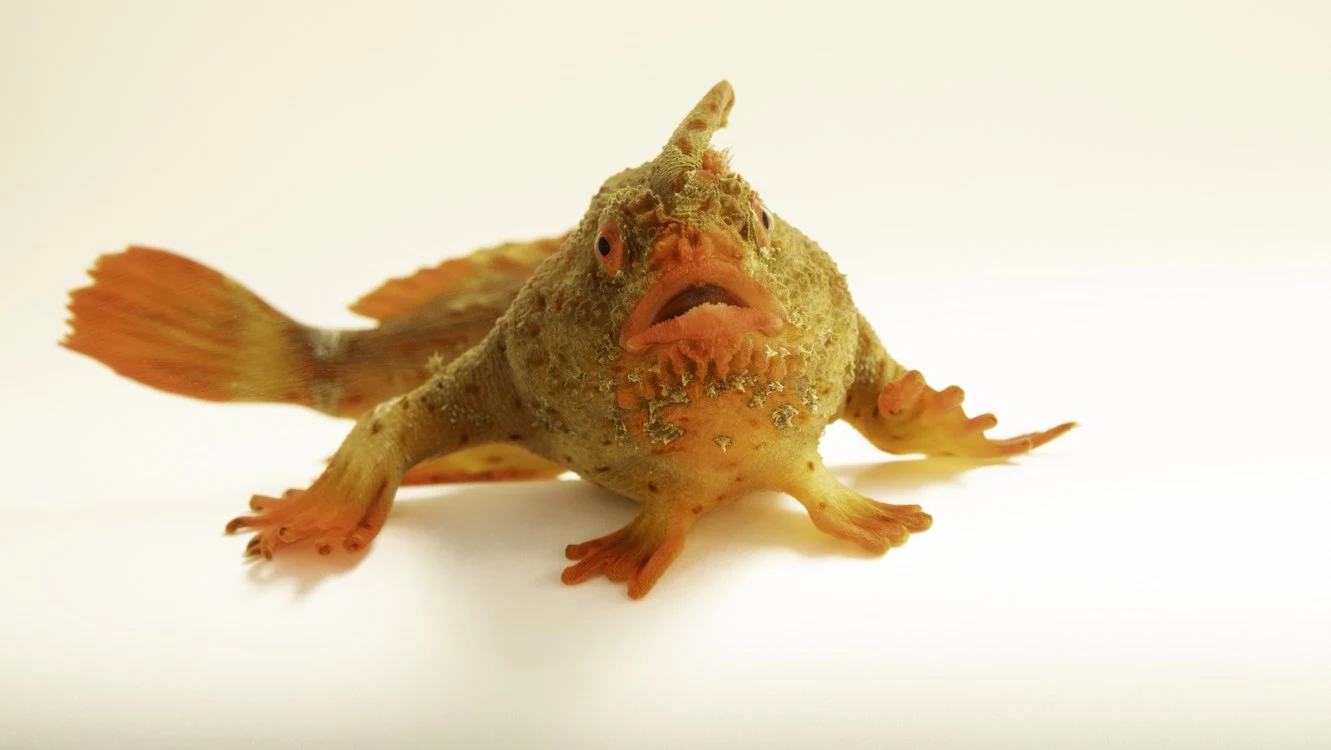
National Geographic describes it as an ocean dweller that moves more like a rock-and-roll frontman than a typical fish.
No bigger than a human thumb and sporting a distinctive red-lipped frown, the critically endangered red handfish has now become the 18,000th species documented by National Geographic’s Photo Ark — a milestone arriving as the project celebrates its 20th anniversary.
National Geographic Explorer, photographer, and Photo Ark founder Joel Sartore photographed the remarkable fish while visiting the Institute for Marine and Antarctic Studies at the University of Tasmania.
The photograph represents another important step in Sartore’s two-decade mission to document species living in human care and inspire people to recognize the extraordinary biodiversity worth protecting.
Sartore launched the Photo Ark in 2006 with a simple but powerful idea: by shining a light on species of every size — particularly smaller animals that are often overlooked — photography could help create a stronger emotional connection between people and wildlife.
For Sartore, the red handfish perfectly represents that mission. Rare, unusual, and critically important to marine biodiversity, the species serves as a reminder that even the smallest and least familiar animals deserve attention and protection.
Red handfish inhabit only a small area of rocky reef along Tasmania’s southeastern coast. Fewer than 250 individuals are believed to remain in the wild.
Unlike most fish, they spend their lives on the ocean floor. Their modified fins function almost like hands, allowing them to “walk” across the seafloor rather than swim through the water.
That unusual method of movement also makes them especially vulnerable. A red handfish may travel only about the length of a standard basketball court over an entire year, severely limiting its ability to escape environmental threats or relocate when its habitat deteriorates.
The species faces pressure from habitat loss, invasive species, human disturbance, pollution, and warming ocean waters. Although the red handfish is one of 14 known handfish species — not all of which are endangered — handfish are considered among the world’s most threatened groups of marine fishes.
Sartore created the Photo Ark to build emotional connections between people and animals and encourage action before vulnerable species disappear.
What began with a single portrait of a naked mole-rat at the Lincoln Children’s Zoo in Nebraska has since grown into a worldwide effort to document both the beauty and fragility of Earth’s biodiversity.
Thousands of Photo Ark portraits are photographed against simple black or white backgrounds. By removing visual distractions and eliminating obvious size comparisons, the images encourage viewers to focus directly on each animal as an individual.
The project’s influence extends beyond raising awareness.
Ian Miller, chief science and innovation officer at the National Geographic Society, says the Photo Ark has helped inspire real conservation efforts by changing the way people see threatened wildlife. Sartore’s portraits demonstrate that when people form a genuine connection with animals, they are more likely to feel motivated to protect them.
As the Photo Ark enters its next 20 years, its legacy is not only the thousands of species Sartore has already documented, but also the possibilities those images create for protecting species that still have a chance to survive.