

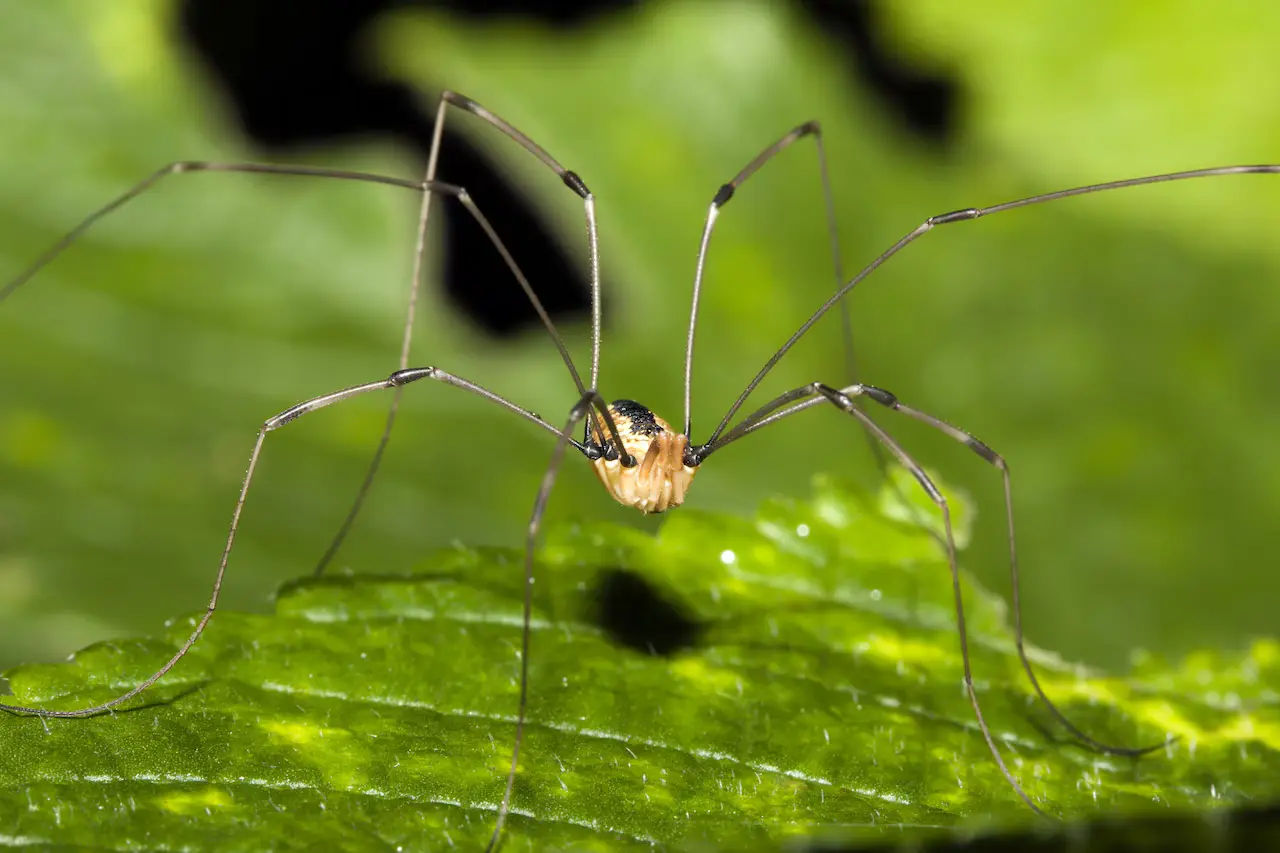
This is a great example of how a popular myth can persist despite being completely false. Here are the key points:
The “Daddy Longlegs” Myth
Many people have heard the claim:
“Daddy longlegs are the most venomous spiders in the world, but their fangs are too small to bite humans.”
This statement is wrong in three different ways.
1. Daddy longlegs are not spiders
Although they are arachnids like spiders, daddy longlegs belong to a different order.
- Daddy longlegs: Order Opiliones
- True spiders: Order Araneae
Key differences
| Daddy Longlegs | True Spiders |
|---|---|
| One fused body section | Two body sections |
| Usually two simple eyes | Usually eight eyes |
| Cannot produce silk | Produce silk |
| No venom glands | Most possess venom glands |
| No fangs | Have fangs (chelicerae) |
As evolutionary biologist Mercedes Burns explains:
“Spiders look like they’re wearing a little corset. Opiliones just let it all hang out.”
Another easy way to tell them apart:
If it’s sitting in a web, it’s a spider. Daddy longlegs don’t build webs because they cannot make silk.
2. They are not venomous
Daddy longlegs do not possess venom glands.
They also lack the hollow fangs used by spiders to inject venom.
Instead, they have tiny mouthparts that work like scissors, allowing them to cut food into small pieces.
They eat:
- insects
- tiny invertebrates
- fungi
- decaying organic matter
- plant material
Since they have no venom at all, they cannot poison or envenom humans.
3. They cannot bite you in any dangerous way
Because they lack venomous fangs:
- they cannot deliver a venomous bite
- they cannot kill a person
- they are essentially harmless
As Burns jokes:
“Their mouthparts look like little scissors.”
Even if you handled one, it poses virtually no danger.
Why are their legs so ridiculously long?
Their anatomy is highly specialized.
Their “knees” (patellae) sit high above the ground, giving them:
- excellent balance
- a very low center of gravity
- flexibility while walking
Each leg contains around 18–20 tiny segments near the end, allowing them to wrap around vegetation almost like flexible fingers.
Even more interesting:
Their second pair of legs is used mostly as sensory organs rather than for walking.
They constantly tap surfaces to:
- feel
- smell
- possibly even taste
their surroundings.
Why do the legs fall off so easily?
This is an adaptation called autotomy.
When grabbed by a predator:
- the leg snaps off cleanly
- the detached leg continues twitching
- the predator focuses on the moving leg
- the daddy longlegs escapes
Because of this strategy, scientists frequently find individuals missing several legs.
Surprisingly, they can still walk effectively with:
- seven legs
- six legs
- five legs
- even four legs
A remarkably successful design
Daddy longlegs may look fragile, but evolution clearly disagrees.
The oldest known fossils of Opiliones are approximately 405 million years old.
What’s astonishing is that their basic body plan has changed very little over that enormous span of time.
Mercedes Burns explains that while they are not “living fossils” (because living species continue evolving), their long-term anatomical stability shows that their design has been exceptionally successful.
Quick Facts
- 🕷️ Not spiders.
- ☠️ Not venomous.
- 🦷 No venomous fangs.
- 🕸️ Cannot build webs.
- 👀 Usually have only two simple eyes.
- 🦵 Can intentionally shed legs to escape predators.
- ⏳ Have existed for about 405 million years.
- ✅ Completely harmless to humans.
So the famous “most venomous spider with tiny fangs” story is entirely fictional. Daddy longlegs are peaceful, ancient arachnids whose greatest defense isn’t venom—it’s their remarkable ability to sacrifice a leg and run away.