

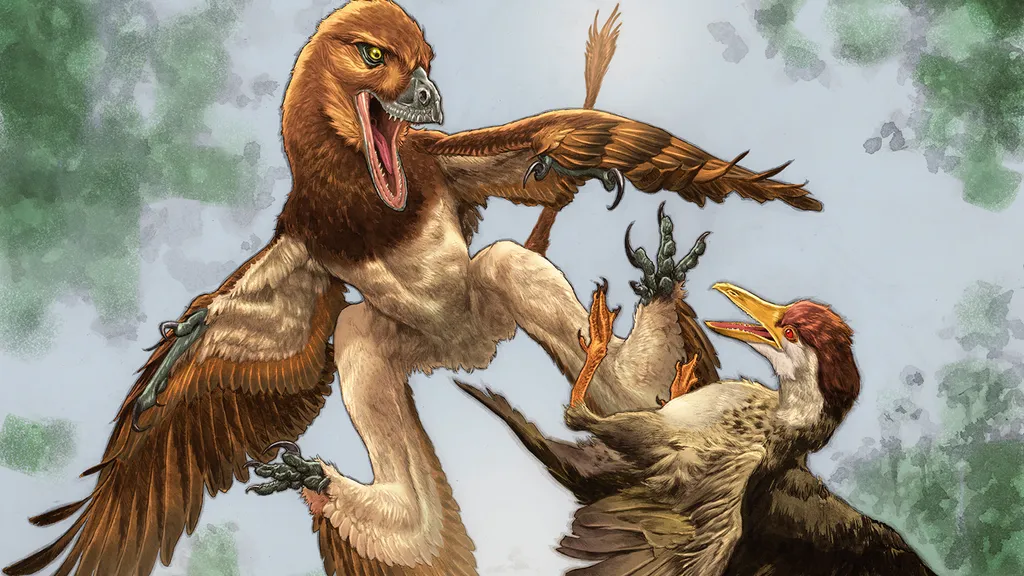
A newly identified feathered dinosaur with four wing-like limbs may once have moved through the lakeside forests of what is now northwestern China, gliding between trees and hunting some of the earliest birds.
The species, named Jian changmaensis, was closely related to Velociraptor and belonged to a group of small, birdlike dinosaurs known as microraptors. Unlike the oversized, scaly raptors often shown in movies, microraptors were light, feathered animals that likely used gliding to move through their environment.
Fossil evidence suggests that J. changmaensis had long feathers not only on its arms but also on its legs, giving it a four-winged appearance. This unusual body shape would have made it look almost like a small dragon as it moved through the trees.
The fossil, described on June 4 in the journal Annals of Carnegie Museum, consists only of part of the dinosaur’s left shoulder and forelimb. Even so, researchers say the bones were distinctive enough to identify a new species. The discovery may also help explain a mystery from China’s Changma Basin, where scientists have found many ancient bird fossils along with broken bird bones resembling the regurgitated pellets produced by modern owls.
According to Matthew Lamanna, a dinosaur researcher and curator of vertebrate paleontology at the Carnegie Museum of Natural History, more than 100 bird fossils have been collected from Changma, but this is the only non-avian dinosaur specimen recovered there so far. He noted that microraptors are especially valuable because they offer clues about what the closest relatives of the first birds were like and how flight may have evolved.
A Rare Find Among Bird Fossils
Paleontologists discovered the fossil in the Lower Cretaceous Xiagou Formation near Changma village in Gansu province. These rocks date to roughly 124 million to 120 million years ago, when the region contained a large lake surrounded by life. Birds, fish, turtles and other animals lived in the area during the early Cretaceous Period.
Changma is already famous for fossils of Gansus yumenensis, one of the first Mesozoic birds discovered in China. Since 2002, researchers have recovered more than 100 partial bird skeletons from the site. Some of these fossils even preserve soft tissues such as feathers, skin and claw coverings.
Lamanna described Changma as one of the world’s most important fossil bird sites. But until this discovery, researchers had not found a non-bird dinosaur fossil from the basin.
That is what makes Jian changmaensis so notable. The specimen includes a fused shoulder blade, upper arm, radius and ulna. Unlike many microraptor fossils that are flattened in rock, this one was preserved in three dimensions.
Jingmai O’Connor, associate curator of fossil reptiles at the Field Museum in Chicago and a co-author of the study, said Jian is among the largest microraptors ever discovered. The preserved part of its upper arm is about 4 inches, or 10 centimeters, long. Based on that measurement, the dinosaur may have had a wingspan of around 4 feet, or 1.2 meters — roughly comparable to that of a barn owl.
Microraptors were not true birds, but they were close relatives of the dinosaur lineage that eventually produced birds. Their bodies combined features seen in both birds and non-avian dinosaurs, including feathers, claws and sickle-shaped raptor feet.
A Predator in the Trees
The Changma Basin may have provided ideal hunting grounds for a gliding predator like J. changmaensis. The site contains many early bird fossils, as well as pellet-like clusters of broken bird bones. Researchers cannot prove that Jian produced those pellets, but the possibility is intriguing.
So far, Jian is the only non-bird dinosaur body fossil found at Changma. It was also a carnivore and much larger than the birds preserved at the site, making it a plausible predator.
Other microraptor fossils strengthen this interpretation. Some have been found with fish, lizards, mammals and birds preserved in their stomach contents. This suggests that microraptors were opportunistic hunters that ate a wide range of prey rather than specializing in a single food source.
For J. changmaensis, early birds may have been easy targets. If the dinosaur lived partly in trees and used its feathered limbs to glide, it could have ambushed birds from branches or moved through the canopy in a way similar to a flying squirrel or sugar glider.
Still, much about Jian remains unknown. The fossil includes only shoulder and forelimb bones, so scientists cannot yet reconstruct the whole animal in detail. Lamanna said the find is enough to show that an unusual microraptor lived in northwestern China about 120 million years ago, but more fossils will be needed to fully understand it.
For now, Jian changmaensis adds another fascinating piece to the story of how feathered dinosaurs experimented with flight-like movement before true birds came to dominate the skies.