

Even after many years of searching, scientists still have not found usable dinosaur DNA. Today, most paleontology work continues to focus on fossils and any original organic traces that may remain inside them, but DNA itself appears unable to survive across such enormous spans of time.
Most of what researchers know about dinosaurs comes from their fossilized bones and teeth. These hard body parts are more likely to survive fossilization, but they can only tell part of the story. They reveal size, shape and some signs of injury, but they do not always show how dinosaurs moved, healed or behaved in life.
Soft tissues can offer much deeper clues. Fossilized remains of skin, feathers, scales, muscles, ligaments or pigments can help scientists better understand what dinosaurs looked like and how their bodies worked. In rare cases, delicate structures inside bones, such as blood vessels, can also be preserved.
A research team recently identified preserved blood vessels inside a fossil from a Tyrannosaurus rex. Their study, published in Scientific Reports, shows how modern imaging technology can reveal hidden details inside ancient bones.
The discovery began with physics. While studying at the University of Regina, an undergraduate physics student joined a team using particle accelerators to examine fossils. During a 3D scan of a T. rex bone, they noticed tiny internal structures that looked like blood vessels.
Years later, that early observation became part of a larger research project. Now continuing the work as a PhD student, the researcher uses physics-based tools to study fossils in ways that do not damage them.
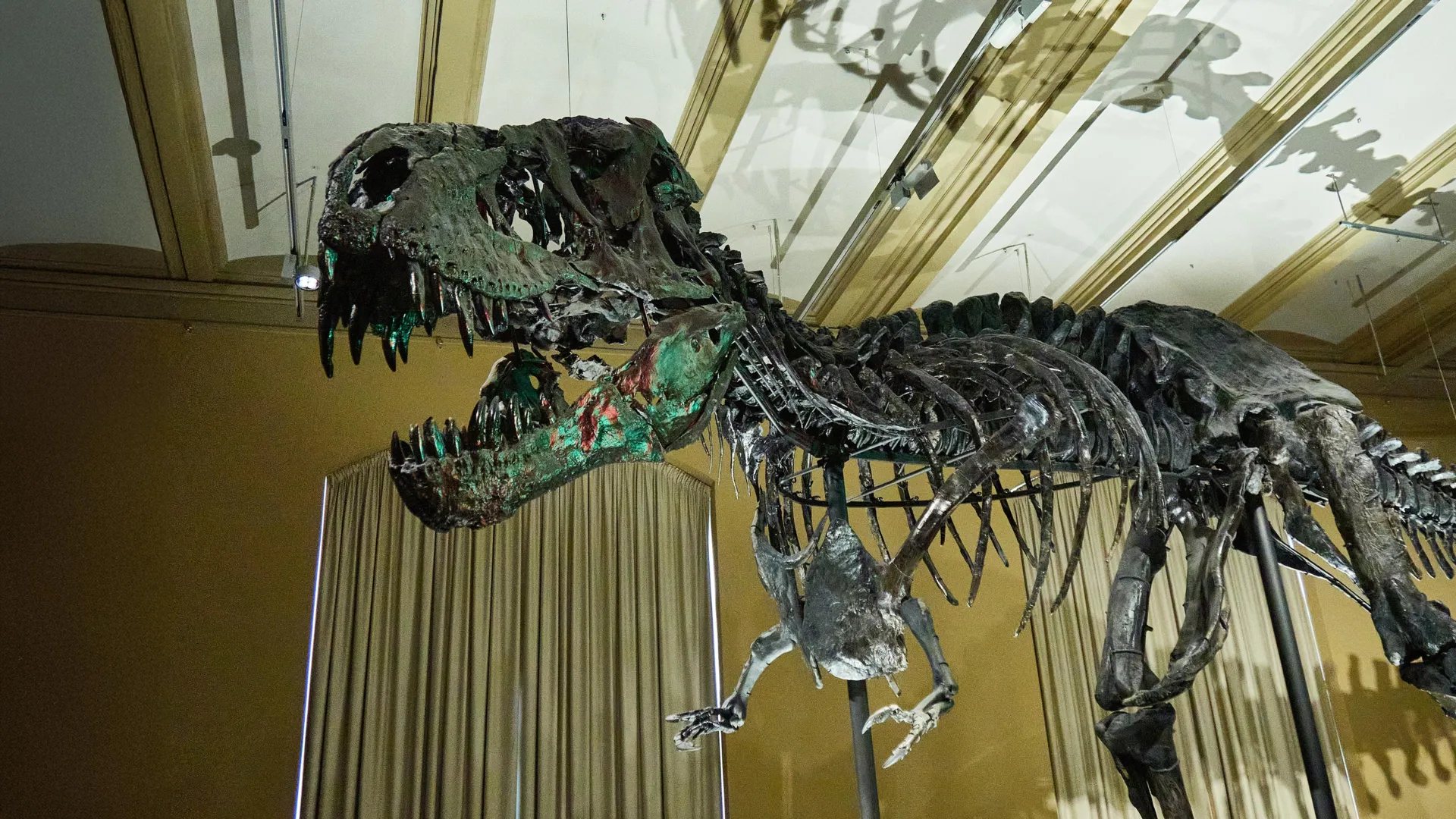
The fossil came from a famous T. rex known as Scotty. Kept at the Royal Saskatchewan Museum in Canada, Scotty is considered the largest T. rex ever discovered and is also one of the most complete specimens.
Scotty lived around 66 million years ago, and the fossil shows evidence of a rough life. Several bones contain signs of injury, possibly caused by fights with other dinosaurs or by illness. One rib was especially interesting because it had a large break that had only partly healed.
When a bone is injured, blood flow increases around the damaged area to help repair it. The structures found inside Scotty’s rib appear to be connected to that healing process. Researchers reconstructed them in 3D and found a dense network of mineralized vessels.
Looking inside fossil bones is difficult for two main reasons. Scientists must avoid damaging valuable specimens, and fossil bones are often extremely dense because minerals have replaced much of the original material over millions of years.
At first, the team considered using a CT scan, similar to the kind used in hospitals. However, regular CT scanners are not powerful enough to clearly see through large, dense dinosaur fossils.
Instead, the researchers used synchrotron light, an intense form of X-ray radiation created at particle accelerator facilities. This method allowed them to see tiny structures hidden inside the bone with far more detail.
Synchrotron imaging also helped the team study the chemistry of the preserved vessels. They found that the blood vessel shapes had been replaced by iron-rich minerals, forming natural casts of the original structures. The vessels appeared in two separate layers, suggesting that the fossil went through a complicated preservation process.
The discovery offers a rare look at how a giant predator like T. rex may have healed after injury. By studying Scotty’s damaged rib and the preserved blood vessels inside it, scientists can learn more about dinosaur biology, recovery and survival.
These findings may also help researchers decide which fossils are most likely to contain similar preserved tissues. Bones showing injuries or disease could be especially promising, since healing areas may once have had more blood vessel activity.
By combining paleontology with physics and advanced imaging, scientists are uncovering details that were once hidden deep inside fossils. Even without dinosaur DNA, discoveries like this are helping bring ancient animals into sharper focus.