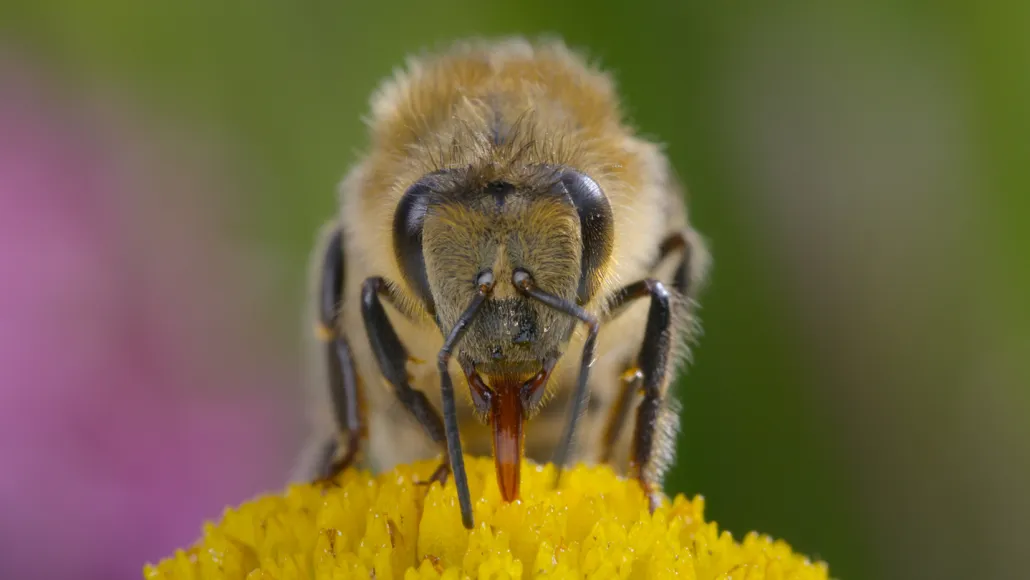
In a wildflower meadow stands a simple tan box with a sloped roof, easy to overlook at first glance. But inside, life is already buzzing. Spring warmth has stirred the honeybees within, and from one wax cell, the first young bee of the season emerges.
Known as Worker Bee One, she begins a short but vital life. She will help care for developing larvae and gather nectar and pollen, joining her sisters in the endless effort to store enough honey to survive the next winter. Her journey, along with the stories of many other bees, is featured in Secrets of the Bees, the newest installment in the Secrets of documentary series from executive producer James Cameron.
Narrated and filmed by Bertie Gregory, the two-part series explores what he calls the hidden world behind the familiar hum of bees. Although Worker Bee One and her colony provide the central thread, the documentary also branches out to feature other remarkable bee species chosen from the more than 20,000 found around the world. Together, the episodes celebrate both the brilliance of these insects and the many dangers they now face. The series debuts March 31 on National Geographic and April 1 on Disney+ and Hulu.
As Gregory walks through the meadow toward the hive, he admits he once underestimated bees. He now sees that as a huge oversight, arguing that despite their tiny size, they may be among the most important animals on Earth.
The documentary points out that bees play a major role in pollinating much of the food humans eat. While that common statistic simplifies a bigger picture that also includes other pollinators, the central point remains clear: bees are essential to ecosystems and human life alike.
The first episode focuses on wonder. Viewers follow Worker Bee One as she learns to build honeycomb and begins foraging for nectar and pollen. Along the way, the documentary introduces other unusual bee species, including vulture bees in Ecuador, which make honey using nutrients from decaying animal flesh.
The film also highlights the surprising intelligence of bees. Some have demonstrated the ability to play with objects or solve simple problems in laboratory settings, while others show inventive behavior in the wild. In Japan, honeybees are shown using leaves to help mask the scent of their hive from attacking murder hornets. According to entomologist Samuel Ramsey, a scientific adviser on the series, this is the first time such leaf use has been documented, expanding what scientists know about bee behavior.
The second episode turns toward the threats bees face. In Ramsey’s lab, viewers meet honeybees with exceptional grooming habits, a trait that may help colonies fight off varroa mites. These parasites can spread harmful viruses and contribute to colony collapse, making resistance especially important. Watching some bees naturally manage that threat, Ramsey says, offers a rare and encouraging glimpse of hope.
At the same time, the documentary notes that honeybees themselves can become a problem when introduced outside their native regions of Europe, western Asia, and Africa. Because they communicate so effectively and work together so efficiently, they can outcompete native bee species in other parts of the world. One example comes from a rooftop garden in London, where a male wool carder bee spends more time defending his territory from honeybees than seeking a mate.
Even though honeybees are not native everywhere they are found today, they have become deeply tied to human agriculture and environmental health. Their close connection to people also makes them a warning sign when pollinators as a whole are in danger. Scientists estimate that as many as a quarter of bee species are declining. The documentary mentions that concern, though it does not spend much time on the human causes behind it, such as habitat destruction, pesticides, and climate change.
The series closes on a more hopeful note by spotlighting people working to protect bees. In Mexico, members of a Maya community are reviving the tradition of keeping stingless Melipona bees, once common across the Yucatán Peninsula. In Oregon, a beekeeper has turned 450 acres into a wildflower meadow that supports not only honeybees but also native bee species.
In the end, Secrets of the Bees succeeds by making bees feel both astonishing and worth defending. It uses beauty and curiosity to remind viewers that these small creatures matter far more than many people realize.