

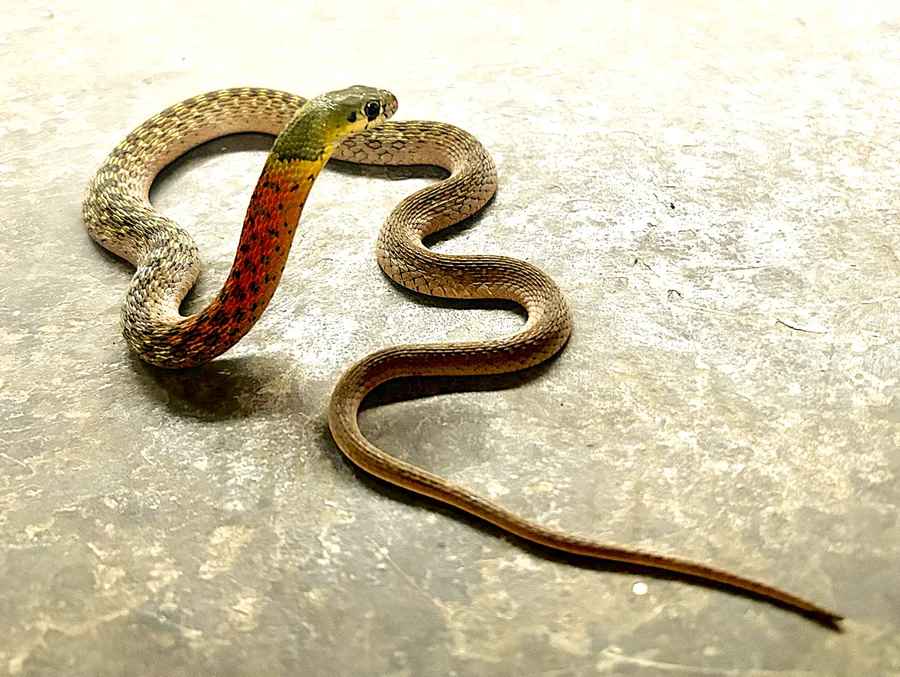
Red-necked keelback snakes carry a powerful toxin — strong enough to blind a mongoose and stop its heart within minutes. But there’s a twist: they don’t produce this poison themselves.
Instead, they steal it.
Borrowing poison from prey
After eating toxic toads, these snakes absorb poisonous compounds through their intestines. The toxins are then stored in special sacs in their necks, called nuchal glands.
Armed with this chemical defense, the snakes become bold. When threatened, they lift their heads and flare their necks, almost daring predators to attack.
But that confidence doesn’t always last.
If they haven’t eaten toxic prey recently — and instead consumed harmless animals like frogs or fish — they’re more likely to retreat.
Testing their awareness
Scientists once believed these snakes could sense how much toxin they had stored and adjust their behavior accordingly — much like venomous snakes that produce their own poison.
To test this, researcher Tomonori Kodama and his team studied 23 wild red-necked keelbacks. Some were fed toxic toads, while others ate non-toxic frogs.
The researchers then simulated predator attacks and observed the snakes’ reactions. Later, they physically emptied the snakes’ toxin glands and repeated the experiment.
A surprising discovery
The results were unexpected.
Even after their toxin stores had been drained, the snakes behaved just as boldly as before — displaying the same defensive posture rather than fleeing.
This suggests that the snakes don’t actually know when their toxin reserves are depleted.
So how do they decide?
Scientists now think the snakes may rely on memory instead.
Rather than sensing how much toxin they have, they might base their behavior on what they’ve eaten recently — assuming they’re still protected if they last consumed a toxic toad.
Why it matters
Researchers aren’t yet sure why these snakes don’t monitor their toxin levels.
One possibility is that, in the wild, they replenish their toxins often enough that running out isn’t a common problem.
Either way, the findings reveal an unusual survival strategy — one where confidence doesn’t necessarily match reality.