

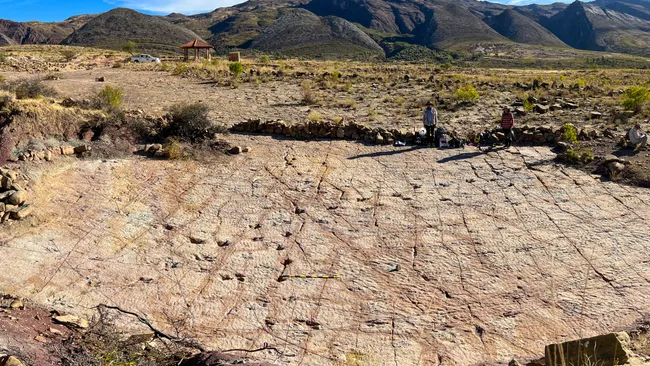
Researchers have counted 16,600 fossilized dinosaur footprints and 1,378 swim tracks at a site in Bolivia that showcase a variety of behaviors and different theropods from the Cretaceous period.
Record-Breaking Dinosaur Footprints Found in Bolivia’s Ancient Coastline
Scientists have uncovered the world’s largest collection of dinosaur footprints and swim tracks at a national park in central Bolivia, setting a new global record.
The discovery was made at a site known as Carreras Pampa, located inside Torotoro National Park. According to new research published in PLOS One, the area was once part of an ancient coastline, with ripple marks preserved alongside thousands of fossilized tracks that run in a northwest–southeast direction.
Most of the footprints belong to theropods — two-legged, three-toed carnivorous dinosaurs that lived near the end of the Cretaceous Period, between 145 and 66 million years ago. Researchers also found numerous fossilized bird tracks at the same site.
“This is now the largest single dinosaur tracksite ever documented,” said study co-author Dr. Jeremy McLarty, a paleontologist and associate professor at Southwestern Adventist University in Texas. “It also contains more preserved dinosaur swim trackways than any other known location in the world.”
Tens of Thousands of Ancient Tracks
After carefully clearing debris and loose rock from the site, the research team documented:
- 16,600 theropod footprints
- 1,378 fossilized swim tracks
The site covers about 80,570 square feet (7,485 square meters). Although the area had been known to scientists before, it had never been studied in detail until now.
The footprints varied greatly in size and shape, suggesting that multiple species — and possibly different age groups — of dinosaurs walked this ancient shoreline.
Some footprints measured less than 4 inches (10 cm), which is unusual in the fossil record. These may have been left by very small dinosaurs like Coelophysis or by juveniles of larger species.
Larger prints measuring over 12 inches (30 cm) likely came from medium-sized theropods such as Dilophosaurus or Allosaurus. For comparison, massive predators like Tyrannosaurus rex typically leave footprints closer to 16 inches (40 cm) long.
Evidence of Dinosaur Behavior
What makes Carreras Pampa especially unique is the wide range of preserved behaviors. The trackways show dinosaurs:
- Walking
- Running
- Swimming
- Dragging their tails
- Making sharp turns
The swim tracks appear as straight or curved, comma-like grooves carved into the ancient sediment. The main groove was likely made by the middle toe scraping the bottom of shallow water, while smaller side grooves came from the other toes.
Unlike most fossil sites, where swim tracks appear randomly, many of the tracks here form alternating left–right sequences, indicating purposeful movement through water.
The team used strings and markers to map individual trackways and group related footprints together during their analysis.
A Prehistoric Dinosaur Highway
The density and alignment of the tracks suggest that the area once functioned as a major dinosaur travel corridor. Some sets of parallel trackways may even indicate that dinosaurs were moving in groups.
Bolivia is already known as one of the world’s richest regions for dinosaur tracks. The country’s Cal Orck’o site previously held records for track density, but that location is arranged as a tall, narrow rock wall inside a quarry. Carreras Pampa, by contrast, is spread across a broad, open surface.
“This new site is not only the largest— it’s also one of the most diverse in terms of preserved dinosaur behavior,” McLarty said.