

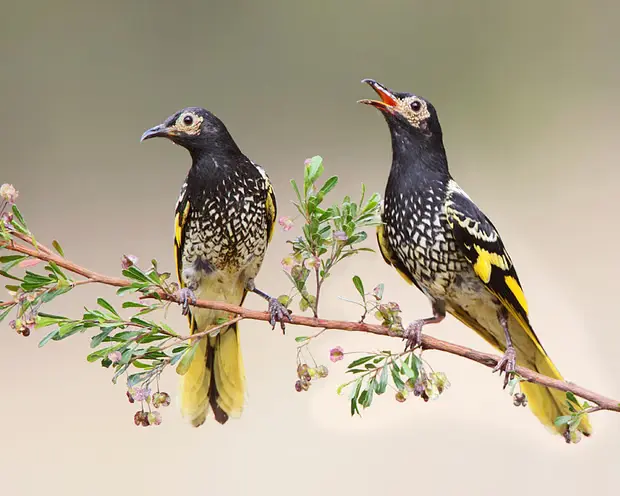
Scientists have successfully revived the fading call of the critically endangered Regent honeyeater — one of Australia’s rarest birds.
Once common across south-eastern Australia, from Queensland to Kangaroo Island, regent honeyeaters are now mostly restricted to the Blue Mountains. With fewer than 250 birds left in the wild, their population crash has led to an unexpected consequence: the loss of their traditional song.
As numbers dwindled, the birds’ once-complex melody was replaced by a shorter, simpler tune — containing roughly half the original syllables. Because male honeyeaters rely on song to attract mates and defend territory, this cultural decline may affect breeding success.
A Captive Breeding Effort
Since 1995, Taronga Zoo has run a captive breeding program for regent honeyeaters. But in recent years, researchers realized that many zoo-bred males were not learning the species’ full traditional song.
Between the 2020–21 breeding seasons and the following two years, scientists launched an ambitious project to restore it.
Why Recordings Didn’t Work
In the first year of the program, researchers played archived recordings of wild regent honeyeater songs to young birds daily for six months.
It didn’t work.
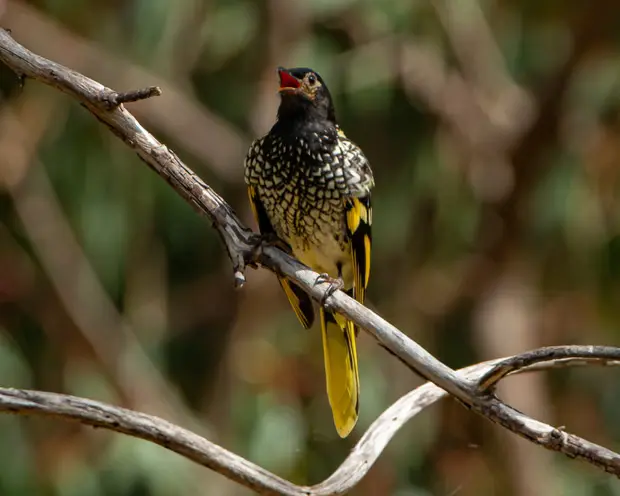
None of the juveniles learned the complete song.
The Power of a Real Teacher
In year two, the team tried a new approach: live tutors.
Two wild-born male honeyeaters were introduced to groups of juvenile males. The results improved dramatically. Researchers also discovered that smaller “class sizes” worked better — about six juveniles per adult tutor.
By the third year:
- The percentage of juveniles mastering the full wild song rose from 0% to 42%.
- Zoo-bred males began teaching the restored song to the next generation.
During the course of the study, the full traditional song actually vanished from the wild — meaning the zoo population became the last remaining source of the original song culture.
Why Song Matters
Male regent honeyeaters use complex vocalizations to:
- Attract females
- Establish territory
- Signal fitness
A simplified song may reduce reproductive success, especially in such a small population.
Researchers hope that restoring the original melody will improve mating outcomes when captive birds are released.
Rebuilding Wild Populations
Since 2000, Taronga and conservation partners have released more than 550 zoo-bred regent honeyeaters into New South Wales and Victoria.
Now, some of those released males carry the revived song.
Scientists are continuing to monitor whether song tutoring improves survival and breeding success in the wild. The ultimate goal is to see captive-bred and wild birds successfully interbreed — something rarely observed in the past.
A Cultural Rescue
The study, published in Nature Scientific Reports, highlights an extraordinary idea: conservation isn’t just about saving bodies — it can also mean saving culture.
For the regent honeyeater, preserving its song may be just as important as protecting its habitat.
And thanks to a handful of patient tutors and years of careful work, a melody once thought lost is now echoing again.