

When people think of animals producing enormous amounts of gas, cows often come to mind.
After all, cattle are famous for the methane generated during digestion, and scientists have spent years studying their contribution to greenhouse gas emissions.
But there’s an unexpected twist.
Most of the methane cows produce doesn’t leave their bodies as flatulence. It escapes through their mouths.
So which animal actually deserves the title of nature’s biggest farter?
According to researchers who study animal digestion, the strongest contenders include horses and even tiny termites.
The answer depends on how scientists measure gas production — and it turns out that keeping track of animal farts is surprisingly difficult.
Scientists Really Do Study Animal Flatulence
It might sound like a strange research topic, but studying digestive gas can reveal important information about how animals process food.
The subject is sometimes humorously called flatology, the study of flatulence.
Gas production is closely connected to an animal’s digestive system and the microorganisms living inside it.
Many animals rely on gut bacteria and other microbes to help break down food.
During digestion, these organisms can produce gases such as methane and carbon dioxide.
Some gas leaves through burping, some through flatulence, and some can be absorbed into the bloodstream and eventually exhaled.
Understanding these processes helps scientists study animal nutrition, digestive health, and environmental emissions.
But identifying the single animal that farts the most is far more complicated than simply measuring methane.
Why Cows Aren’t Necessarily the Biggest Farters
<AsyncImage query=”dairy cows grazing in green pasture countryside natural photography” aspectRatio=”5:3″ width=”100%”/>
Cows are among the best-known animal sources of digestive methane.
They possess a specialized digestive system that allows them to extract nutrients from fibrous plants.
Much of this process takes place in the rumen, a large fermentation chamber near the beginning of the digestive tract.
Inside the rumen, microorganisms break down plant material and produce gas.
Because fermentation occurs relatively early in the digestive process, much of that gas escapes through belching.
This is why scientists distinguish between methane emissions from cattle and actual flatulence.
A cow may release a large quantity of methane without producing an equally impressive amount of intestinal gas from the rear.
That distinction changes the competition considerably.
Animals that ferment food farther along their digestive systems may be more promising candidates.
Horses Could Be Among the World’s Biggest Farters
<AsyncImage query=”brown horse grazing grass in meadow side profile wildlife natural photograph” aspectRatio=”5:3″ width=”100%”/>
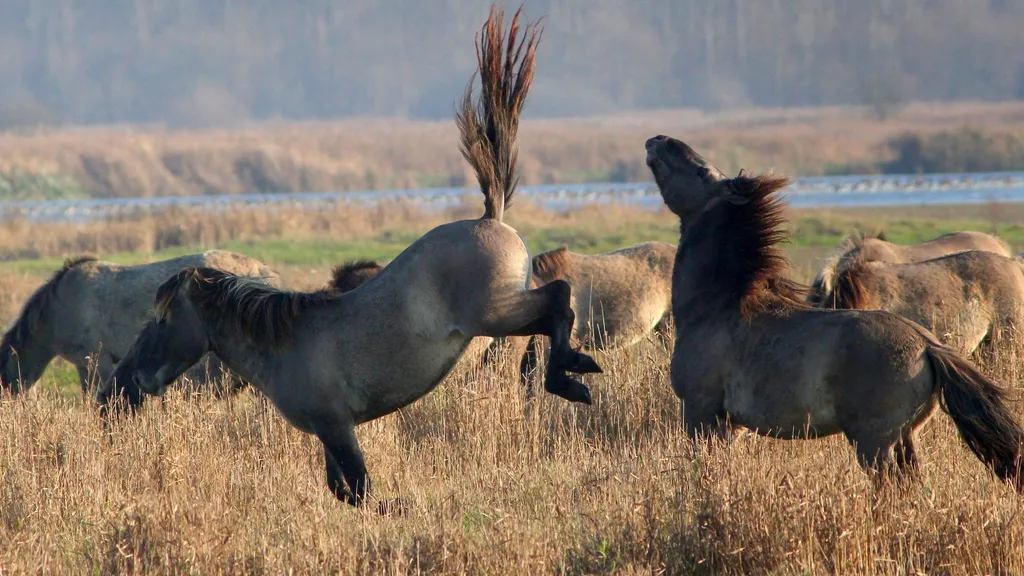
Horses digest plant material differently from cows.
They are known as hindgut fermenters, meaning much of their microbial fermentation occurs in the large intestine and cecum.
These digestive structures are located toward the rear of the digestive tract.
As microbes break down fibrous food, they produce gases that may be expelled through flatulence.
This makes horses interesting candidates for the title of biggest farter.
A 2019 report from the Intergovernmental Panel on Climate Change estimated methane production from horses at approximately 18 kilograms per animal annually.
That figure has been used to compare methane emissions among animals that rely on hindgut fermentation.
However, 18 kilograms of methane production does not mean 18 kilograms of measured farts.
Some gas may leave the body through other routes.
Scientists also haven’t collected equally detailed measurements for every large herbivorous species.
Rhinoceroses and elephants, for example, are also hindgut fermenters.
Without comparable data for all these animals, horses cannot be declared the undisputed champions.
Tiny Termites Are Unexpected Contenders
<AsyncImage query=”macro photograph worker termites feeding on weathered wood close up insect colony” aspectRatio=”5:3″ width=”100%”/>
If horses are serious contenders among large animals, termites present a very different possibility.
These tiny insects consume wood, grasses, and other cellulose-rich plant materials.
They depend on microorganisms in their digestive systems to help break down those materials.
During the process, some termites produce methane.
Individually, their emissions are tiny.
But termites exist in extraordinary numbers across the planet.
Collectively, they are estimated to release roughly 10 million metric tons of methane annually.
Because much of their fermentation occurs in the hindgut, termites are particularly interesting when researchers consider gas released through the rear of the digestive system.
Their enormous populations mean their collective emissions can be substantial.
But there is an important complication.
A significant portion of methane associated with termite activity can be consumed by methane-eating microorganisms in the surrounding soil before reaching the atmosphere.
And estimating total emissions from termites is not the same as counting individual farts.
So while termites may be impressive collective gas producers, scientists still lack enough evidence to place them definitively at the top of a flatulence ranking.
What About Elephants, Rhinos, and Other Animals?
Horses aren’t the only large herbivores with hindgut fermentation.
Elephants and rhinoceroses also rely on microbial digestion farther along their intestinal systems.
Their large body sizes and plant-based diets make them interesting subjects for comparative research.
But there is a shortage of directly comparable gas measurements for many wildlife species.
This creates a major scientific limitation.
Researchers cannot reliably conclude that one species produces the most flatulence when other potential contenders have barely been studied.
Body size also complicates the comparison.
A large animal might produce more gas overall, while a smaller species could produce more relative to its body weight.
For example, researchers have identified the nutria, a semiaquatic rodent, as a species with comparatively high methane production relative to its mass.
That raises another question: should the title belong to the animal producing the most total gas, or the animal producing the most per kilogram of body weight?
The answer could change depending on the measurement used.
Why Is Measuring Animal Farts So Difficult?
Studying animal methane is already technically demanding.
Researchers use specialized equipment to estimate emissions, including respiration chambers and systems that collect breath samples.
Some methods also use tracer gases to help estimate methane production.
These approaches can measure gas released by an animal, but they don’t necessarily determine how much exits through the mouth versus the rear.
That difference is crucial.
Methane readings alone cannot provide an accurate count of farts.
Researchers would need methods that distinguish flatulence from burping and exhalation while accounting for the amount and composition of gas released.
Measuring gas in humans has become increasingly sophisticated, with technologies such as ingestible sensors being investigated.
But applying comparable techniques consistently across animals ranging from insects to rhinoceroses would be a major challenge.
Until then, the world’s most flatulent animal remains an open scientific question.
Do Animal Farts Contribute to Climate Change?
Methane is an important greenhouse gas, which is why researchers study its production by livestock and other animals.
But it is essential to distinguish animal flatulence from broader digestive methane emissions.
In cattle, the majority of methane escapes through belching.
These emissions matter because livestock farming is a significant human-associated source of methane.
Scientists are studying ways to reduce emissions through changes in feed, animal management, and other approaches.
Naturally occurring methane from insects such as termites is part of a different environmental context.
Methane produced underground may also be consumed by soil microorganisms before entering the atmosphere.
As a result, the amount of methane generated inside an animal does not necessarily equal the amount that ultimately reaches the atmosphere.
That distinction matters when studying climate effects.
It also explains why the animal with the biggest methane