

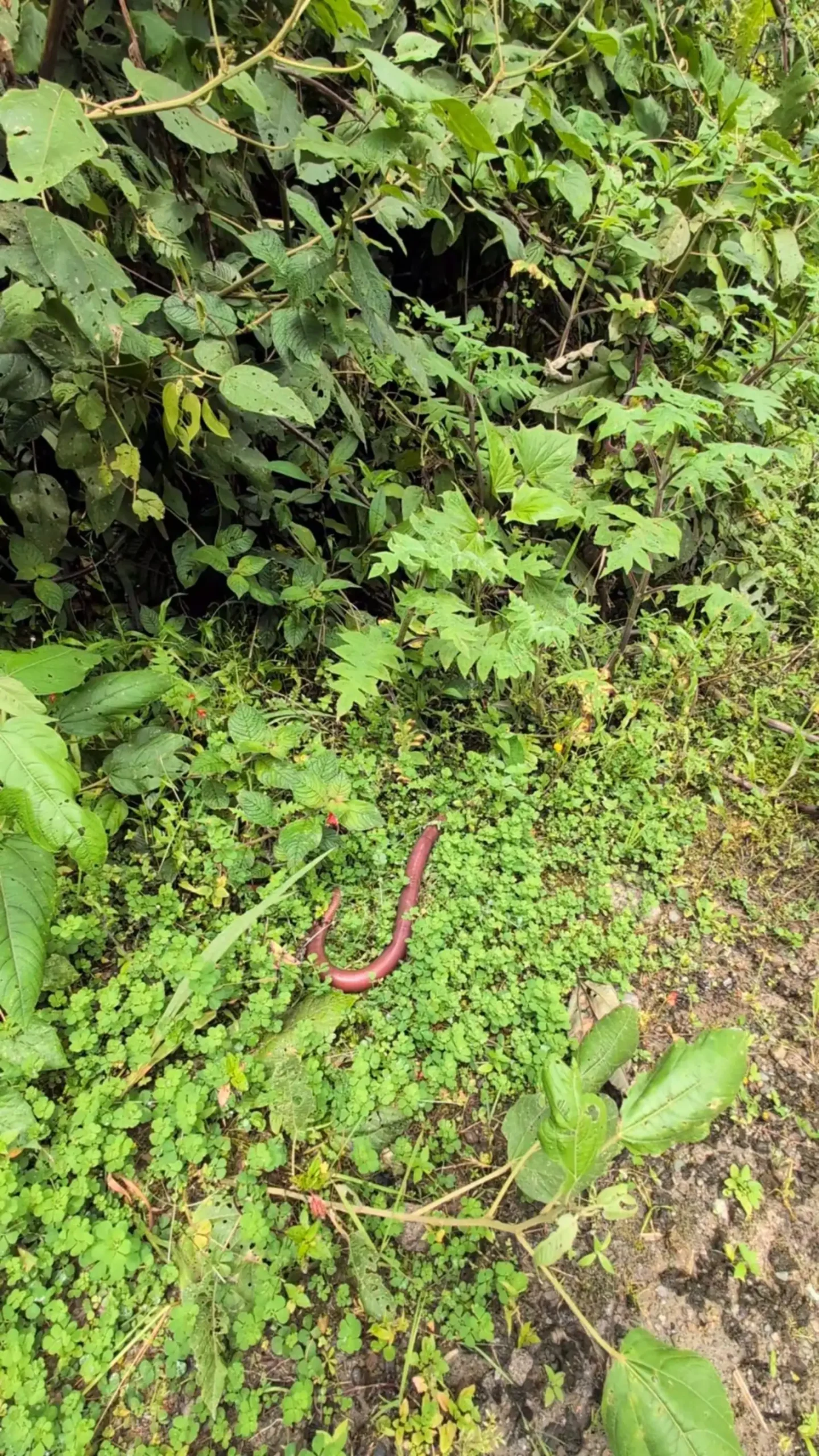
“If you’ve never seen one before, you’d never imagine …”
When Scott and Angie Drake noticed an enormous brown creature beside a road in Ecuador’s cloud forest, their first thought was that they had encountered a snake.
The animal’s long, smooth body stretched across the ground, looking nothing like an ordinary creature someone might expect to find in the forest.
But when the couple stopped for a closer look, they made a surprising discovery.
It wasn’t a snake at all.
It was a giant earthworm — a remarkable invertebrate that can grow to astonishing lengths in parts of South America.
And just when the Drakes thought their wildlife encounter couldn’t get any more unusual, they spotted another enormous worm a few minutes later.
This time, the creature was directly in the path of passing vehicles.
A Strange Creature Appears Along a Cloud Forest Road
Scott and Angie Drake operate Not Your Average American, a sustainable tourism consultancy dedicated to connecting travelers with local communities and businesses throughout South America.
Their work has introduced them to some of the region’s most extraordinary landscapes and wildlife.
But even after spending time living in Ecuador, the couple had never seen anything quite like the animal they encountered on this particular drive.
While traveling through the country’s cloud forest, they noticed a long, brown shape near the roadside.
At first glance, it appeared to be a snake.
The couple stopped to investigate, curious about the unfamiliar creature.
As they approached, they realized it had no scales or recognizable snake-like head.
Instead, the animal had a thick, segmented body.
They were looking at an enormous earthworm.
The sight left both travelers astonished.
Although they had previously heard stories about giant earthworms living in Ecuador’s forests, seeing one in person was an entirely different experience.
They stepped out of the car to take photographs and record the remarkable discovery.
After spending a few moments observing the unusual animal, they continued their journey.
But the surprises weren’t over.
Minutes Later, They Spot Another Giant Earthworm
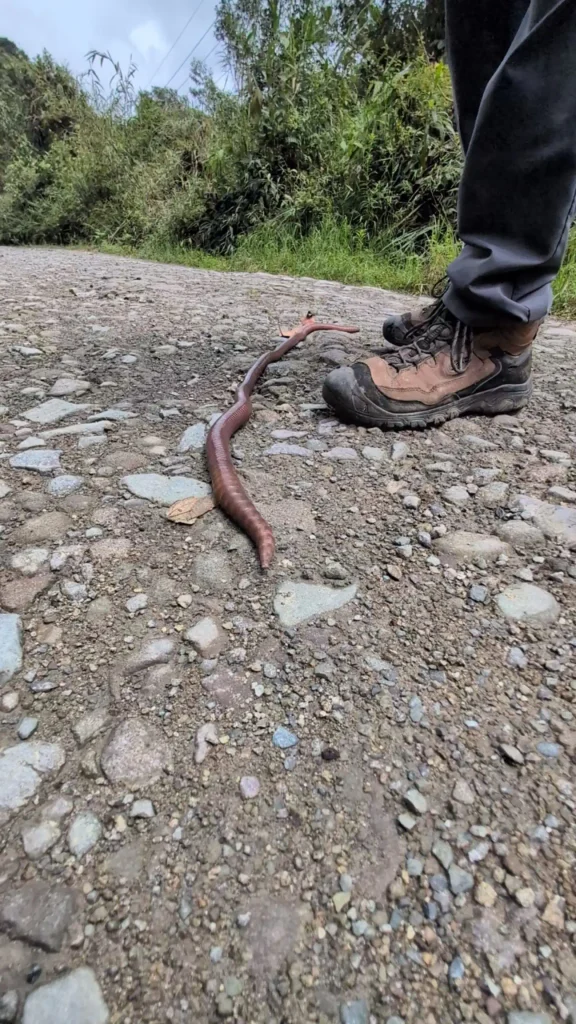
Just a short distance farther along the road, Scott and Angie noticed another strange shape ahead.
It was a second giant earthworm.
Unlike the first animal, which had been near the roadside, this one was moving across the road itself.
The couple immediately recognized the danger.
Earthworms are slow-moving animals, and even a creature of extraordinary size would stand little chance against an approaching vehicle.
A driver unfamiliar with giant earthworms might not recognize the unusual shape until it was too late.
The Drakes decided they couldn’t simply leave the animal in harm’s way.
They stopped their vehicle and approached carefully.
Scott then gently picked up the enormous worm and moved it away from the path of traffic.
Angie captured the brief rescue on video.
Within moments, the giant earthworm was safely beside the road.
What began as an unexpected wildlife sighting had turned into a small but meaningful act of compassion.
Just How Big Can Ecuador’s Giant Earthworms Get?
Most people are familiar with the small earthworms found in gardens and parks.
But some species living in tropical environments can grow dramatically larger.
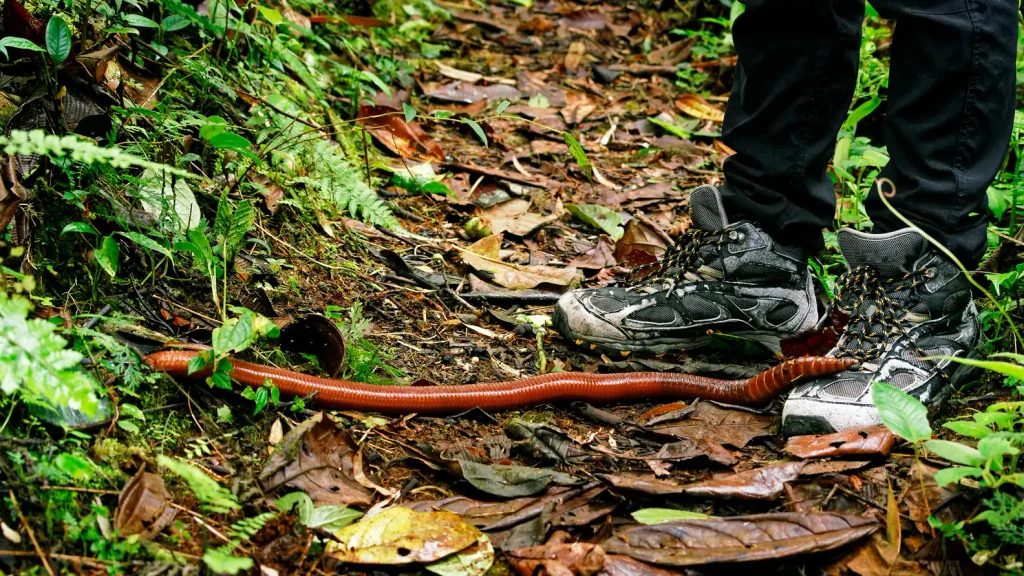
The giant earthworms encountered by the Drakes were identified in the original account as Martiodrilus crassus, a species associated with Ecuador.
Certain giant earthworms reported from the region can reach lengths of several feet, with some accounts describing individuals measuring approximately five to seven feet.
That is long enough to resemble a snake when seen from a distance.
Despite their intimidating size, these invertebrates are not dangerous predators.
Earthworms lack the venomous fangs and other hunting adaptations found in some snakes.
They feed on organic material associated with soil, including decomposing plant matter.
Their segmented bodies allow them to stretch, contract, and move through their surroundings.
Unlike reptiles, earthworms have no backbone, and they rely on their moist skin for gas exchange.
Their unusual anatomy is part of what makes giant earthworms so fascinating.
They may look extraordinary, but they belong to the same broad group of animals as the much smaller earthworms found in backyards around the world.
The Fascinating Wildlife Hidden Beneath Ecuador’s Forests
Ecuador is famous for its biodiversity, with cloud forests supporting an extraordinary variety of animals and plants.
Travelers often hope to see colorful birds, unusual mammals, and rare amphibians.
But some of the region’s most fascinating wildlife lives beneath the forest floor.
Earthworms play an important role in soil ecosystems.
As they move underground and consume organic material, they contribute to processes that influence soil structure and nutrient cycling.
Their tunnels can also affect how water and air move through the soil.
Although these activities usually happen out of sight, they help maintain conditions that support plant growth and other forms of life.
Giant earthworms are especially intriguing because their enormous size makes these normally hidden animals much more noticeable.
Still, spotting one is not an everyday occurrence for most travelers.
For Scott and Angie, encountering two during the same drive made the experience particularly memorable.
A Local Guide Knows Just How Unusual They Are
Jacquie Granda, a tour guide associated with Not Your Average American, has encountered giant earthworms during her work in Ecuador.
She describes them as extraordinary animals whose appearance can be difficult to believe until someone sees one up close.
Their bodies have a soft, flexible texture similar to those of ordinary earthworms, but on a much larger scale.
Their individual segments can also be noticeable.
Those features make them very different from snakes, despite the resemblance at a distance.
For people unfamiliar with these invertebrates, the sight of such an enormous worm moving through the forest can be startling.
But the animals themselves are generally harmless to humans.
Rather than fearing them, visitors can appreciate their role in the ecosystem while allowing them to continue moving through their natural habitat undisturbed.
A Small Rescue Makes a Big Difference
The Drakes’ encounter illustrates an important aspect of wildlife protection.
Not every animal rescue involves a dramatic emergency or a team of professionals.
Sometimes, the difference between safety and danger comes down to someone noticing a vulnerable creature in the wrong place.
For the giant earthworm crossing the road, passing traffic presented an immediate threat.
Scott and Angie recognized the situation and chose to help.
Their simple action gave the animal a chance to continue its journey away from moving vehicles.
Of course, handling wild animals should always be approached with caution.
Earthworms have delicate skin that can be damaged by rough handling or prolonged exposure to dry conditions.
Anyone who encounters wildlife on a road should avoid placing themselves in danger and minimize unnecessary contact with the animal.
In this case, the couple’s intervention was brief, and the worm was moved away from the immediate hazard.
For Scott and Angie, the experience was another reminder of just how surprising nature can be.
One Unexpected Road Trip, Two Extraordinary Encounters
The couple began their journey expecting another opportunity to explore Ecuador’s beautiful cloud forests.
Instead, they encountered two enormous creatures that looked like snakes but were actually giant earthworms.
The first left them amazed by the diversity of wildlife living in the region.
The second gave them an opportunity to help protect one of those remarkable animals.
Their story is a reminder that extraordinary creatures don’t always have feathers, fur, or dramatic colors.
Sometimes, they live quietly beneath the soil, contributing to the natural world in ways most people never see.
And occasionally, one emerges long enough to surprise a passing traveler.
Scott and Angie stopped because they thought they had spotted a snake. What they discovered instead was something just as remarkable — and one little act of kindness gave an extraordinary giant earthworm a safer path back into the forest.