

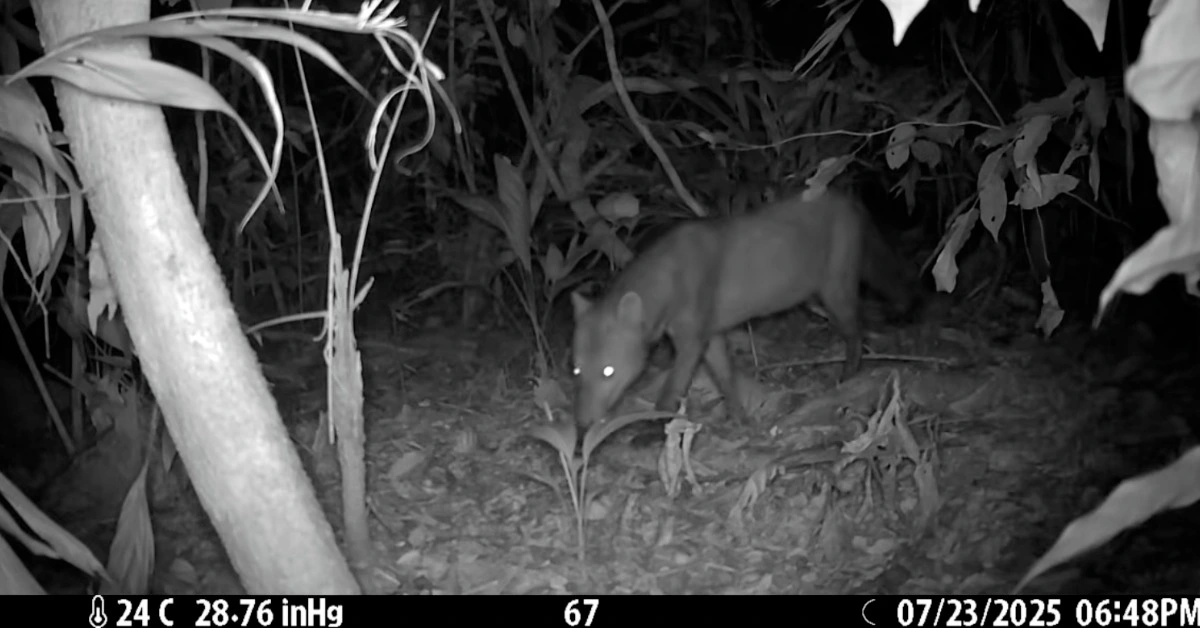
Hidden deep within South America’s tropical rainforests lives one of the world’s most mysterious mammals — a shy, rarely seen canid with short legs, a bushy fox-like tail and partly webbed feet.
Known as the short-eared dog, this elusive animal is often called Latin America’s “ghost dog” in the Amazon Basin. Its sharp hearing, powerful sense of smell and natural avoidance of humans make it extremely difficult for researchers to observe in the wild.
Although the species is listed as endangered in Brazil and Colombia, scientists still do not know exactly how many remain. For years, much of what was known about the animal was based on limited sightings and educated guesses.
Now, a long-term study is giving researchers a clearer look at this secretive predator.
“The short-eared dog (Atelocynus microtis) is one of the world’s least-known canids and one of Latin America’s least-known carnivores,” lead researcher Dr. Robert Wallace wrote in a study published in Neotropical Biology and Conservation on March 27.
Wallace and his team noted that even the animal’s full range and preferred habitats have remained uncertain. However, recent research suggests that short-eared dogs are strongly tied to forested areas, especially upland forests located away from rivers.
To better understand the species, Wallace worked with co-authors Guido Ayala, Maria Viscarra and Zulia Porcel on 34 camera-trap surveys across Bolivia and southeastern Peru between 2001 and 2024.
Over the course of 23 years, the cameras captured 594 recordings of short-eared dogs in the Greater Madidi-Tambopata and Llanos de Moxos regions. The results suggested that the animals may be more common than previously believed, with researchers estimating around 15 individuals per 100 square kilometers.
“The most surprising aspect of the results was that despite being an almost mythical beast, short-eared dogs are much more abundant than we had imagined,” the researchers said in a shared statement.
The study also confirmed the importance of upland forests to the survival of these medium-sized carnivores, which are roughly similar in weight to an average beagle.
Researchers found that short-eared dogs were recorded more often in protected areas and Indigenous territories than in unprotected regions threatened by logging and deforestation.
Their presence is also important for the wider ecosystem. As predators, short-eared dogs help balance populations of animals such as fish, insects, rodents, birds, frogs and crabs across forest floors and riverbanks.
Wallace and his colleagues stressed that protecting Amazonian forest canopy is essential for the species’ future. They said strong protected areas, combined with sustainable management of Indigenous lands, are among the most important conservation strategies.
The study also showed how valuable camera traps can be for studying animals that are almost impossible to observe directly.
Wallace described the research as a powerful example of how conservation technology and remote sensing can reveal new information about one of the Amazon’s least-understood species.