

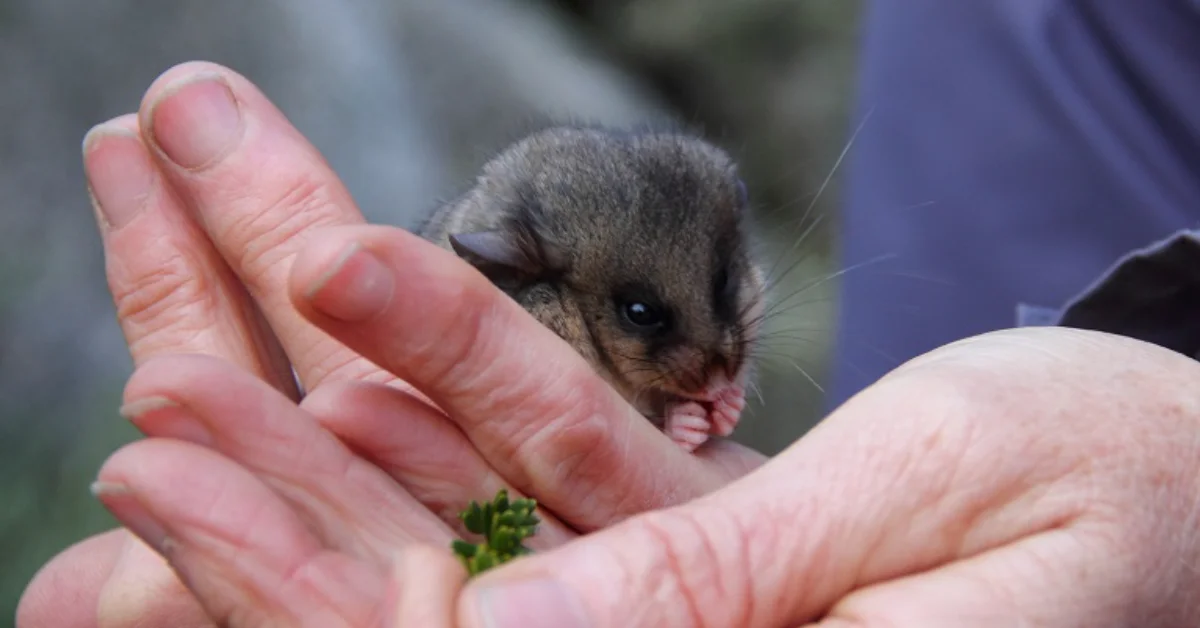
The burramy, better known as the mountain pygmy-possum, plays an important role in Australia’s delicate alpine ecosystems. As the tiny marsupial moves through rocky mountain terrain, it helps spread seeds from native mountain plum-pines and supports the regeneration of local plant life.
Measuring only about four inches long, the animal has a prehensile tail that can actually exceed the length of its body. For years, scientists believed the species had disappeared entirely. That changed in 1966, when living mountain pygmy-possums were discovered at Mount Hotham in Australia’s Victorian Alps.
Since that rediscovery, conservationists have spent decades developing ways to protect and rebuild the population.
One particularly vulnerable group lives near Little Mount Higginbotham, where roughly 150 mountain pygmy-possums were identified. Their habitat, however, had been divided by the Great Alpine Road, a major route stretching about 210 miles through the region.
Jerry Alexander, a natural environment program officer with Victoria’s Department of Environment, Land, Water and Planning, explained that the road had effectively prevented possums from moving freely between habitat on either side.
That separation was especially problematic during breeding season.
Female mountain pygmy-possums generally occupy higher elevations, where they live among alpine boulder fields. Males typically stay farther down the mountain. Because the Great Alpine Road cuts between those areas, crossing it safely can be extremely difficult.
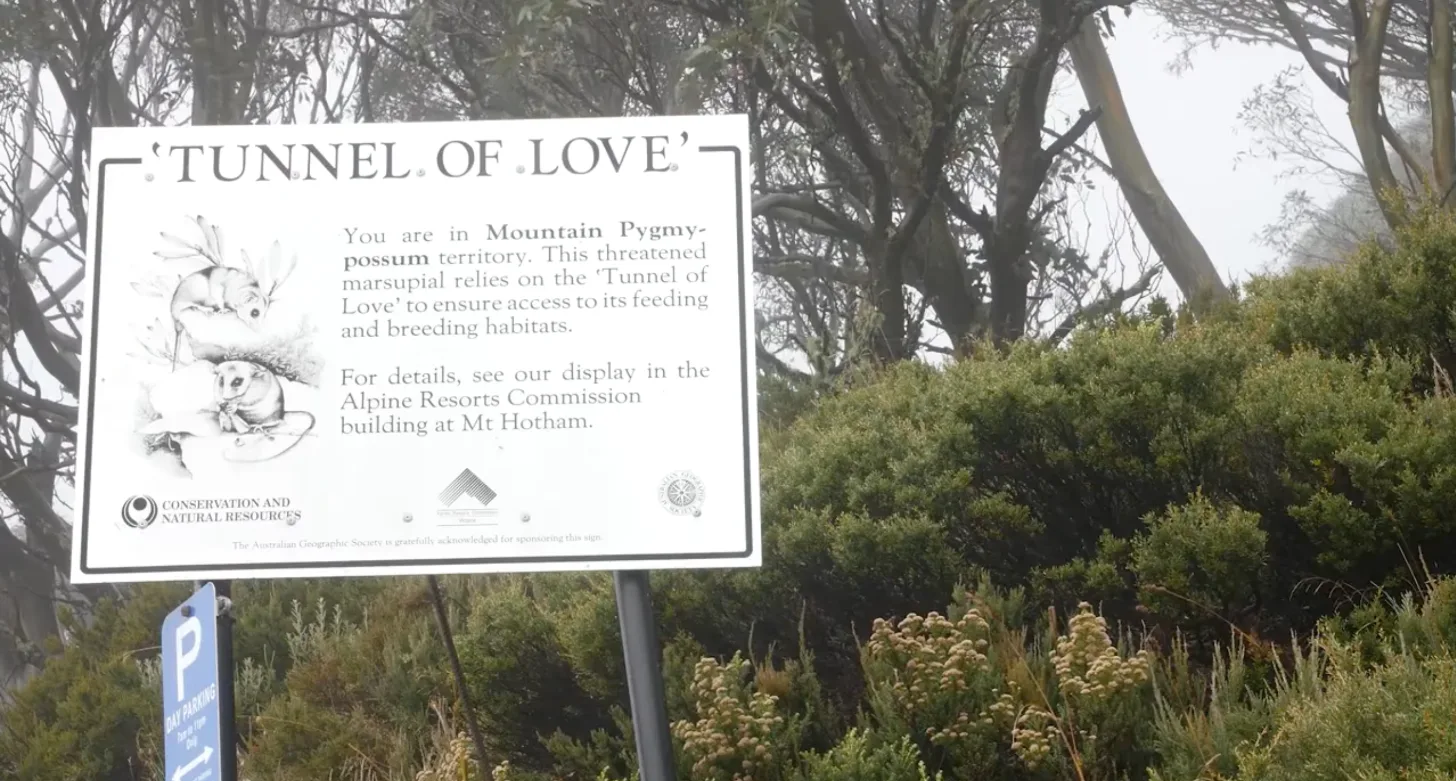
To reconnect the two groups, conservationists created a wildlife passage beneath the roadway. The crossing quickly earned an affectionate nickname: the “Tunnel of Love.”
The purpose of the tunnel was simple — allow male possums to travel safely uphill to reach females without having to cross traffic.
Alexander said improving those connections, combined with habitat restoration and predator management, could increase breeding opportunities and give the critically endangered marsupial a stronger chance of recovery.
A roadside sign reads “TUNNEL OF LOVE” beside an illustration of mountain pygmy-possums.
Victoria Department of Energy, Environment & Climate Action
Evidence suggests the passage is being used.
During monitoring conducted across two summer seasons, researchers documented 30 mountain pygmy-possums traveling through the tunnel. Many crossings occurred during spring, when females had recently emerged from hibernation and breeding activity increased.
The animals can move through the nearly 50-foot passage with remarkable speed. Scientists found that a possum may cross the entire tunnel in approximately 15 seconds — sometimes moving so quickly that monitoring cameras struggle to capture the journey.
Despite conservation progress, the species remains in serious danger.
Fewer than 2,000 mountain pygmy-possums are thought to survive in the wild today. Wildlife corridors and other low-impact conservation measures are important, but captive breeding has also become a major part of efforts to prevent the species from disappearing.
In March, Healesville Sanctuary, operated by Zoos Victoria, announced the arrival of 12 young mountain pygmy-possums through its breeding and research program.
The animals are remarkable for another reason as well: they are Australia’s only marsupials known to undergo true hibernation.
In their natural alpine habitat, mountain pygmy-possums can spend more than five months of the year beneath snow.
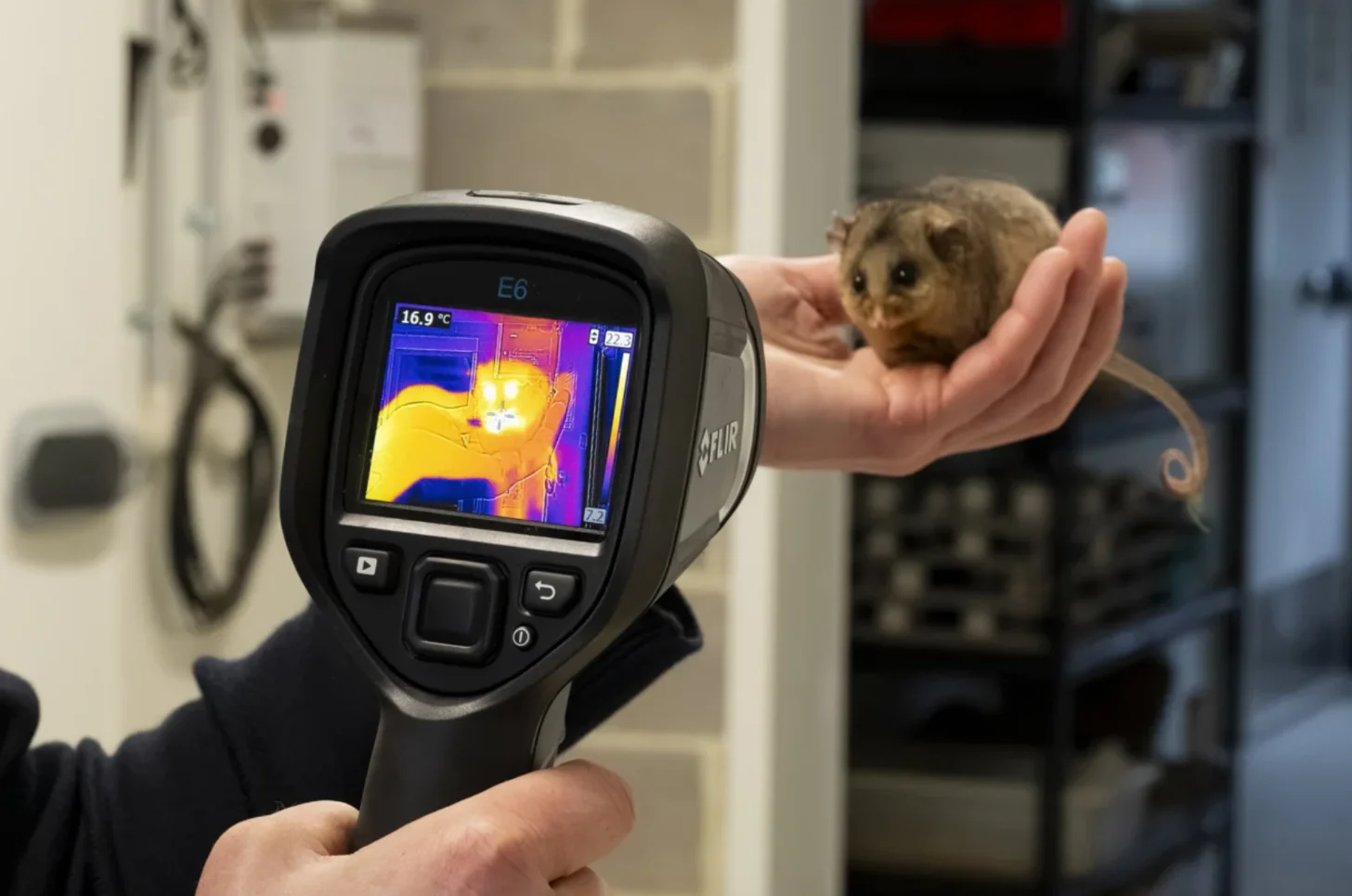
At Healesville Sanctuary, keepers have begun using thermal-imaging cameras to observe the animals during this period without disturbing them unnecessarily.
Jo Howell/Zoos Victoria
Threatened Species Keeper Amie Hindson explained that when a mountain pygmy-possum enters torpor, its body temperature can fall to roughly 2 degrees Celsius.
During this state, the animal curls tightly into a ball, usually tucking its head against its chest or abdomen. Females may even position their noses inside their pouches while resting.
The possums also prepare extensively before winter.
Ahead of hibernation, they can nearly double their body weight, reaching around two ounces. Over the course of winter, they gradually lose much of that stored mass and emerge close to half their pre-hibernation weight.
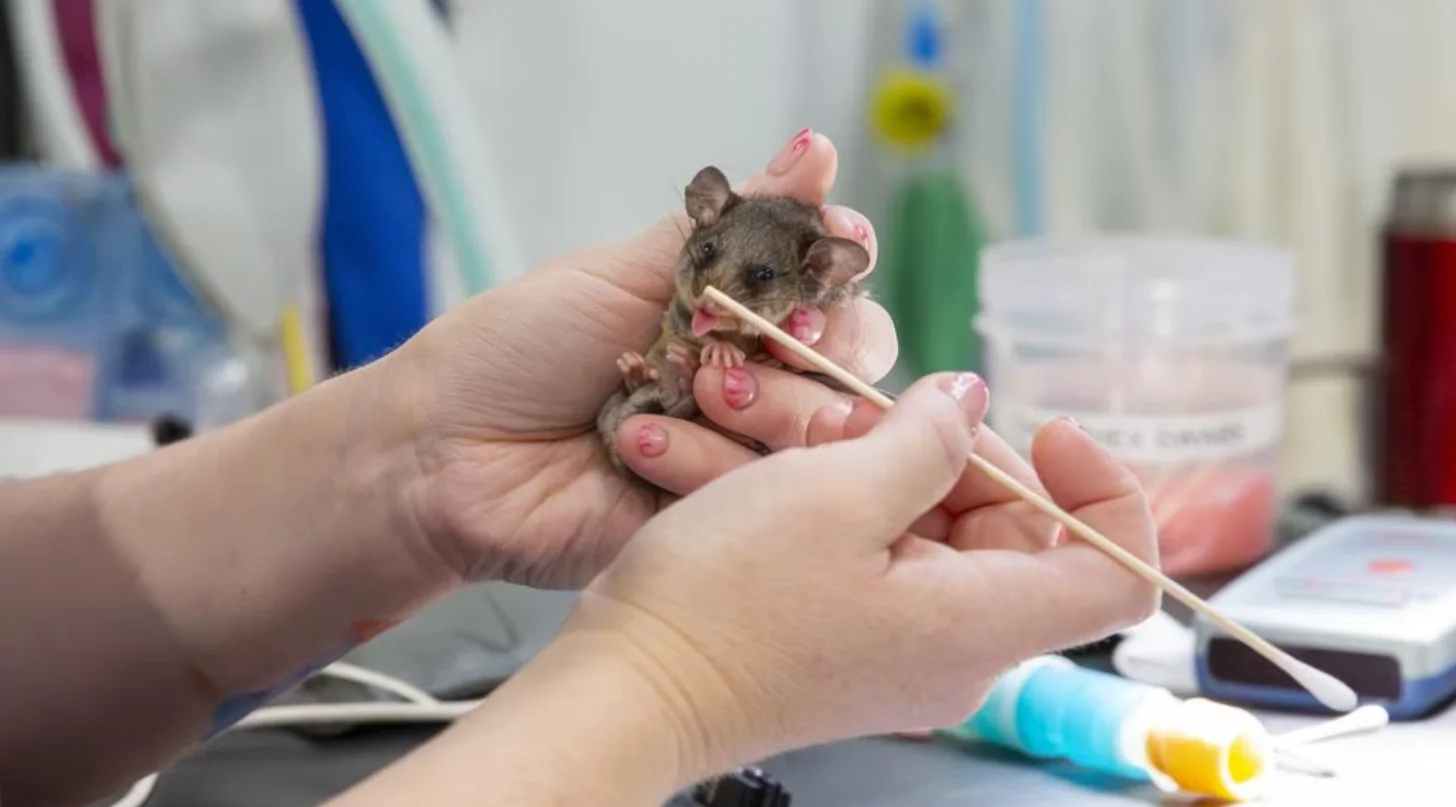
A small gray mountain pygmy-possum is gently held during an examination.
Zoos Victoria/Healesville Sanctuary
Keepers already monitor the possums closely throughout hibernation. Their routine includes weekly weight measurements, daily observations of activity and records of how much food each animal consumes.
Thermal imaging adds another layer of information by allowing staff to distinguish between an active animal and one that has entered torpor without needing to handle it.
Hindson said that kind of non-invasive monitoring is particularly useful for nocturnal wildlife because it allows researchers to gather important health information while minimizing unnecessary disturbance.
Together, wildlife crossings, habitat restoration, captive breeding and improved monitoring are helping conservationists address different threats facing the mountain pygmy-possum.
For a species once believed to be extinct, even something as simple as a short tunnel beneath a mountain road can make a meaningful difference by reconnecting separated populations and creating more opportunities for the animals to survive and reproduce.