

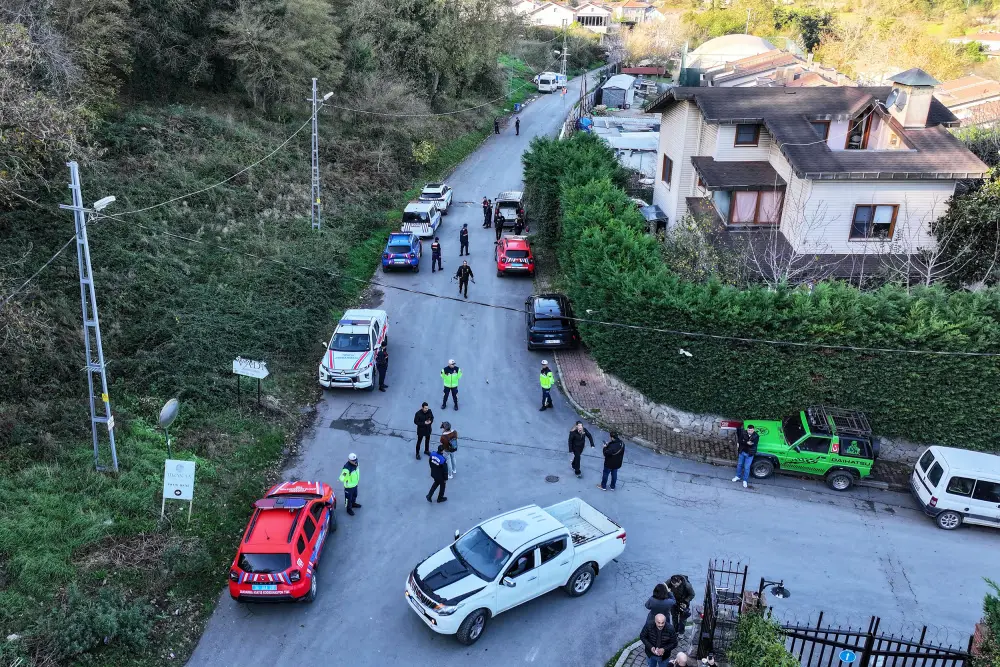
Residents of an upscale neighborhood on the outskirts of Istanbul were urged to stay indoors after reports emerged that a lioness was roaming nearby woodland.
Security camera footage appeared to show a large animal moving through the darkness, raising fears that a dangerous predator might be loose in the area.
Authorities responded immediately.
Police, wildlife specialists, and emergency personnel were deployed, while access to nearby woodland was restricted.
Drones equipped with thermal cameras searched from above as teams combed the ground.
But after nearly 24 hours of searching, the operation took an extraordinary turn.
Officials announced that the animal in the footage wasn’t a lioness after all.
In fact, they said it wasn’t any kind of big cat.
The revelation left residents and social media users asking the same question.
What had everyone been looking for?
A Mysterious Animal Appears on Camera
The unusual incident began on the evening of November 22, 2026, in Uskumruköy, a neighborhood in Istanbul’s Sarıyer district.
Someone reported seeing an animal resembling a lioness in a wooded area near local sports facilities.
Footage circulating online appeared to show a large, four-legged creature moving through vegetation.
The images were concerning enough to prompt an official response.
The possibility that an escaped lioness might be roaming near homes and public areas quickly attracted attention.
Authorities began investigating the sighting, while residents were warned to take precautions.
For people living near the woodland, the situation was understandably unsettling.
A lioness would represent a serious potential danger if it were moving freely through a residential area.
But no one had yet established exactly what the camera had captured.
Authorities Launch an Extensive Search
The Istanbul Governor’s Office coordinated a major operation involving several agencies.
Among those responding were gendarmerie personnel, wildlife conservation officials, municipal veterinary teams, and emergency management specialists.
Searchers focused on woodland in Sarıyer, including areas near Belgrade Forest.
Access to parts of the recreational woodland was restricted as the investigation continued.
Officials used drones with thermal imaging equipment to scan for heat signatures from the air.
Meanwhile, teams on the ground searched possible hiding places and examined locations where the animal might have traveled.
They also deployed motion-activated wildlife cameras and bait to help detect its presence.
The operation was designed to locate the animal and, if it proved to be a lioness, allow specialists to capture it alive.
Despite the extensive effort, the search produced no confirmed evidence that a lion was present.
Then new footage changed the direction of the investigation.
New Camera Footage Changes Everything
On November 23, the Istanbul Governor’s Office announced that investigators had reviewed additional images recorded from different angles.
Their conclusion was unexpected.
The animal shown in the footage did not appear to be a lion or another large cat species.
It was a major change from the initial reports that had triggered the emergency response.
Authorities also confirmed that field searches had uncovered no concrete evidence of a lion in the area.
The announcement significantly reduced the basis for the original alarm.
However, it didn’t completely solve the mystery.
Officials had ruled out the suspected lioness, but they had not conclusively identified the animal seen on camera.
That unanswered question quickly became the center of public attention.
Was the Mystery Animal Actually a Dog?
Following the announcement, speculation spread online about what might have appeared in the recordings.
Some observers suggested that the animal could have been a large dog.
Others questioned whether the unclear footage had created a misleading impression of its size or shape.
Social media users also responded with humor, sharing images and videos of domestic cats while joking about the supposed lioness.
The story became an unusual mix of public concern, scientific uncertainty, and internet amusement.
But there was an important distinction between the jokes and the official findings.
Authorities had not confirmed that the animal was a dog.
Nor had they established that a particular pet or other animal was responsible for the original sighting.
As more recordings circulated, the discussion continued.
Some media outlets published additional images showing an animal emerging from bushes, prompting further debate over its identity.
However, those images did not provide a definitive answer.
Why Unclear Wildlife Footage Can Be Misleading
Identifying an animal from a brief nighttime recording can be surprisingly difficult.
Poor lighting, camera angles, vegetation, and a lack of reliable size references can all distort an animal’s apparent appearance.
A relatively ordinary animal may look much larger when filmed close to a camera.
Movement through bushes can also obscure distinguishing features such as the head, tail, ears, and body shape.
Thermal cameras introduce another challenge.
Although they are useful for detecting warm objects in darkness, the images they produce may not show the fine details needed for reliable species identification.
That is why wildlife specialists often consider several kinds of evidence before reaching a conclusion.
Clear photographs, tracks, physical traces, and repeated observations can help establish an animal’s identity.
In Istanbul, the early footage raised an alarm, but later images and the lack of supporting field evidence led officials to reconsider.
The incident demonstrates how easily uncertainty can grow when unusual animal sightings circulate before they have been conclusively verified.
A Search That Captured the City’s Attention
For roughly a day, the reported lioness became the focus of an extraordinary response in northern Istanbul.
Residents were warned, access to woodland was restricted, and multiple agencies searched for an animal that authorities initially believed could be a dangerous predator.
Then the story changed.
The same officials who had investigated reports of a lioness announced that the recorded creature was not a big cat.
The finding left the original sighting unexplained.
It also highlighted the difficult decisions authorities sometimes face when responding to potential wildlife emergencies.
Ignoring a credible report of a dangerous animal could have serious consequences.
But acting on uncertain evidence can also lead to extensive searches that ultimately reveal no such threat.
In this case, officials chose to investigate the possibility, then revised their assessment when new information emerged.
The mystery animal’s identity remained unresolved in the available reporting.
The Lioness Mystery Remains Unsolved
What began as a frightening report of a lioness wandering through Istanbul ended as one of the city’s most unusual animal mysteries.
A large-scale search uncovered no verified evidence of a lion.
Additional footage persuaded authorities that the animal seen on camera belonged to neither the lion species nor another big-cat species.
Yet the question of what actually appeared in the original recordings remained unanswered.
Was it a dog? Another animal? Or simply a misleading image captured under difficult conditions?
Without further verified evidence, those possibilities remain speculation.
For the residents who spent the evening worried about a potential predator, the official announcement offered some reassurance.
For everyone following the story online, it provided an unexpected ending.
Istanbul spent nearly 24 hours searching for a suspected lioness. But when the search was over, the biggest mystery wasn’t where the lion had gone — it was what animal had been there in the first place.