

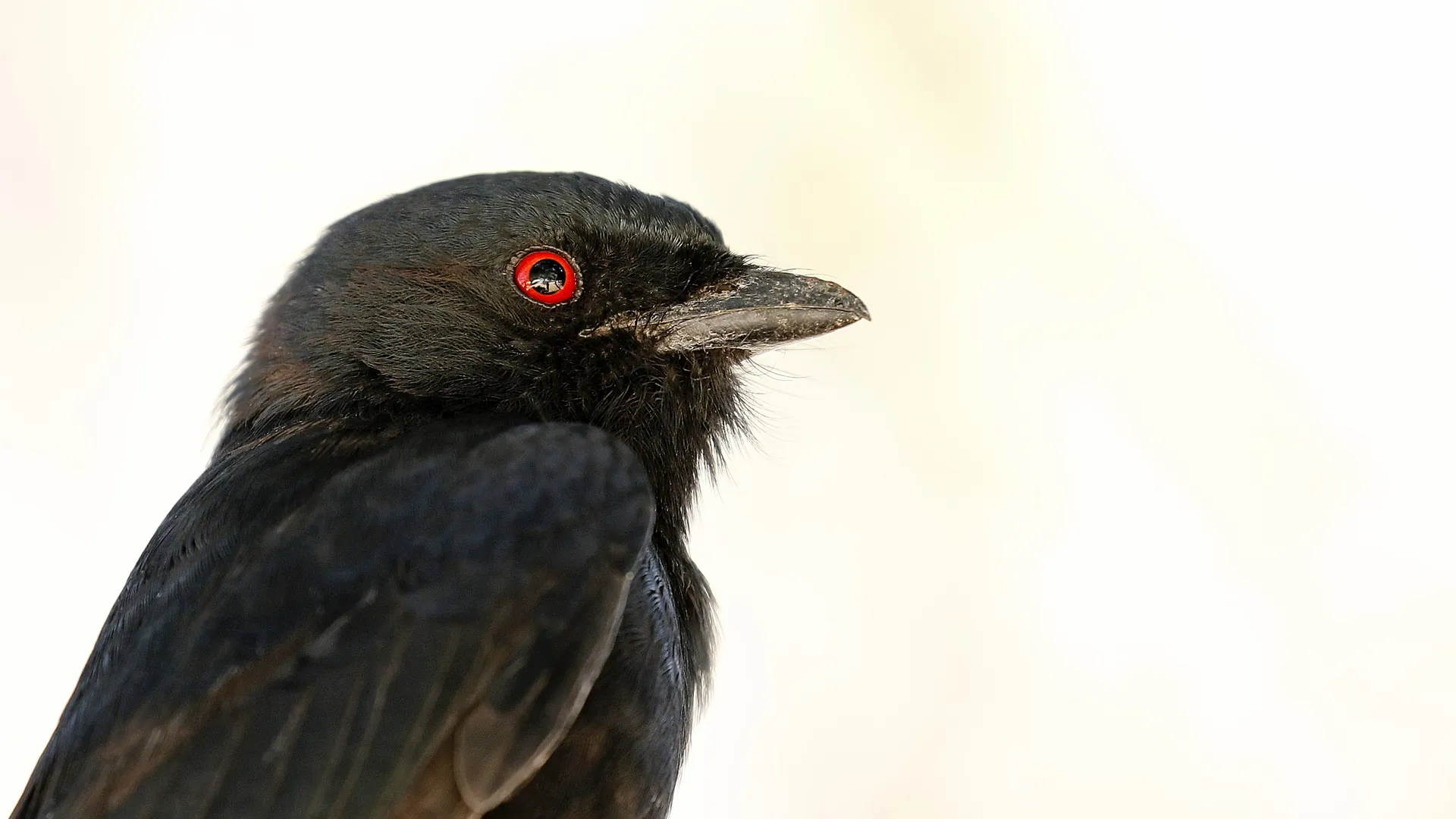
A small black bird sits near a group of meerkats searching for food in the African wilderness.
Suddenly, a warning cry breaks the silence.
The meerkats react immediately. Believing a predator may be approaching, they abandon their food and hurry toward safety.
But there may be no predator at all.
The warning came from a fork-tailed drongo, a bird capable of imitating the alarm calls of other animals.
While the meerkats take cover, the bird swoops down and steals the food they left behind.
It looks remarkably like a calculated trick.
But does the drongo actually understand that it has misled another animal?
That question lies at the center of one of the most fascinating debates in animal behavior research: Can animals really lie?
Nature Is Full of Tricks, but Not All Deception Is Intentional
The natural world is filled with animals that appear to deceive other creatures.
Some insects resemble leaves, sticks, or flowers. Certain butterflies and moths have markings that resemble the eyes of much larger animals.
These adaptations can confuse predators or help hunters approach unsuspecting prey.
One striking example is the orchid mantis, scientifically known as Hymenopus coronatus.
With its pale coloring and petal-like body structures, this remarkable insect can attract pollinating insects that mistake its appearance for something associated with flowers.
But scientists do not need to assume that the mantis consciously understands its resemblance to a flower.
Its physical characteristics developed through evolution.
Over many generations, natural selection favored traits that improved survival and reproduction.
A moth does not necessarily understand why its wing markings startle predators, either.
These forms of deception can function effectively without requiring conscious planning.
The more difficult question arises when an animal changes its behavior depending on what another animal is doing.
A Sneaky African Bird Has Scientists Asking Questions
<AsyncImage query=”fork-tailed drongo Dicrurus adsimilis glossy black bird red eyes perched South Africa wildlife” aspectRatio=”5:3″ width=”100%”/>
Among the most intriguing examples of animal deception is the fork-tailed drongo (Dicrurus adsimilis).
This glossy black bird lives in parts of sub-Saharan Africa and is known for its impressive vocal abilities.
Drongos can reproduce calls made by other bird species and even some mammals.
That talent becomes particularly useful when food is involved.
Researchers have documented drongos producing false alarm calls near animals that are feeding.
When those animals flee in response to the warning, the birds seize the opportunity to steal their abandoned food.
The behavior has been observed during interactions with species such as meerkats and pied babblers.
What makes the strategy especially interesting is that drongos do not always use the same warning sound.
They can switch between different alarm calls.
This flexibility has made them important subjects in scientific investigations of animal deception.
Drongos Change Their Alarm Calls When Other Animals Stop Listening
One of the most remarkable discoveries about fork-tailed drongos is that they can vary their misleading calls.
In a study published in Science in 2014, researchers examined how these birds used alarm calls to obtain food from other animals.
The team found that drongos could change the type of alarm call they produced during repeated attempts to steal food.
When another animal became less responsive to one call, switching to a different warning could increase the chance of provoking another reaction.
The findings suggested that the birds were using flexible strategies rather than simply repeating one fixed signal.
This matters because animals can learn to ignore warnings that repeatedly prove false.
A drongo that uses the same alarm call too often risks losing its effectiveness.
By changing its calls, the bird can continue exploiting the defensive reactions of other species.
The research demonstrates remarkably adaptable behavior.
However, it does not establish that the bird understands another animal’s beliefs in the same way a person might.
Monkeys Also Appear to Use False Warnings to Get Food
Drongos aren’t the only animals associated with misleading alarm calls.
Researchers have also studied deceptive behavior in primates.
In one investigation of tufted capuchin monkeys, scientists examined whether individuals produced alarm calls during competition for food.
The findings supported the idea that some monkeys used these calls in situations where another monkey’s reaction could help them gain access to desirable food.
Lower-ranking animals were particularly interesting because they could benefit from distracting more dominant members of their group.
A warning that causes competitors to move away may create an opportunity to obtain food.
Similar questions have been investigated in golden snub-nosed monkeys.
These observations suggest that misleading communication is not limited to birds.
But an important distinction remains: producing a signal that misleads another animal does not necessarily prove that the caller consciously intends to create a false belief.
What Is the Difference Between Deception and Lying?
In everyday language, people often use the words deception and lying interchangeably.
Scientists generally make a more careful distinction.
Deception can describe an action or signal that causes another individual to respond to misleading information.
For example, a bird producing a false warning can be described as engaging in functionally deceptive behavior if that warning causes another animal to abandon food.
Lying, especially in the human sense, often implies something more.
It suggests that an individual recognizes that information is false and intentionally communicates it to influence what another individual believes.
That mental process is difficult to establish in animals.
Researchers can observe a bird giving a warning.
They can record another animal fleeing.
They can even document the bird immediately stealing the abandoned food.
But determining exactly what the bird understood during that sequence is a much greater challenge.
An animal might learn through experience that a particular sound produces a useful response without consciously considering whether the listener believes it.
Both explanations can produce similar outward behavior.
Why Scientists Are Careful About Calling Animals Liars
Zoologist and science communicator James O’Hanlon has explored the many ways organisms use deception in nature.
His work raises an important issue in animal behavior research: interpreting an animal’s actions without automatically assuming it thinks like a human.
Scientists call the tendency to assign human characteristics or motives to animals anthropomorphism.
Although comparisons with human behavior can be useful, they can also lead researchers to draw conclusions that the evidence does not support.
A bird may appear to be executing a clever plan.
A monkey may seem to be distracting a competitor on purpose.
Yet similar behavior could arise through learning, environmental cues, or other processes that do not require an understanding of another individual’s mind.
This is why researchers distinguish between observing deceptive behavior and demonstrating deliberate, mentally sophisticated deception.
The first can often be measured directly.
The second requires stronger evidence.
How Can Researchers Test Whether Animals Intentionally Deceive?
To investigate animal deception, scientists study behavior under carefully controlled conditions.
They can compare how often an animal gives a misleading signal when food is available versus when it is absent.
They may also examine whether deceptive behavior changes depending on who is listening.
Another approach involves measuring how potential victims respond after receiving repeated false warnings.
If a misleading signal becomes less effective, researchers can investigate whether the animal producing it changes tactics.
Studies of fork-tailed drongos have already demonstrated that these birds can vary their calls during food-stealing attempts.
Such findings are valuable because they reveal flexible and context-sensitive behavior.
Nevertheless, researchers must still consider simpler explanations, including trial-and-error learning.
The ultimate challenge is finding evidence that distinguishes learned strategies from an awareness of what other individuals know or believe.
Animal Deception Reveals a More Complex Natural World
Even without proof that animals lie like humans, the documented behavior is extraordinary.
Fork-tailed drongos can imitate warning calls that influence how other species respond to danger.
Some monkeys produce alarm calls in competitive feeding situations where those signals can help them obtain resources.
Meanwhile, animals such as orchid mantises demonstrate how evolution can produce effective deception through physical appearance alone.
These different forms of trickery reveal just how varied communication and survival strategies can be.
They also show why scientists must be careful about interpreting behavior.
What appears to be a deliberate lie might be a learned response.
Or it might involve a more sophisticated understanding that researchers have not yet been able to demonstrate conclusively.
So, Can Animals Really Lie?
The scientific answer depends on what counts as a lie.
If deception means causing another animal to respond to misleading information, then yes, researchers have documented many examples.
Fork-tailed drongos provide particularly compelling evidence.
They use false warnings to make other animals abandon food and can change their calls when one warning becomes less effective.
But if lying requires an animal to understand that it is deliberately creating a false belief, the evidence remains less conclusive.
Researchers are still investigating how much animals understand about the knowledge and expectations of others.
For now, the most intriguing conclusion is not that animals have been proved to lie exactly like humans.
It’s that some animals are capable of far more flexible and effective deception than their appearance might suggest.
A tiny black bird can imitate danger, scatter a group of hungry animals, and steal their dinner. Whether it knows it has told a lie remains one of nature’s most fascinating unanswered questions.