

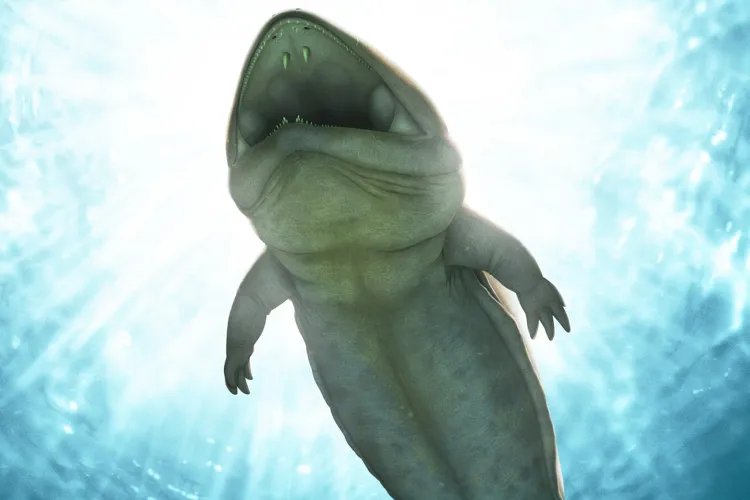
The fossil belonged to a nearly 4-foot-long amphibian that lived millions of years before the dinosaurs
An ordinary garden renovation in Australia led to an extraordinary discovery when a landscaper uncovered the remains of a mysterious creature that had been hidden inside a rock for approximately 240 million years.
The ancient fossil was so remarkable that it attracted the attention of scientists and eventually became part of a major museum exhibition.
But the story didn’t end with its discovery.
Among the visitors who saw the prehistoric remains was a 12-year-old boy fascinated by dinosaurs and ancient animals.
More than two decades later, that same boy would grow up to become the scientist who finally identified the creature as an entirely new species.
And what researchers discovered about the animal was just as remarkable as the circumstances surrounding its discovery.
Landscaper Makes Incredible Discovery While Building a Garden Wall
In October 1996, landscaper David King was working on a retaining wall at the home of retired poultry farmer Mihail Mihailidis on the Central Coast of New South Wales, Australia.
The project seemed straightforward.
King was using sandstone blocks obtained from Kincumber Quarry to construct the garden wall.
As he finished his work, he began washing dirt from the newly placed stones with a hose.
That’s when something unusual caught his attention.
As the water washed away the dirt, an unexpected pattern began appearing on the surface of one of the rocks.
It wasn’t an ordinary marking.
Hidden inside the stone were the fossilized remains of an animal that had lived hundreds of millions of years before humans existed.
What was supposed to be a simple landscaping job had suddenly become a significant paleontological discovery.
Ancient Fossil Turns Out to Be a Giant Prehistoric Amphibian
After the unexpected find, Mihailidis contacted the Australian Museum in early 1997.
Several paleontologists examined the specimen, including Dr. Anne Warren, who recognized it as belonging to an extinct group of amphibians known as temnospondyls.
These prehistoric animals lived before and during the age of dinosaurs.
Some resembled enormous salamanders, while others had broad, flattened heads and powerful jaws that made them formidable aquatic predators.
The fossil discovered in the garden wall was particularly unusual because so much of the animal had survived.
Rather than containing only a few isolated bones or teeth, the specimen preserved much of the creature’s skeleton.
Scientists could examine its skull, ribs, and other anatomical features, along with something far rarer: impressions of its soft tissue.
The discovery created considerable excitement, eventually leading to the fossil being displayed in a public exhibition.
Nobody could have predicted how important that exhibition would become to one young visitor.
A 12-Year-Old Boy Sees the Fossil and Never Forgets It
When the fossil was included in the Dinosaur World Tour exhibition in Sydney in 1997, it captured the imagination of visitors fascinated by prehistoric life.
Among them was a 12-year-old boy named Lachlan Hart.
Hart was already passionate about paleontology, and seeing the ancient amphibian left a lasting impression on him.
At the time, he could only admire the fossil as a young enthusiast.
He had no idea that the specimen would eventually become an important part of his professional career.
In 2000, Mihailidis donated the fossil to the Australian Museum, ensuring it would be preserved and available for scientific study.
For years, the specimen remained in the museum’s collection, awaiting detailed research.
Meanwhile, Hart continued pursuing his interest in prehistoric animals.
His childhood fascination eventually led him into the world of scientific research.
And roughly two decades after the fossil entered the museum’s collection, an extraordinary opportunity came his way.
Hart was invited to study the very same specimen he had admired as a child.
Childhood Dinosaur Fan Becomes the Scientist Who Identifies the Fossil
As part of his doctoral research, Hart began carefully studying the ancient amphibian.
Working with researchers from the Australian Museum and UNSW Sydney, he compared the fossil with other known prehistoric amphibians.
The detailed examination revealed something exciting.
The animal represented a previously unrecognized genus and species.
In 2023, Hart and his colleagues formally described the creature in the scientific journal Journal of Vertebrate Paleontology.
They named it Arenaerpeton supinatus, a name meaning “supine sand creeper.”
The name refers to the sandy rock in which the animal was preserved and the unusual position of its body.
The creature had been fossilized lying on its back.
For Hart, the identification represented more than a scientific accomplishment.
It completed a remarkable personal journey that had begun when he first encountered the fossil at just 12 years old.
The childhood visitor had become the researcher responsible for helping reveal the animal’s identity.
Giant Amphibian Lived in Australian Rivers 240 Million Years Ago
According to the research, Arenaerpeton supinatus lived during the Triassic period, approximately 240 million years ago.
At that time, the landscape of what is now Australia’s Sydney Basin looked very different.
Freshwater rivers supported a variety of ancient aquatic creatures, including fish and large amphibians.
Researchers believe Arenaerpeton was a predator that likely hunted fish living in these waterways.
The animal measured approximately 1.2 to 1.5 meters in length, or roughly 4 to 5 feet.
That made it relatively large compared with many closely related amphibians living during the same period.
Its appearance may have resembled a modern giant salamander, particularly in the shape of its broad head.
However, scientists found that Arenaerpeton had a considerably thicker body and an impressive set of teeth.
Among its most striking features were two large, fang-like teeth positioned on the roof of its mouth.
These specialized teeth likely helped the aquatic predator seize and hold slippery prey.
With its powerful jaws and substantial body, Arenaerpeton would have been an imposing animal in the ancient rivers it inhabited.
Scientists Discover Rare Skin Impressions Preserved in the Fossil
One of the most scientifically valuable aspects of the discovery was the fossil’s exceptional preservation.
Most animals that die never become fossils.
Over time, natural processes typically destroy their remains before they can be preserved in sediment.
Even when fossilization occurs, harder structures such as bones and teeth are much more likely to survive than skin or other soft tissues.
But Arenaerpeton was different.
The fossil preserved much of its skeleton, with the skull still attached to the body.
Researchers also identified impressions outlining parts of the animal’s skin.
These rare details provided important clues about its overall body shape and proportions.
Although the specimen was missing its tail and hind legs, the preserved anatomy allowed scientists to reconstruct much of the creature’s appearance.
The fossil’s belly-up position created some challenges because certain features on the upper surface of its skull could not be examined directly.
Nevertheless, the preservation was extraordinary.
For paleontologists, discoveries like this can provide information that isolated bones simply cannot reveal.
Ancient Amphibian Offers Clues About Life After Mass Extinction
Arenaerpeton belonged to a group of amphibians called chigutisaurids, which were part of the broader temnospondyl lineage.
Temnospondyls survived through major periods of environmental change, including some of Earth’s most devastating extinction events.
The discovery of Arenaerpeton helps scientists understand how certain members of this group evolved during the Triassic period.
Its relatively large size is especially interesting.
Many related amphibians living around the same time were smaller, while some later members of the group became enormous.
One of those later animals, Koolasuchus cleelandi, lived in Australia approximately 120 million years after Arenaerpeton and may have reached lengths of around five meters.
Researchers believe examining changes in body size across these prehistoric amphibians could provide clues about their evolutionary success.
However, the precise relationship between size and survival remains an area of scientific investigation.
Each new fossil contributes another piece to the puzzle of how ancient animals adapted to changing environments.
Australian Museum Celebrates Remarkable Fossil Discovery
The importance of Arenaerpeton extends beyond its unusual anatomy and fascinating discovery story.
Dr. Matthew McCurry, a paleontologist associated with UNSW Sydney and the Australian Museum, has described the specimen as one of the most significant fossil discoveries made in New South Wales in recent decades.
The research provides valuable information about Australia’s prehistoric ecosystems and the evolution of ancient vertebrates.
It also highlights the scientific importance of museum collections.
Although the fossil was discovered in 1996, it took years before researchers had the opportunity to formally describe it.
Without the decision to preserve and donate the specimen, scientists might never have been able to study it in such detail.
And without Hart’s childhood encounter with the fossil, the story would have lacked its remarkable personal connection.
A Garden Wall Discovery Comes Full Circle After Nearly 30 Years
What makes the story of Arenaerpeton particularly memorable is the unexpected journey connecting its discovery to its scientific identification.
A landscaper noticed something unusual while washing dirt from a garden wall.
A retired farmer contacted a museum to ensure the fossil could be examined.
Scientists recognized the remains as belonging to an ancient amphibian.
And a young boy who saw the fossil during a museum exhibition eventually grew up to become the researcher who formally identified it.
The discovery is a reminder that remarkable scientific finds don’t always begin with major expeditions or expensive excavations.
Sometimes, they begin with ordinary people paying attention to something unexpected.
For Lachlan Hart, the fossil that inspired him as a child became part of his life’s work.
And for science, the 240-million-year-old remains provided another valuable glimpse into a world that disappeared long before humans arrived.
A prehistoric creature hidden inside a garden wall for millions of years ultimately helped shape the future of the young scientist who uncovered its secrets.