

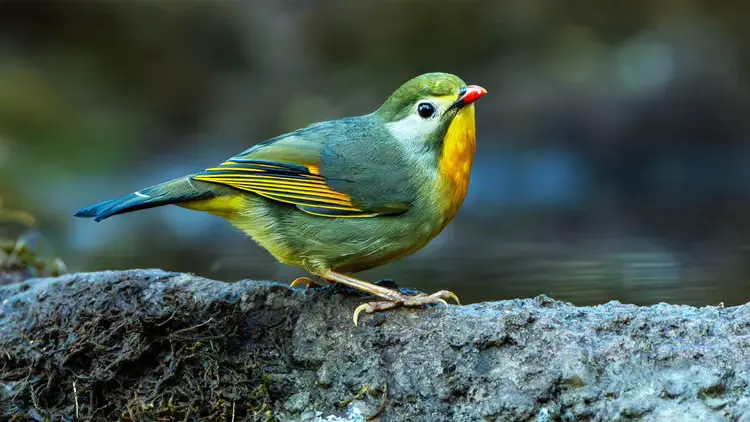
They may be among the most familiar birds in their environment, but common songbirds in China’s Gaoligong Mountains are facing a hidden crisis. Despite having populations large enough to be classified as being at low risk of extinction, these birds have lost nearly half of their genetic diversity in just five decades.
A new study examining 62 songbird species found that genetic variation declined by an average of 43% to 49% between historical and modern populations. Surprisingly, not a single species escaped the losses.
Even more concerning, the research suggests that species with larger global populations sometimes experienced the greatest genetic erosion.
The findings challenge the assumption that widespread, abundant animals are automatically protected from long-term biological decline.
A hidden crisis in the birds’ DNA
Researchers Ri Liu, Feng Dong, and their colleagues at the Kunming Institute of Zoology, part of the Chinese Academy of Sciences, investigated how the genetic makeup of songbirds had changed over approximately 50 years.
To do so, they examined DNA from birds collected in the 1960s and 1970s and compared it with genetic material obtained from more recent specimens collected in the same mountain range.
The researchers measured genetic diversity in two ways.
Across entire populations, genetic variation had declined by an average of 48.8%. Individual species experienced losses ranging from 18.1% to 77.2%.
They also examined genetic variation within individual birds, finding an average decline of 42.9%, with losses reaching as high as 80% in some species.
These results were considerably more severe than estimates from earlier research. A 2019 analysis of 91 species suggested that genetic diversity had declined by approximately 6% over a century.
The new findings indicate that the Gaoligong songbirds experienced losses several times greater than that estimate, despite the comparison covering only about five decades.
The results also approach the most concerning projections from a 2021 study, which suggested that global vertebrate populations could lose more than half their genetic diversity over a similar period.
Why having a large population wasn’t enough
One of the most surprising findings involved the relationship between population size and genetic health.
Scientists generally expect large populations to retain more genetic variation because they contain more individuals capable of passing different genetic traits to future generations.
However, the researchers observed the opposite pattern among the songbirds.
Feng Dong explained that the team had expected abundant species to be better protected against genetic decline. Instead, those with larger estimated global populations tended to experience greater losses.
The researchers believe habitat fragmentation may help explain this unexpected result.
A large population can maintain genetic diversity when individuals move freely across a connected landscape and reproduce with birds from different areas. But when forests are divided into isolated patches, populations become separated.
Over time, birds in each fragment increasingly breed within their own small groups, reducing the exchange of genetic material and accelerating the loss of variation.
This means that a species can remain relatively abundant worldwide while individual populations become genetically isolated and vulnerable.
The researchers caution that population size explained less than 10% of the differences in genetic losses between species. They also note that global population estimates may not accurately reflect the number of birds living in the Gaoligong Mountains.
Forest fragmentation is changing the genetic future of birds
The team investigated several characteristics that might explain why certain species lost more genetic diversity than others.
Two possibilities were particularly important: the amount of habitat disappearing and the degree to which remaining habitats had become isolated.
If habitat destruction alone were responsible, species producing fewer offspring might be expected to experience greater losses. If isolation played a larger role, birds capable of flying longer distances might be better able to maintain contact between separated populations.
The results supported the second explanation.
Species with stronger flight abilities generally retained more genetic diversity. Researchers estimated their dispersal potential using wing characteristics and found that better fliers experienced smaller losses per generation.
The strongest predictor, however, was how dramatically a species’ population had declined in recent decades.
Other factors, including clutch size, adult survival, and breeding elevation, did not show a measurable relationship with genetic losses.
The landscape itself has undergone substantial changes. Forest patches throughout the Gaoligong Mountains have increased more than tenfold in number, while their average size has fallen to less than one-tenth of what it once was.
Fragmentation is particularly severe at low and middle elevations. This is especially problematic because lowland forests provide important routes through which birds can travel between neighboring mountain areas.
Rivers and steep terrain already create natural barriers in the region. As forests become increasingly divided, the remaining connections between populations become even more important.
Dong believes conservation efforts must prioritize landscape connectivity rather than focusing exclusively on population numbers or the total area under protection.
Maintaining and restoring forest corridors could help isolated bird populations reconnect and exchange genetic material.
Museum collections reveal decades of genetic decline
One of the most valuable aspects of the research was the use of historical museum specimens.
The Kunming Natural History Museum of Zoology preserves bird specimens collected throughout the Gaoligong Mountains during the 1960s and 1970s. Researchers extracted DNA from these preserved birds and compared it with modern tissue samples stored in a wildlife tissue bank in Kunming.
Each species was represented by four or five birds from each period.
Although the sample sizes were relatively small, the researchers cited previous work indicating that this approach can provide useful estimates of population-level genetic variation.
The historical specimens had a median collection year of 1973, while the modern samples had a median year of 2022. For these relatively small birds, the approximately 49-year interval represents around 20 generations.
Importantly, the older specimens were collected before forest fragmentation intensified in the region.
They therefore provided researchers with a valuable genetic snapshot of the bird populations before many of the landscape changes that followed.
Why the Least Concern label can be misleading
All 62 species included in the study are classified as Least Concern on the International