

When villagers in eastern India spotted five tiny, reddish-haired creatures hiding among the trees, they knew something wasn’t right.
The little animals had unfamiliar faces, unusually long arms, and expressions that immediately caught people’s attention.
They looked frightened and completely out of place.
At first, the villagers struggled to understand what they were seeing.
But when the animals were identified, the discovery became even more troubling.
They were five baby orangutans.
And somehow, these vulnerable youngsters had ended up more than 1,700 miles from the tropical rainforests where their species naturally belongs.
The babies were alone, far from their mothers, and caught up in what wildlife experts fear is a growing international trafficking crisis.
Fortunately, someone noticed them before they disappeared again.
Five Tiny Strangers In An Unfamiliar Forest
The unusual discovery happened in early September 2026 in the Indian state of Odisha.
Villagers noticed a group of small animals in a casuarina forest on a plantation.
Their reddish fur immediately stood out against the surrounding vegetation.
As people approached and examined them more carefully, they realized the creatures were unlike the wildlife normally seen in the area.
There were three males and two females, all estimated to be between 6 and 8 months old.
At such a young age, orangutans are normally still completely dependent on their mothers.
In the wild, baby orangutans spend years learning how to climb, find food, build nests, and survive in the forest.
Their mothers provide not only nourishment and protection but also the knowledge they need to navigate life high in the rainforest canopy.
But these five babies had been separated from that protection.
And the place where they were discovered was nowhere near their natural habitat.
Wild orangutans are native to the Indonesian island of Sumatra and the island of Borneo, which is shared by Indonesia, Malaysia, and Brunei.
The Indian plantation where the babies were found was more than 2,700 kilometers, or roughly 1,700 miles, away.
Their presence raised an alarming question.
How had five endangered baby orangutans traveled so far from home?
Photo: Nandankanan Zoo via Associated Press
A Discovery With A Heartbreaking Explanation
Wildlife experts believe the orangutans’ appearance in India is evidence of a much larger problem.
The babies were likely victims of illegal wildlife trafficking.
Across parts of the world, rare and exotic animals are captured or transported illegally to satisfy demand from collectors and people seeking unusual pets.
Young primates are particularly vulnerable to this trade because their small size and humanlike expressions can make them appealing to buyers.
But behind the demand lies a devastating reality.
Orangutan babies naturally remain with their mothers for many years.
Separating them at such a young age deprives them of the care and protection they need during a critical stage of development.
The exact circumstances that brought these five orangutans to Odisha remain unclear.
Authorities have not established publicly how they were transported, who was responsible, or why they were left on the plantation.
But their discovery thousands of miles from their native forests has raised serious concerns among conservationists.
These babies had somehow crossed international boundaries and ended up in an environment where they could not survive independently.
And without help, their future would have been dangerously uncertain.
Finally, A Safe Place To Rest
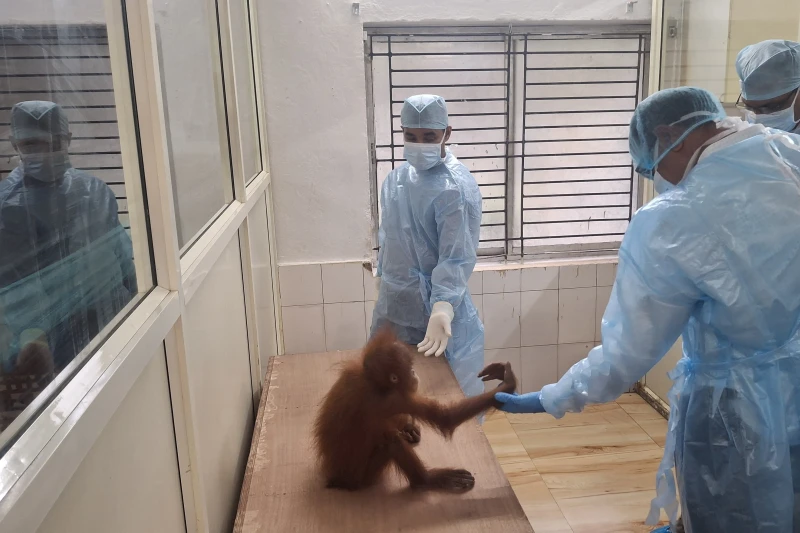
After their discovery, the five orangutans were taken to Nandankanan Zoo in Odisha, where they came under the care of experienced keepers and veterinary staff.
For animals so young, the transition into a new environment requires special attention.
The babies had already experienced significant disruption, and their caretakers needed to ensure they received appropriate food, medical monitoring, and a calm environment.
Veterinarians examined the rescued orangutans, while keepers worked to help them settle into their temporary surroundings.
And according to reports, the zoo staff introduced one particularly gentle approach to helping the youngsters feel more comfortable.
They began playing classical music.
The soothing melodies were intended to create a calmer atmosphere for the little orangutans as they adjusted to life under human care.
It’s a touching detail in an otherwise disturbing story.
Five babies who should have been growing up beside their mothers in the rainforest were instead being cared for by people trying to help them recover from an ordeal they never should have experienced.
Their long-term future has not yet been established.
But for now, they have access to professional care and protection.
Why Orangutans Need Their Mothers For So Long
Orangutans are among the most intelligent and remarkable animals on Earth.
Their name comes from words meaning “person of the forest,” a fitting description for primates that spend much of their lives high among the trees.
Unlike many animals that become independent shortly after birth, orangutans have an exceptionally long childhood.
Youngsters rely heavily on their mothers, often remaining close to them for six to eight years.
During that time, they learn which fruits are safe to eat, how to move through the forest, where to find resources, and how to construct nests for sleeping.
These skills are essential for surviving independently.
That makes the situation of the five rescued babies especially heartbreaking.
At only 6 to 8 months old, they are still at an age when they would normally spend much of their time clinging to their mothers.
They are not yet capable of navigating life in the wild on their own.
And although professional caregivers can help meet their immediate needs, replacing the experience of growing up with an orangutan mother is an enormous challenge.
For conservationists, every young animal lost to trafficking represents more than an individual tragedy.
It is another blow to a species already facing serious threats.
A Species Fighting For Survival
Orangutans are critically endangered, and their populations have declined under pressure from habitat destruction and other human activities.
Their native rainforests have been affected by deforestation, agricultural expansion, and development.
As forests disappear or become fragmented, orangutans lose access to the food, shelter, and safe spaces they need.
But their importance extends far beyond their own survival.
Orangutans play a major role in maintaining the health of tropical forests.
As they travel through the canopy and feed on fruit, they disperse seeds across large areas.
Some of those seeds eventually grow into new trees, helping forests regenerate.
Healthy forests, in turn, store enormous amounts of carbon and support countless other species.
In that sense, protecting orangutans also helps protect the ecosystems they sustain.
According to the World Wildlife Fund figure cited in the report, approximately 119,500 orangutans remain in the wild.
That makes the loss of even a small number of youngsters a serious conservation concern.
And the discovery of five babies in India suggests that trafficking networks may be placing additional pressure on already vulnerable populations.
A Growing Trade In Exotic Animals
The five rescued orangutans are not an isolated case.
Wildlife authorities have encountered a series of incidents involving illegally transported primates in recent years.
In 2022, two young Sumatran orangutans were discovered inside boxes at a checkpoint between the Indian states of Assam and Mizoram.
Another orangutan was rescued in Mizoram in 2023.
In November 2024, a young orangutan was found inside an apartment near Mumbai.
And the cases extend beyond orangutans.
According to an analysis by the Wildlife Trust of India, at least 23 gibbons were seized at Indian airports during 2025.
In May 2026, Egyptian authorities intercepted three sedated baby chimpanzees that were reportedly being transported toward India.
Together, these discoveries paint an unsettling picture of the international trade in exotic primates.
A 2026 study by researchers at the National University of Singapore estimated the global illegal wildlife trade at approximately $34 billion annually.
Experts believe India has become an increasingly important destination for exotic animals sought by wealthy collectors.
Sinan Serhadli, a wildlife trafficking expert at the Orangutan Information Centre in North Sumatra, expressed deep concern about the trend.
“India has become the number one destination for the live trade of primates,” he said.
His assessment underscores how serious the problem has become for conservation organizations attempting to protect vulnerable species.
Why Stopping Traffickers Is So Difficult
India has long maintained wildlife protection laws designed to safeguard native animals, including elephants, rhinoceroses, and tigers.
Historically, much of the country’s enforcement framework has focused on preventing the illegal hunting and export of those species.
But the trafficking of exotic animals into India creates additional challenges.
When animals originate in another country, authorities may struggle to establish exactly where they came from and how they entered the country.
Documentation can be missing or misleading, and trafficking networks may move animals through multiple locations before they reach their intended destination.
The five orangutans discovered in Odisha illustrate those difficulties.
Although the animals’ natural origins can be identified at a broad geographic level, determining their precise journey is another matter entirely.
Were they transported directly from Southeast Asia?
Did they pass through other countries?
And why were they abandoned on a plantation rather than delivered to a buyer?
Those questions remain unanswered.
What is clear is that the animals ended up extremely far from the forests where they should have been growing up.
Five Babies Who Deserve A Better Future
At Nandankanan Zoo, the immediate priority is caring for the rescued youngsters.
The five orangutans are still babies, with years of development ahead of them.
They need proper nutrition, veterinary supervision, opportunities to develop normal orangutan behavior, and a stable environment.
For now, dedicated keepers are providing that care.
The reported use of classical music is a small but memorable detail, suggesting the attention being given to their surroundings and comfort.
But the larger challenge remains.
These youngsters belong to a species whose natural home is the rainforest, not a trafficking route or a private collection.
Their recovery and future placement will require careful decisions from the relevant wildlife authorities and experts.
And their story serves as a reminder that rescuing trafficked animals is only one part of solving the problem.
Preventing the capture, illegal transport, and sale of endangered wildlife is just as important.
A Small Rescue That Reveals A Much Bigger Problem
When villagers first noticed the five reddish-haired creatures in the forest, they had no idea their discovery would highlight a growing international wildlife crisis.
To them, the little animals were simply strange and unfamiliar.
But behind their unusual appearance was a story involving endangered wildlife, international trafficking concerns, and the separation of young primates from their natural environment.
The babies had no way to explain how they arrived in Odisha.
They couldn’t tell anyone where their mothers were or what they had experienced along the way.
All they could do was depend on the people who found and cared for them.
Fortunately, their discovery brought them into the protection of trained professionals.
And although their future remains uncertain, their situation is now receiving attention.
For conservationists, the hope is that cases like this will encourage stronger efforts to stop the illegal trade before more animals are taken from their forests.
Because orangutans belong in the wild, where they help sustain the remarkable rainforests of Borneo and Sumatra.
They deserve the chance to grow up with their mothers, learn the skills needed for survival, and eventually live independently among the trees.
And no baby animal should have to travel thousands of miles from home to become someone’s exotic possession.
Five tiny orangutans were found abandoned in a forest far from where they belonged. Now, with caring hands looking after them, they have a chance at a safer future — and their story is a powerful reminder of why endangered animals need protection long before a rescue becomes necessary.