

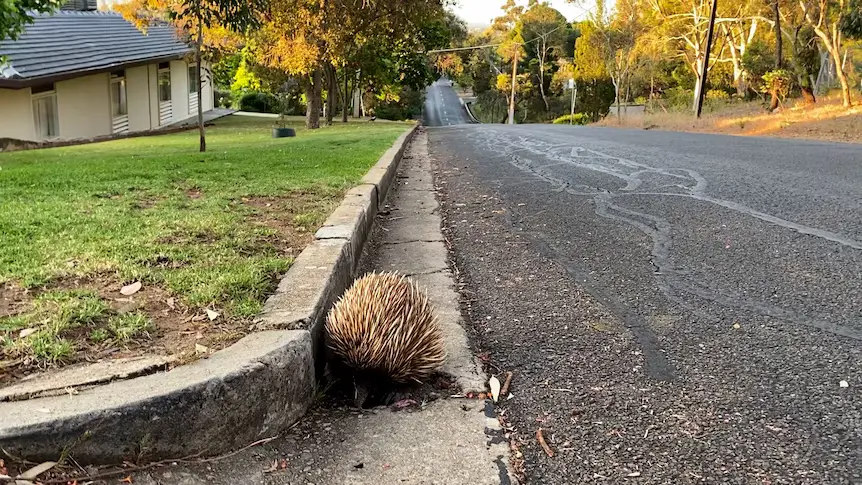
When people in the suburbs of Adelaide, Australia, spot a small, spiky animal wandering through their backyard or strolling along a neighborhood street, their first instinct is often to help.
After all, seeing an echidna far from the bush might seem unusual, especially when the little creature appears to be traveling alone through an area filled with houses, cars, and people.
Concerned residents sometimes decide to pick up the animal and relocate it to nearby bushland, believing they’re returning it to safety.
But according to wildlife rescuers, that well-intentioned act can actually create an entirely new problem.
Because those wandering echidnas usually aren’t lost at all.
They know exactly where they’re going.
And every time someone moves them, they may be forced to start their journey all over again.
The Little Wanderers Who Know Their Way Home
Echidnas are among Australia’s most unusual native animals.
Covered in protective spines, equipped with long snouts, and known for their distinctive waddling walk, these fascinating mammals can look almost prehistoric.
But beneath their unusual appearance are remarkably capable survivors.
In Adelaide, echidnas are relatively common in areas where suitable habitat remains, and their local population is considered stable.
Although people often associate them with remote bushland, echidnas are also perfectly capable of navigating suburban environments.
They travel through gardens, along streets, and even through stormwater networks as they search for food, water, and potential mates.
To someone unfamiliar with their behavior, a lone echidna walking through a residential neighborhood might appear confused or out of place.
But wildlife rescuer Mish Simpson knows that appearances can be misleading.
Simpson, co-founder of Southern Koala and Echidna Rescue, has spent years helping injured and vulnerable native animals.
And one of her biggest frustrations is seeing people repeatedly relocate perfectly healthy echidnas simply because they believe the animals don’t belong in suburbia.
“I hate to think how many get moved on because they are species that some people are really scared of,” Simpson said.
She has even seen stories online where the same echidna appears to have been relocated multiple times by different people.
One person moves the animal away from a street.
Someone else finds it and moves it again.
Then another person decides it needs rescuing.
All the while, the little echidna is simply trying to reach its destination.
“This poor thing doesn’t want to be in the scrub. Stop taking it to the scrub. It’s trying to get somewhere,” Simpson explained.
And that simple message is something she wishes more people understood.
Why Leaving Them Alone Is Often The Kindest Choice
For people who encounter an echidna in their backyard, Simpson has a surprisingly straightforward suggestion.
Give it some time.
Rather than immediately trying to catch or relocate the animal, she recommends watching from a safe distance and allowing it to continue on its way.
In many cases, the echidna will disappear on its own within an hour.
“I just say give them half an hour to an hour and there’s a good chance it will disappear,” Simpson said.
And according to her, that’s exactly what often happens.
Residents later contact the rescue group to report that the animal has already moved along.
The reason is simple.
Echidnas are natural wanderers, and a suburban garden might be nothing more than a temporary stop along their route.
They may be searching for ants, exploring familiar territory, or traveling toward another area where they know food and shelter can be found.
Moving them somewhere unfamiliar can interrupt that process.
<text color=”secondary” size=”xs”>Mish Simpson, co-founder of Southern Koala and Echidna Rescue.</text>
Photo: ABC News/Luke Pike
These Spiky Animals Are Surprisingly Good At Surviving In Cities
Despite their small size and unusual appearance, echidnas have several remarkable abilities that help them survive in developed areas.
According to South Australia’s Department for Environment and Water, the animals are excellent navigators.
They can remember familiar routes and use that knowledge to avoid some of the dangers associated with cars and human activity.
Unlike animals that are active only during a narrow period, echidnas can also adjust when they move around.
Their activity can occur at different times of the day or night, giving them opportunities to avoid busy environments.
And when they encounter a potential threat, they have some impressive ways of protecting themselves.
Their sharp spines are the most obvious defense.
But echidnas can also curl up or dig themselves into the ground, making it difficult for predators to reach their vulnerable undersides.
These adaptations help protect them from animals such as domestic dogs, cats, and foxes.
In fact, Simpson says she has witnessed some surprisingly unsuccessful encounters between dogs and echidnas.
Most dogs quickly lose interest after discovering just how uncomfortable those sharp spines can be.
“Most of the time, the dogs are not determined enough. They get pricked in the face a few times and they give up,” she explained.
On some occasions, rescuers were called because an echidna appeared to have blood on its spines following a dog encounter.
But after examination, they discovered that the blood had actually come from the dog.
Of course, echidnas aren’t invincible.
Simpson recalled one particularly tragic case in which two dogs managed to severely injure an echidna’s beak.
Feral cats can also pose a serious threat, especially when they learn how to attack the animals from underneath.
Nevertheless, echidnas have managed to maintain their distribution across much of South Australia more successfully than some other mammals of similar size.
Their natural defenses and adaptable behavior have helped them persist in environments where other species may struggle.
When Echidnas Really Do Need Help
Although many suburban echidnas are perfectly capable of looking after themselves, some situations genuinely require intervention.
And Simpson knows that better than anyone.
Over a decade of wildlife rescue work, she has encountered echidnas suffering from serious injuries, particularly after being struck by vehicles.
Road accidents remain one of the biggest dangers these animals face.
While echidnas can navigate familiar suburban environments, they are still vulnerable when crossing busy roads.
Simpson says many of the vehicle-related injuries she encounters occur on dark, winding country roads where drivers may have little warning before an animal appears.
Tragically, her rescue group also recently learned of an echidna killed in a driveway.
It’s a reminder that even familiar human environments can present sudden dangers.
Photo: Southern Koala and Echidna Rescue
Wildlife experts emphasize that an echidna wandering through a garden is very different from one trapped on a major road or showing signs of injury.
An animal attempting to cross a busy highway may need help from trained wildlife rescuers.
But a healthy echidna simply walking through someone’s property usually doesn’t need to be moved at all.
The safest response is often to keep pets away, give the animal space, and allow it to continue its journey undisturbed.
Why More People Are Seeing Echidnas
Southern Koala and Echidna Rescue has reported a noticeable increase in calls from people seeking advice about the animals.
According to Simpson, the number of inquiries rose from 76 in 2024 to 212 in 2026.
That’s a considerable increase, but it doesn’t necessarily mean that Adelaide suddenly has many more echidnas than before.
Simpson suspects that growing awareness of the rescue organization may be contributing to the higher number of calls.
More residents may simply know whom to contact when they encounter an unfamiliar native animal.
However, she has also noticed something intriguing about echidna behavior.
Their breeding activity appears to be shifting later in the year.
Traditionally, the colder winter months have been associated with echidna breeding.
But Simpson says September and October have increasingly become busy periods for her rescue work.
“Their breeding season used to be in winter, but it’s September and October that’s becoming our busiest time,” she explained.
The changes have raised interesting questions about what might be happening in the wild.
An Unexpected Change In Their Breeding Season
Over the years, Simpson and her team have cared for numerous echidnas that needed rehabilitation.
But recently, they’ve noticed patterns that seem different from what they previously expected.
Some female echidnas have been arriving in care while still producing milk toward the end of summer.
For Simpson, this suggests that some breeding activity may be occurring later than usual.
“We’re getting lactating echidnas coming through at the end of the summer and they shouldn’t still be having babies at that time,” she said.
The reasons aren’t yet clear.
But the observations have encouraged Simpson to pay closer attention to how changing seasonal conditions might be affecting echidna behavior.
Another clue came from the animals being cared for during winter.
Some echidnas in rehabilitation became unusually inactive.
They showed little interest in eating and repeatedly entered a state called torpor.
Torpor is a natural physiological response that allows certain animals to conserve energy by lowering their body temperature, heart rate, and metabolic activity.
For echidnas, this ability can help them survive periods when food is scarce or temperatures are unfavorable.
But it also presents challenges for wildlife rehabilitators who are trying to help sick or injured animals recover.
Simpson recalled having to make considerable efforts to keep the echidnas’ enclosures warm enough to encourage them to eat.
“So we had to try every trick under the sun to make their enclosures warmer so we could get them eating,” she said.
She wonders whether echidnas in the wild may be experiencing similar patterns, remaining inactive through colder periods before becoming more active as temperatures rise.
Although these observations don’t establish exactly why seasonal behavior may be changing, they highlight how much researchers and rescuers are still learning about these remarkable animals.
Looking For Love, Not A Rescue
One particularly charming explanation for the increase in wandering echidnas is that many may simply be searching for a mate.
According to Simpson, echidnas observed moving around Adelaide during this period often appear to have a clear destination in mind.
And for some, that destination may involve finding another echidna.
“They’re all looking for their mates right now,” she said, noting that the timing seemed unusually late compared with traditional seasonal patterns.
This means a little echidna traveling through someone’s backyard might not be lost, injured, or in need of assistance.
It could be on an important journey connected to its breeding behavior.
And relocating it to unfamiliar bushland could disrupt that journey.
For Simpson, this is one of the reasons she’s so passionate about encouraging people to leave healthy echidnas alone.
The animals have their own routines, territories, and biological needs.
What looks like aimless wandering to a human observer may actually be purposeful movement.
And sometimes, the best way to support wildlife is to resist the urge to interfere.
The Biggest Threat Isn’t What People Think
While dogs, cats, and other predators can sometimes harm echidnas, wildlife authorities say the biggest long-term dangers are vehicles and habitat loss.
As cities expand and natural vegetation is cleared, echidnas can lose access to the places they depend on for shelter and food.
Fallen logs, tree stumps, undergrowth, and rocky areas all play important roles in their environment.
These natural features provide shelter while also supporting colonies of ants, one of the echidna’s primary food sources.
When these areas are removed through development or landscaping, the animals may struggle to find suitable habitat.
And as their natural environments become more fragmented, their journeys may increasingly bring them into contact with roads, homes, and other human infrastructure.
Protecting their habitat is therefore just as important as responding to injured individuals.
Even something as simple as preserving suitable vegetation and avoiding unnecessary disturbance can help support local echidna populations.
Sometimes The Kindest Thing Is To Do Nothing
For Simpson and her fellow wildlife rescuers, the message to Adelaide residents is clear.
Seeing an echidna in an unexpected place doesn’t automatically mean something is wrong.
These unusual little mammals are often far more capable and independent than people realize.
They can navigate complex environments, remember routes, defend themselves against predators, and travel considerable distances in search of food or mates.
And although their slow, waddling movements might make them look vulnerable, they frequently know exactly what they’re doing.
Of course, an injured echidna or one facing immediate danger may need professional assistance.
But when a healthy animal appears in a suburban backyard, there is often no need for a dramatic rescue.
Sometimes, all it needs is a little patience.
Give it some space.
Keep curious pets away.
And let it continue on its way.
Within an hour, it may already be long gone, continuing a journey that only it understands.
Because that little echidna wandering through your garden probably isn’t lost at all — it may simply be on its way to find dinner, shelter, or even love. And the best way to help might be to let it go.