

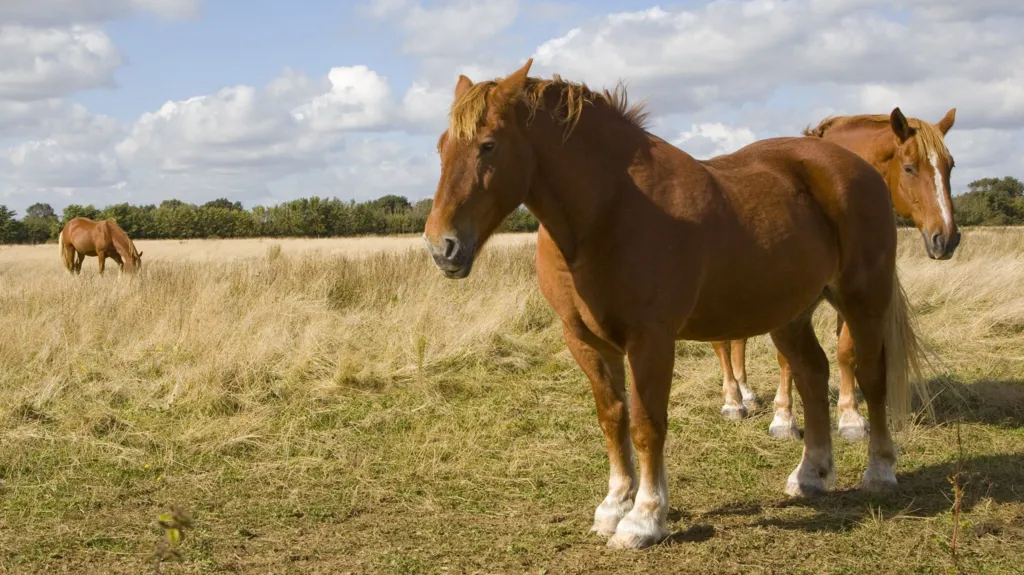
Concerns are growing over the future of the Suffolk Punch Trust after its historic farm and visitor centre were placed on the market for £2.4 million.
The charity, which works to protect the critically endangered Suffolk Punch horse, announced in February that it would close its visitor centre, café and shop because of rising costs.
Now, breeders and supporters fear the trust itself could disappear.
Former Suffolk Horse Society president Nigel Oakley said the organisation had worked hard to preserve the breed but appeared to have reached a point where continuing was no longer financially sustainable.
“The trust made every effort to breed and increase the population of the Suffolk horse and they tried very hard to make it a success,” he said.
“It is very, very sad but unfortunately I think it was inevitable to be truthful.”
Nigel Oakley said the trust had done everything it could to support the breed.
Suffolk Punch horses have been bred at the Colony Stud in Hollesley, near Woodbridge, since 1759.
The trust’s website says the site is home to 19 horses, raising questions about where they will go if the property is sold.
Oakley, who has bred 52 foals himself, said he had been told that several horses had already been sold.
“They have got some very good quality horses, there’s no doubt about that, but I think it will be very difficult to place the stallions,” he said.
He explained that stallions can be more challenging to rehome because they often form strong bonds with individual handlers.
The Suffolk Punch Trust has long worked to preserve one of Britain’s rarest native horse breeds.
The trust’s financial difficulties were already evident in its accounts for the year ending 2024.
Chairman Andrew Fane described the outlook as uncertain unless further funding could be secured.
The charity reported a net loss of £90,561 in 2024, compared with a surplus of £24,439 the year before.
Total income fell from £609,958 to £497,207, while donations and legacies dropped sharply from £302,003 to £172,939.
Visitor numbers, however, had increased, with entrance fee income rising from £74,296 to £87,902.
Earlier this year, the trust said it planned to restructure and concentrate on the future of the stud in a reduced form.
The subsequent decision to place the farm on the market has deepened concerns among supporters.
Oakley said some long-time donors were upset by the situation.
Farmer Tom Walne, who has spent decades working with Suffolk Punch horses, said he was shocked to learn the property was for sale.
“The Suffolk horse needs all the help it can get, so I was shocked and I think that is very sad,” he said.
“There’s lots of people, like me, who have spent a large amount of their life and all their money to produce Suffolk horses and to have the pleasure of them.”
Farmer Tom Walne said losing the trust would be a major blow for the breed.
Walne said he had been told that any remaining surplus money could be donated to other charities.
He also said stud manager Tracey Pettit was working to find suitable permanent homes for the remaining horses.
“That trust was set up as a good, wonderful thing for the Suffolk horse so that they could breed, train and sell horses,” Walne said.
“But once it’s gone, it’s gone.”
The Charity Commission said it was aware of financial concerns involving the Suffolk Punch Trust and was assessing the available information.
It has not yet opened a formal compliance case or statutory inquiry.
The future of the farm, the trust and its remaining horses now remains uncertain, while breeders continue to worry about what the loss of such a long-standing institution could mean for the survival of the Suffolk Punch.