

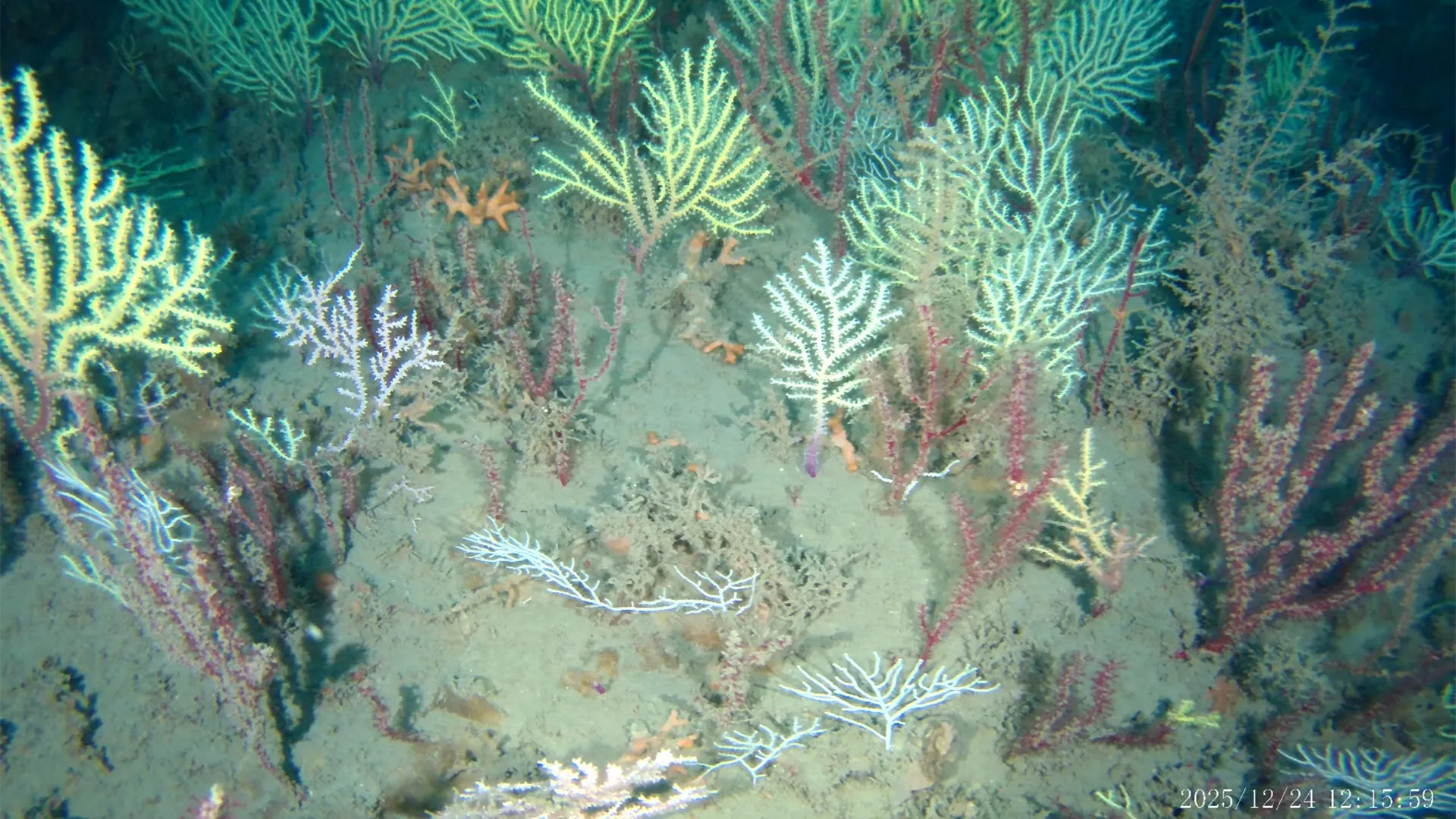
A coral reef off the coast of Benin, long believed to be lifeless, has been rediscovered — and it appears to be alive and in surprisingly good condition.
The reef was first documented during marine surveys in the 1960s, when researchers were mainly searching for productive fishing areas. Those early studies identified what looked like a deep-water coral formation more than 50 meters below the surface, but scientists at the time concluded that it was probably dead.
More than six decades later, a research team returned to the area using modern sonar, underwater imaging equipment, and the Deep Sea Camera System developed by the National Geographic Exploration Technology Lab.
What they saw challenged the old assumption.
Gérard Zinzindohoué of the Institut de Recherches Halieutiques et Océanologiques du Bénin, lead author of the study published in Frontiers in Marine Science, said the expedition was difficult and full of uncertainty.
Long days at sea, technical setbacks, and limited visibility made the work challenging. But sonar scans eventually revealed formations that resembled reef structures, encouraging the team to investigate further.
Researchers then deployed an underwater drone and deep-sea cameras to examine the seafloor directly.
The first images revealed living coral.
For the team, the moment was striking. After years of wondering whether the reef still existed, they were finally looking at a functioning ecosystem.
A Deep-Water Reef Hidden From View
The researchers believe the site may be a mesophotic coral ecosystem.
Unlike the coral reefs most people are familiar with, mesophotic reefs develop at greater depths, where much less sunlight reaches the ocean floor.
They also do not always form one continuous reef. Instead, they may consist of separate patches of coral growing wherever suitable rock and environmental conditions are available.
Using records from the 1960s as a guide, the team scanned around 11.5 kilometers of seabed with sonar.
Two areas produced signals that appeared consistent with reef habitat.
The scientists then focused their cameras on the most promising locations.
What appeared on the footage was not an abandoned reef, but a living coral community supporting a variety of marine animals.
Corals and Fish Still Using the Reef
The researchers identified eight types of coral from the video footage, along with eight fish species that appeared to use the habitat for feeding and shelter.
Among the fish recorded were golden African snappers, blackbar soldierfish, Guinean angelfish, West African goatfish, Monrovia doctorfish, three-banded butterflyfish, and two species of damselfish.
Instead of forming a single solid wall, the corals appeared in separate clusters across rocky parts of the seafloor.
That patchy structure is consistent with how some deeper coral ecosystems develop.
The finding may also represent the first confirmed living mesophotic coral ecosystem documented on the continental shelf of the Gulf of Guinea.
Researche