

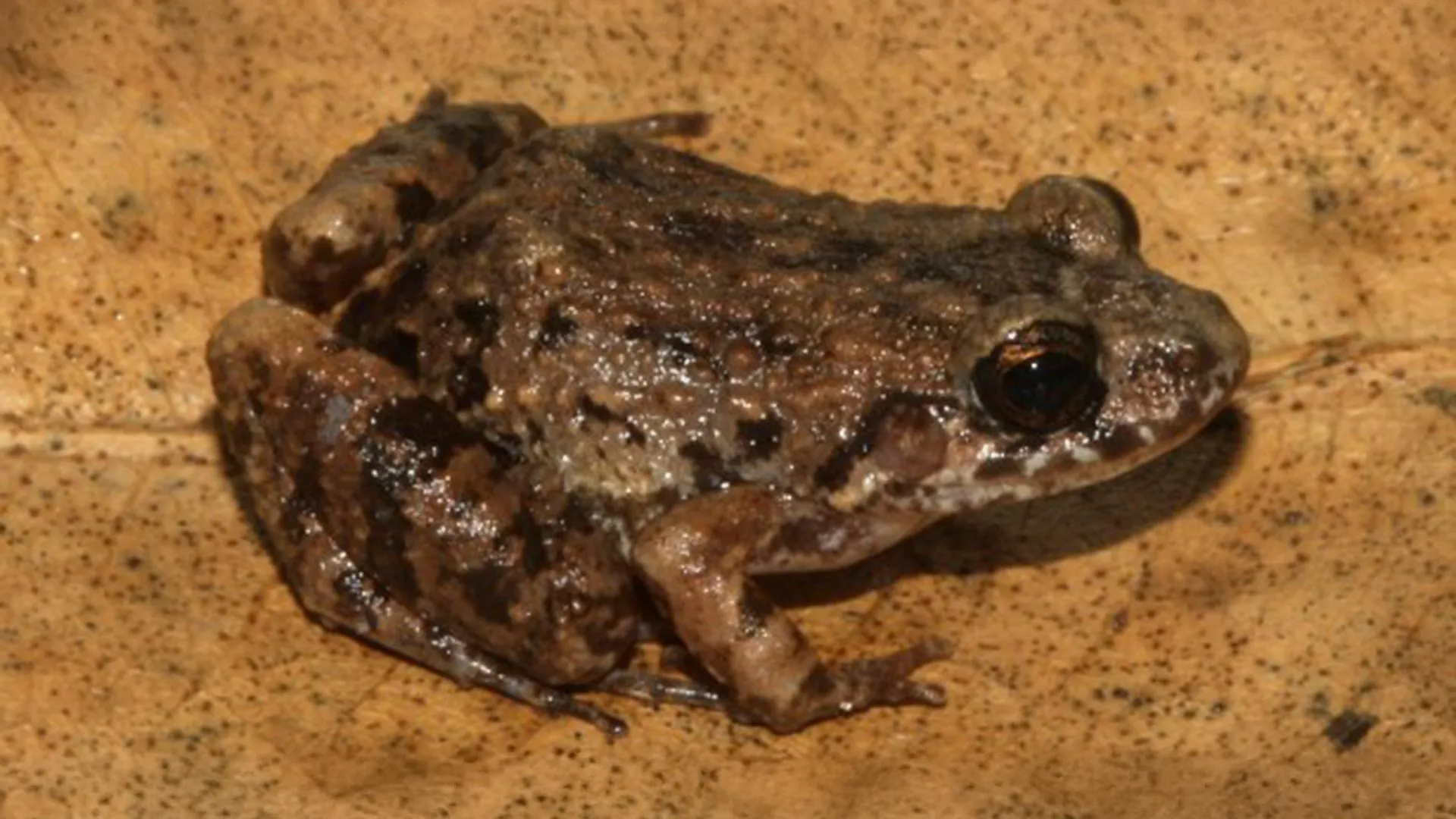
Scientists exploring the western Amazon have described a previously unknown frog species that lives in forests regularly covered by seasonal floodwaters.
The species, named Adenomera varcena, provides another example of how much biodiversity in the Amazon remains hidden, even among animals that may look almost identical to species already known to science.
Researchers confirmed the frog’s identity by combining genetic evidence with recordings of its call, physical characteristics, habitat observations, and comparisons with preserved museum specimens.
The study was published in Ichthyology & Herpetology. Among the researchers involved were Célio F. B. Haddad of São Paulo State University and Thiago R. Carvalho of the Federal University of Minas Gerais. Both are associated with the Center for Research on Biodiversity Dynamics and Climate Change, or CBioClima.
Discovery in a Seasonally Flooded Forest
The new species was found during fieldwork in the Upper Juruá River region of Acre, in western Brazil.
Researchers surveyed forested areas near the Moa and Crôa rivers, not far from the city of Cruzeiro do Sul.
At first glance, the frog closely resembled several related species. Its appearance alone was therefore not enough to determine whether it represented something new.
To reach that conclusion, scientists examined several types of evidence at once. They analyzed DNA, studied the frog’s body proportions and external features, compared its vocalizations, reviewed information about its habitat, and examined specimens stored in scientific collections.
The name varcena refers to Amazonian floodplain forests, which are periodically submerged during the year.
That habitat is one of the most interesting aspects of the discovery.
Species in the genus Adenomera are more commonly associated with forests on dry ground. Finding this frog in a seasonally flooded environment expands what scientists know about the types of ecosystems members of the genus can occupy.
Its Voice Helped Reveal a Hidden Species
Although Adenomera varcena resembles its close relatives, researchers identified several traits that distinguish it.
One of the visible differences is the absence of a dark marking on the underside of the forearm.
Its call proved even more useful.
The frog produces a brief mating call at a relatively slow pace, along with other acoustic features that differ from those of related species.
These differences helped researchers recognize that the animal represented a separate evolutionary lineage rather than simply a regional variation of another frog.
The finding is an example of what biologists call cryptic diversity.
Cryptic species can appear nearly identical to one another while being genetically and behaviorally distinct. Without DNA analysis or detailed studies of traits such as mating calls, they can easily remain undetected.
Researchers believe Adenomera may contain several additional lineages that have yet to receive formal scientific names.
That means the true diversity of these frogs across the Amazon may be considerably greater than current species lists suggest.
An Ecosystem That Could Be Sensitive to Climate Shifts
Scientists still know relatively little about the newly identified frog’s ecology, reproductive cycle, and long-term habitat requirements.
That lack of information makes it difficult to predict exactly how environmental changes might affect the species.
Because Adenomera varcena appears closely associated with seasonally flooded forest, changes in the timing, duration, or intensity of flooding could potentially influence its behavior and reproduction.
Carvalho noted that scientists do not yet have enough information to determine the scale of those effects.
Climate change could alter flooding patterns across parts of the Amazon, but more research will be needed to understand how dependent the frog is on specific seasonal conditions.
The discovery also raises a broader conservation concern.
Species that occupy specialized habitats may be particularly vulnerable if those environments are altered or destroyed before scientists have had a chance to study them fully.
Why Naming New Species Matters
The continued discovery of amphibians across Brazil shows that the country’s biodiversity is still far from completely documented.
At the same time, researchers warn that natural habitats are disappearing faster than taxonomists can catalog the speci