

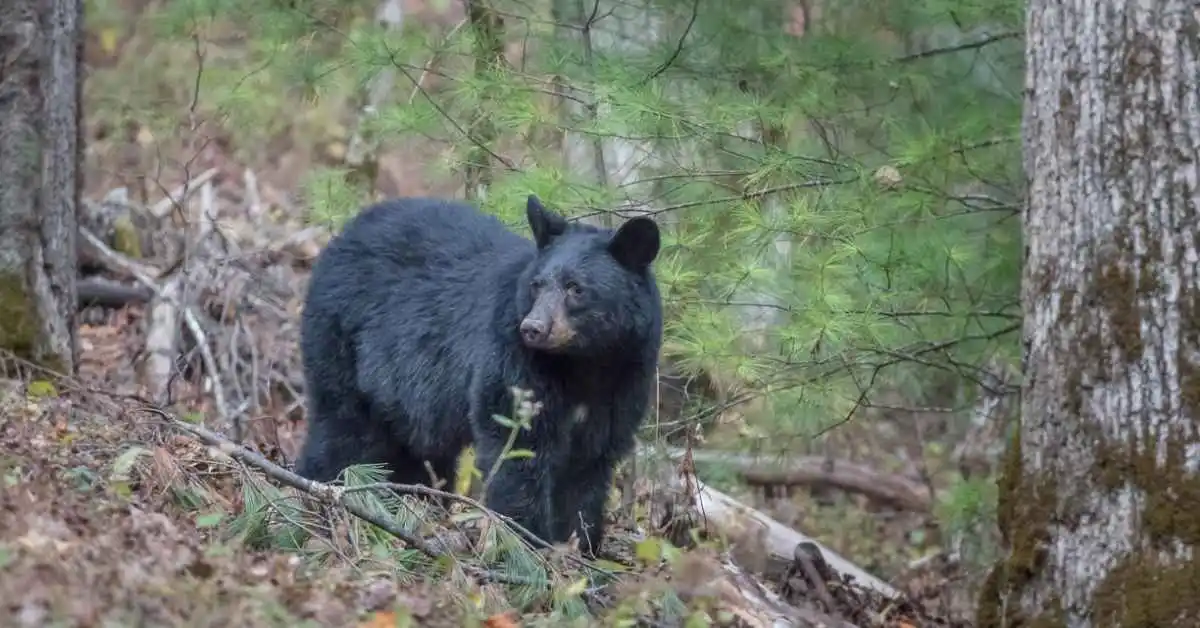
A photograph of a black bear resting at the edge of a Tennessee cornfield on the Fourth of July quickly drew attention across social media.
That sighting was only the beginning. During the following weeks, additional bears were captured on camera moving through residential yards and even racing across a golf course during rainy weather.
For many people, the surprising part was not simply seeing a bear, but where the animals were appearing. These encounters were happening far from the mountainous forests and valleys of East Tennessee, where most of the state’s black bears are traditionally found. Instead, the animals were showing up hundreds of miles away in the flatter landscapes of West Tennessee.
For wildlife officials, however, the sightings were not entirely unexpected.
Dan Gibbs, black bear coordinator for the Tennessee Wildlife Resources Agency, said reports of bears in Middle and West Tennessee have become increasingly common in recent years. Although the majority of the state’s population remains concentrated in eastern Tennessee, bears have slowly begun expanding into other parts of the state.
Officials believe the recent sightings probably involved several individual animals. Some may have wandered into Tennessee from nearby states where bear populations are also increasing, including Kentucky, Arkansas, Mississippi and Missouri.
Gibbs expects that expansion to continue gradually. Black bears once occupied much of this broader region, and as populations recover, they are beginning to return to portions of their historic territory.
The Mississippi Valley Once Provided Ideal Bear Habitat
Black bears historically lived across large areas of the United States, including the lower Mississippi River region. Their numbers fell dramatically during the 1800s and 1900s as hunting pressure increased and large areas of natural habitat were cleared.
By the early 1970s, Tennessee’s remaining black bears were largely restricted to about 10 remote counties along the state’s eastern border.
The decline was even more severe in Mississippi. When the Mississippi Game and Fish Commission was established in 1932, the state’s black bear population was estimated at only about 12 animals.
One common misunderstanding is that black bears naturally belong only in mountainous environments. In reality, they are highly adaptable animals capable of living in many types of habitat, including wetlands, swamps and forests.
In Tennessee, settlement and hunting gradually pushed surviving bears into protected and difficult-to-reach places such as the Great Smoky Mountains and Cherokee National Forest. Those areas became important refuges, but they were never the only environments capable of supporting bears.
Wetlands can provide especially productive habitat because they contain abundant food.
Anthony Ballard, who leads Mississippi’s black bear program, explained that the Mississippi Alluvial Valley historically offered extensive feeding habitat. Before levees altered the region’s natural flooding patterns, large stretches of floodplain provided highly productive ecosystems for bears throughout the Southeast.
Today, Mississippi’s main black bear population remains concentrated near the Mississippi River, particularly in bottomland hardwood forests. These low-lying areas frequently contain oak, hickory and mature cypress trees.
At the same time, bears are beginning to establish themselves in southeastern Mississippi, where the landscape is quite different. In that region, they are using pine forests and areas with dense