

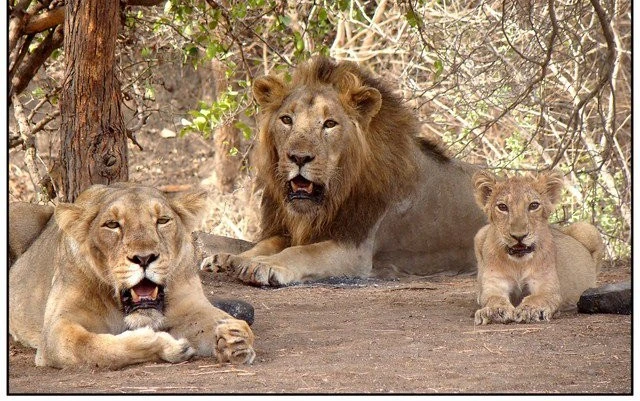
The Asiatic lion populations living in western India have increased 70% over the last decade, while their rangeland has also increased 15%.
In a large protected area called the Greater Gir Landscape in Gujurat state, the animals now number 891, up from 523 lions in 2015.
Though almost entirely pictured as an African animal, subspecies of the lion ranged right the way across the Old World, from South Africa to Morocco, and from Morocco to India. All of Africa’s big cats, in fact, had such extended ranges, with cheetahs still living wild in Iran today, and leopards in Azerbaijan.
The Asiatic lion is smaller than its African brethren, and exists today only in India. Union Environment Minister Bhupender Yadav presented the findings of the 16th Asiatic Lion Population Estimation, conducted in May 2025, in time for World Lion Day on August 10th.
The results were a growth in the population of 32% in 6 years, and 70% in 10 years.
Nearing 1,000 individuals, it’s a far cry from the 60-80 that existed in Gir in the 1980s. Since then, Yadav wrote in a column, extensive conservation efforts across the whole landscape, with a particular emphasis on rebuilding prey populations of nilgai, sambar and spotted deer, and wild pigs, has helped to rapidly multiply the big cat population.
The lions’ range has also expanded from about 30,000 square kilometers in 2020 to nearly 35,000 across 11 districts. In 1990, their range was a mere 20% of that figure.
Another crowning achievement in India’s efforts to keep the lion alive was the natural recolonization of Barda Wildlife Sanctuary, where the cats had disappeared from in the 19th century. Arriving anew in 2023, there are now 17 lions living there year-round.
It sits high on the admittedly-long list of conservation triumphs the modern Indian state has engineered, among such diverse fauna as the one-horned rhinoceros, tiger, and a suite of vulture species.