

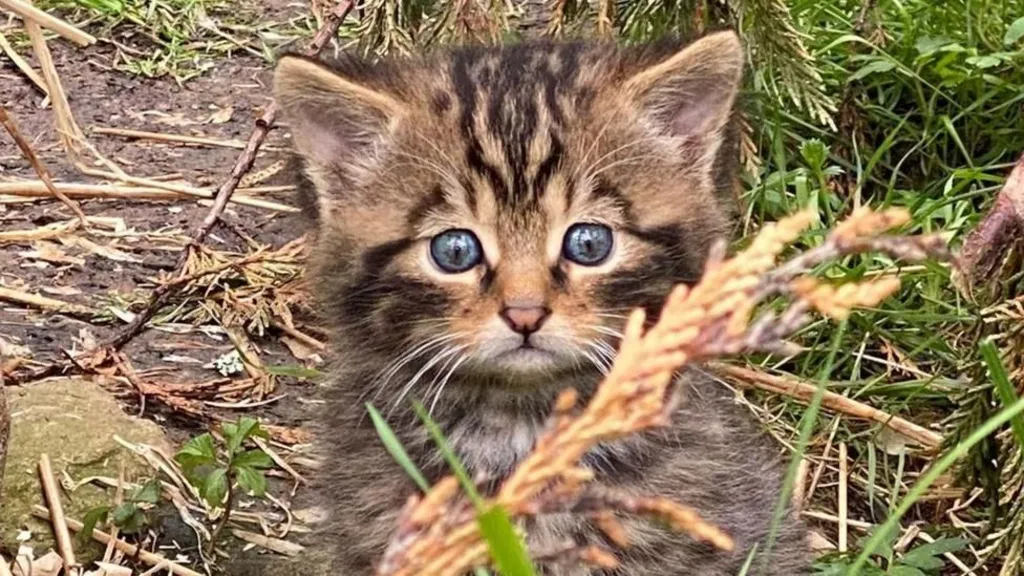
A Scottish wildcat released as part of a major conservation programme has been filmed swimming through a river — the first time the behaviour has been recorded in the wild by the project.
The female wildcat, named Sully, was spotted earlier this summer by a group of friends canoeing on the River Spey.
Born in captivity in 2022 and released into the wild in 2024, Sully is one of the cats helping conservationists rebuild the critically threatened wild population in the Cairngorms National Park.
Canoeists Spot Something Unexpected
Craig Porter first noticed the animal while canoeing with friends David McKillop and Will Walter.
The group quickly realized they were witnessing something unusual and managed to capture photographs and video as the cat moved through the water.
Saving Wildcats later confirmed Sully’s identity using information from the GPS radio collar she wears.
The collar allows conservationists to monitor released animals and better understand how they adapt to life outside captivity.
The Sighting Offers New Insight Into Wildcat Behaviour
For the Saving Wildcats team, the encounter provided more than an impressive piece of footage.
Reports and images from members of the public can help researchers build a clearer picture of how reintroduced wildcats behave and move through their environment.
Sully’s swim offered a rare glimpse into a behaviour that had not previously been documented by the project.
Sully Was Released to Help Rebuild the Population
Sully was bred in captivity before being released into the Cairngorms in 2024.
Her release forms part of a wider effort led by Saving Wildcats and the Royal Zoological Society of Scotland to restore the species after decades of decline.
Wildcats are bred at Highland Wildlife Park near Aviemore before carefully selected animals are released into suitable habitat.
The aim is to establish a stronger and more sustainable wild population.
Scotland’s “Highland Tiger”
Scottish wildcats are sometimes nicknamed the “Highland Tiger” because of their striped appearance and fiercely independent nature.
They are typically stockier and more muscular than domestic cats, with longer legs and a broader head.
They have also developed a reputation for being extremely difficult to tame, reflecting their genuinely wild behaviour.
The Species Came Close to Disappearing
Scottish wildcats have faced severe pressures for decades.
Habitat loss and road collisions have contributed to declining numbers, while breeding with domestic cats has created another major threat.
Hybridisation can gradually dilute the genetic characteristics of wildcat populations.
Diseases transmitted by domestic cats can also pose a danger.
By 2018, research concluded that the Scottish wildcat was effectively “functionally extinct” in the wild.
Captive Breeding Has Become a Lifeline
Because so few genetically suitable wildcats remained, conservationists turned to carefully managed breeding and release programmes.
Saving Wildcats breeds animals in captivity before preparing them for independent life in the Scottish Highlands.
The project has already released multiple cats into the Cairngorms and continues monitoring them after release.
Early Results Have Been Encouraging
Research examining the programme’s first year found that nearly all of the 19 released cats survived their first 10 months.
The results were considered a positive sign that captive-bred wildcats could successfully adapt to life in the wild.
However, the project has also demonstrated the challenges the animals continue to face.
Two kittens died after the study period, with one killed on a road and another dying from starvation.
Every Observation Helps Conservationists Learn
Because restoring Scottish wildcats is still a relatively new effort, every piece of information about released animals can be valuable.
GPS tracking provides researchers with detailed movement data, while unexpected sightings from members of the public can reveal behaviours that tracking alone may not capture.
Sully’s river crossing is one example.
What might have looked like a brief wildlife encounter to a group of canoeists became a useful new observation for scientists trying to understand how these cats navigate their restored habitat.
A Rare Glimpse of a Species Making a Comeback
For decades, seeing a true Scottish wildcat in the countryside became increasingly unlikely.
Now, conservationists are working to change that.
Sully’s appearance on the River Spey is a small but encouraging sign that released wildcats are exploring, adapting and behaving naturally in their new surroundings.
And with her unexpected swim, one of Scotland’s rarest animals has given researchers another fascinating glimpse into what life looks like for the Highland Tiger as it returns to the wild.