

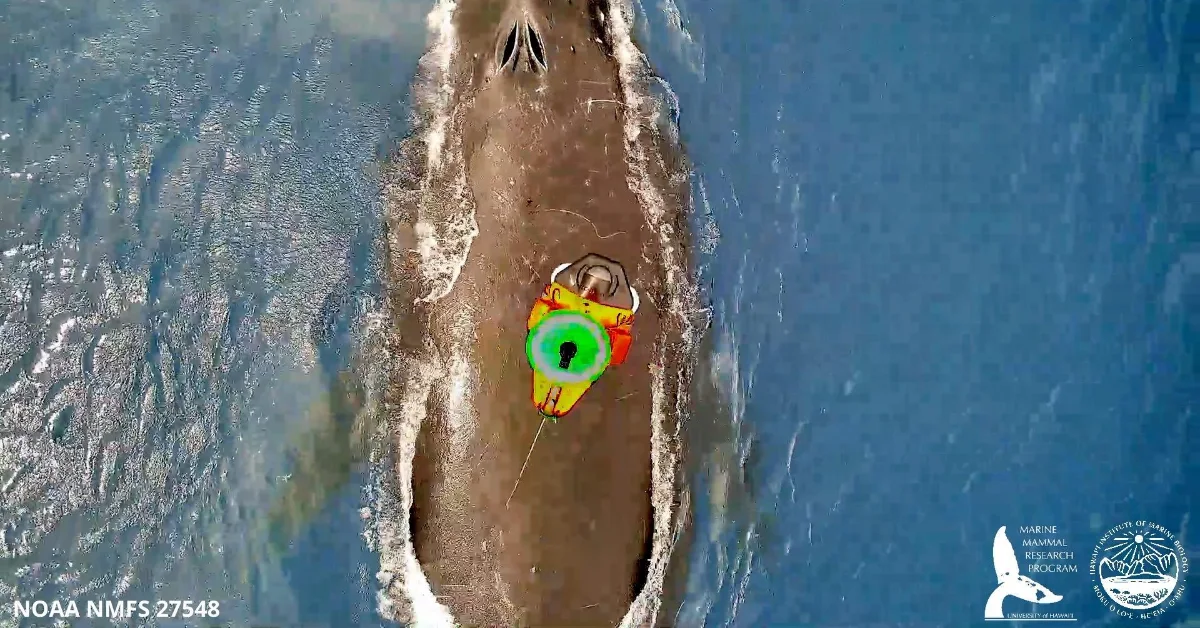
Marine mammal researchers in Hawai’i have developed a new way to study humpback whales without getting as close to them as before.
Scientists at the Hawai’i Institute of Marine Biology are now using drones to attach research tags to whales from above, creating a less invasive method that could transform how marine mammals are monitored in the wild.
The technique was developed by researchers with the university’s Marine Mammal Research Program, which has traditionally relied on boats and long carbon-fiber poles to place tags directly onto whales.
A New Approach to Whale Tagging
The tags attach to a whale’s body using suction cups and are connected to a CATS camera system equipped with cameras, pressure sensors and accelerometers.
These devices allow scientists to collect detailed information about a whale’s movement, diving behavior and surroundings while the animal continues swimming freely.
Until recently, researchers had to approach whales closely by boat in order to attach the equipment.
Now, drones can carry and deploy the tags from the air.
Less Disturbance for the Whales
One of the biggest advantages of the new system is that researchers no longer need to move directly alongside the animals.
“We do not need to get close to the whales to tag them, so we don’t disturb them,” researcher Lars Bejder said.
The aerial approach also makes it possible to study whales that may be difficult or impossible to approach safely using traditional methods.
That could allow scientists to gather information from a wider range of animals while reducing the impact of their presence.
Researchers Successfully Tested the Method in 2026
The team first used the drone-tagging technique during a field expedition in February 2026.
Researchers quickly saw how the system could reduce human interference while still allowing them to collect detailed scientific data.
In one notable case, the team successfully tagged a cautious male humpback that was singing and had surfaced only briefly.
Researchers said placing a tag on the animal using the traditional pole method would likely have been impossible.
More Than 20 Whales Were Tagged
During the 2026 research season, scientists successfully deployed 22 tags.
These included tags placed on seven nursing females, one calf and 14 adult males.
The range of animals studied gave researchers an opportunity to collect information across different ages, sexes and behavioral groups.
Heart Rate Sensors Reveal Even More
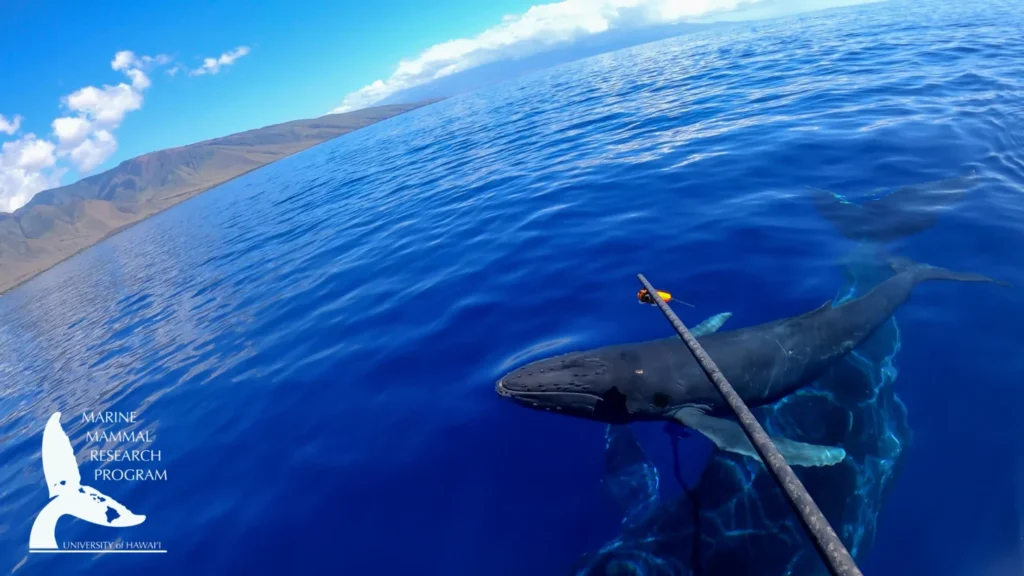
The new drone system also allowed researchers to test specialized heart rate sensors connected to the CATS tags.
Seven of these sensors were deployed on whales from different age and sex groups.
Heart rate information can provide scientists with valuable clues about diving physiology, energy use and stress.
This is particularly important because researchers want to understand not just whether whales encounter disturbances, but how those disturbances affect the animals physically.
Measuring the Impact of Human Activity
The information collected through the tags could help scientists better understand how whales respond to environmental and human pressures.
These may include vessel traffic, military activity, changing ocean conditions and major climate-related events.
High-resolution video, movement data and physiological measurements can provide a much clearer picture of how individual whales react to these conditions.
Better Data Could Improve Whale Protection

Researchers say the technology could have important implications for wildlife management.
Rather than relying only on estimates of how much disturbance whales are exposed to, scientists may be able to measure the actual biological effects on individual animals.
Those findings could then be used in broader models examining survival, reproduction and long-term population trends.
The Technology Could Help Other Marine Mammals
The benefits may also extend beyond humpback whales.
Researchers believe drone-based tagging could eventually be used to study other whale and dolphin species while keeping human interference to a minimum.
By combining lower-impact research methods with more detailed biological data, scientists hope the technology can support better conservation decisions and more effective protection for marine mammals in the years ahead.