

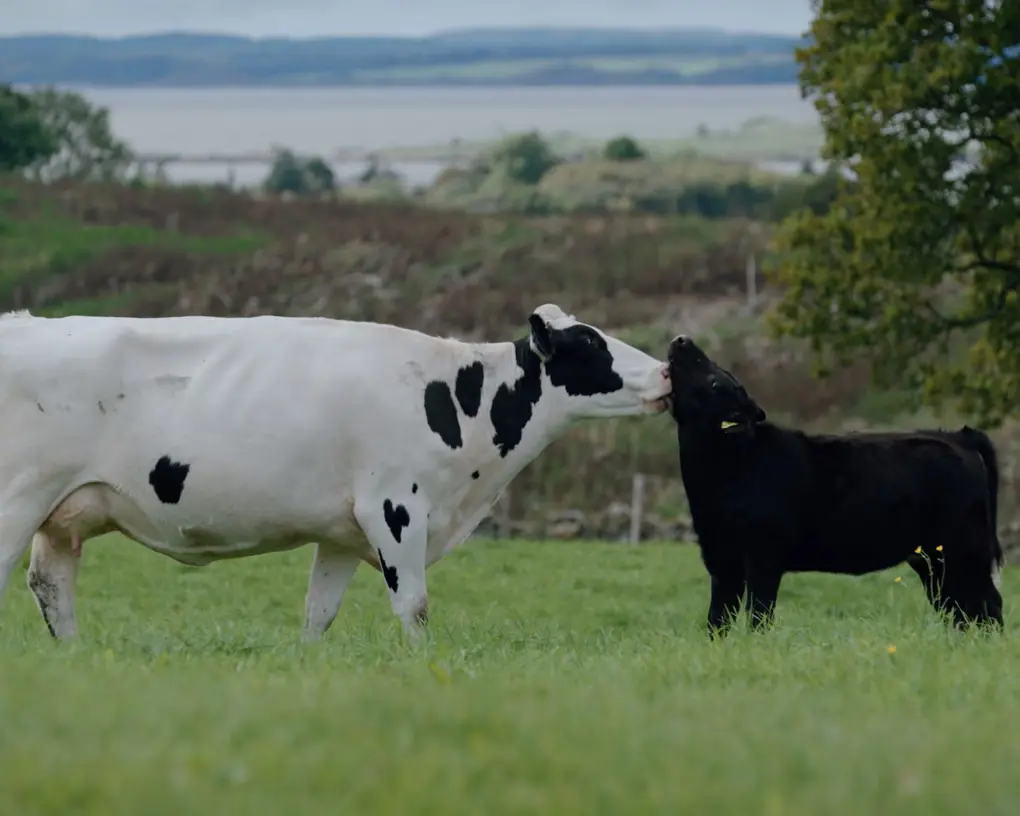
A quiet Scottish farm is making a radical argument — that dairy farming doesn’t have to work the way it always has.
A different kind of dairy
At Rainton Farm in Dumfries and Galloway, owners David and Wilma Finlay do something the dairy industry considers almost unthinkable: they let calves stay with their mothers. Not for a few hours after birth, as is standard practice, but for five or six months. Rainton is thought to be the first farm in Europe to attempt cow-and-calf farming at commercial scale.
The new documentary from director Ian Findlay follows the Finlays as they quietly challenge one of agriculture’s most entrenched orthodoxies.
Why it matters
Conventional dairy farming separates calves from their mothers almost immediately after birth — partly to preserve the milk for human consumption, partly because it’s simply how things have always been done. The Finlays, who have run a fully organic operation since the 1990s, decided that wasn’t good enough.
The early results were messy. When the cow-and-calf pilot launched in 2012, the animals themselves were unsettled — stressed by a sudden change in routine, confronted with offspring they had been conditioned to expect would disappear. Milk yields dropped. But as the mothers adjusted and the natural stimulation of suckling kicked in, yields rebounded — eventually climbing 25% above baseline.
The film also turns its lens on what conventional methods cost the farmers themselves: a grinding, stress-laden milking schedule propped up by intensive veterinary intervention and chemical fertilisation, with ecological ripple effects that extend well beyond the barn.
The film itself
Filled with drone footage of rolling emerald pastures and gambolling calves, the documentary is warm, unhurried, and quietly persuasive. Its most affecting argument is one that sneaks up on you: when farmers slow down and give animals space, each cow’s individual personality becomes impossible to ignore. The sentience that industrial farming asks everyone to look past becomes simply undeniable.
That said, the film wears its convictions on its sleeve — sometimes to a fault. It is openly a manifesto, and occasionally a repetitive one. It glosses over some important details, including the farm’s economics, which David Finlay himself admits are still a work in progress. And it sidesteps a harder truth: that Rainton is ultimately a beef-producing operation, meaning the milk of human kindness has its limits.
A quiet tribute
The film carries an additional weight. Wilma Finlay, who was central to the farm’s ethos and its evolution, died last year of lung cancer. What might have been a straightforward agricultural documentary becomes, in part, a tender farewell to her — and to the vision she helped build.
It is a small film about a small farm making a very large point. And it makes it well.