

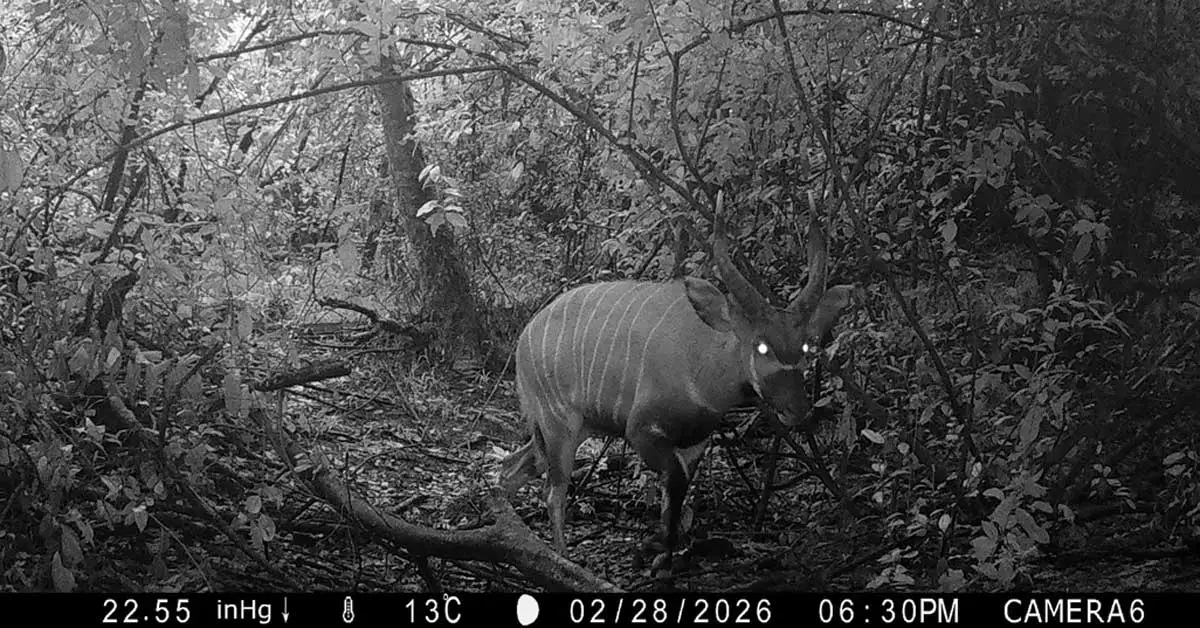
For years, conservationists believed that Kenya’s Aberdare Mountains held the last remaining wild population of mountain bongos.
These critically endangered antelopes are among Africa’s rarest mammals. Known for their chestnut coats and bright white vertical stripes, mountain bongos are thought to number fewer than 100 in the wild.
Now, new trail camera footage is giving experts fresh hope.
Cameras recently captured three wild mountain bongos moving through Kenya’s Maasai Mau forest — an area where the animals had not been recorded for years. Until this discovery, experts feared they had nearly disappeared from the region.
Chester Zoo, which partners with the Mountain Bongo Project, helped conservation teams place AI-powered trail cameras during a survey of the forest. Earlier camera work in the Aberdares had identified only 28 individual bongos, making the new Maasai Mau footage especially significant.
The Maasai Mau forest lies about 125 miles, or 200 kilometers, from the Aberdares protected area. The sighting suggests the species may still have a foothold outside its known stronghold.
“The excitement in camp was unbelievable when we first looked through the photos,” Oscar Dyer, director of operations at the Mountain Bongo Project, said in a statement shared by Chester Zoo.
He added that the image was the result of years of effort by rangers working in one of Kenya’s hardest-to-reach forests.
Although around 900 mountain bongos live in zoos and sanctuaries around the world, wild sightings remain extremely rare. Over the past century, hunting, disease, habitat loss and human disturbance have pushed the species close to extinction.
Illegal logging is another major threat. Mountain bongos depend on forest areas with fertile soil and reliable water sources — the same qualities that make land attractive for farming.
The Maasai Mau cameras recorded an older male first identified in 2018, as well as a younger male and a female, moving through the forest.
Local rangers, many of whom are Okiek and Maasai, play an important role in this work. Their deep knowledge of the landscape helps conservation teams place motion-sensitive cameras in remote and difficult terrain.
Setting up and checking the cameras requires long treks through rugged forest, but the recent discovery proved the effort was worth it.
“This is huge news,” said Dr. Tommaso Sandri, a conservationist at Chester Zoo. “Unlike Aberdares, Maasai Mau is not a national park, and the reappearance of bongo may focus organizations on increasing broader protections.”
The Mountain Bongo Project is now developing plans to strengthen protection efforts in the Maasai Mau forest.
Conservationists hope the discovery will bring more attention and support to the species. Protecting the forests where bongos still survive may be their best chance at recovery.
As Chester Zoo wrote on Instagram, the future of mountain bongos depends on safeguarding their habitat before it disappears. Both Chester Zoo and the Mountain Bongo Project are now calling for stronger formal protection for the Maasai Mau forest.