

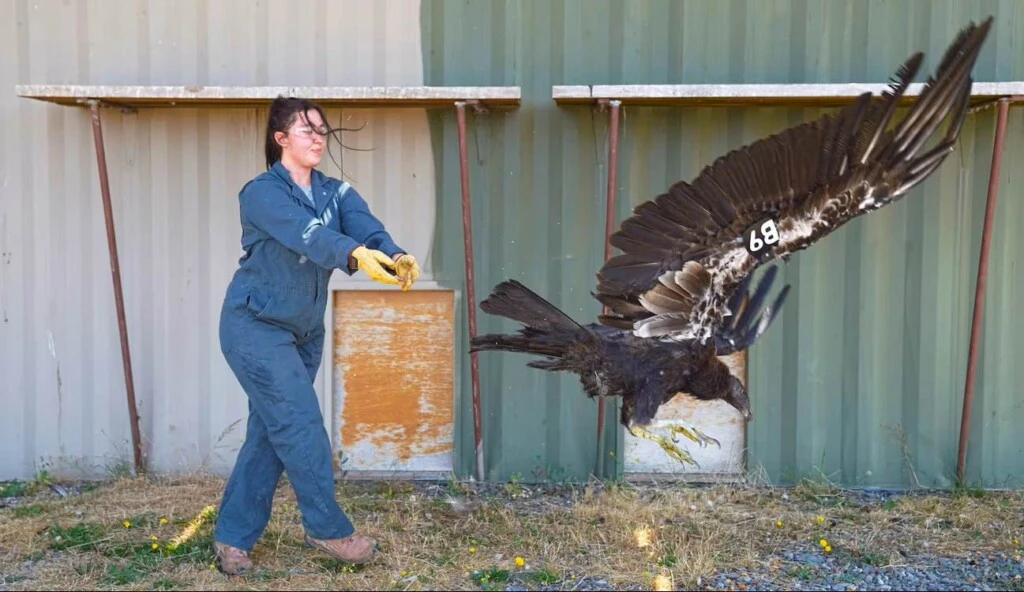
A California condor recently made a landmark journey into Oregon before returning to its home in Redwood National Park, marking the first confirmed condor sighting in the state since 1904.
After reviewing the flight, conservationists from the Yurok Tribe in Northern California identified the bird as condor B9. She was born in captivity and released into the wild by the Yurok Tribe in 2022 as part of ongoing efforts to restore the critically endangered species.
Over four days, B9 traveled about 380 miles in a wide loop. Her journey began among the redwoods, then took her past Redding in Northern California and into Oregon. She stopped near Medford, Cave Junction and Brookings before crossing back into California and returning to Redwood National Park.
Tiana Williams Claussen, director of the Yurok Tribe Wildlife Department, described B9 as an especially curious bird. She noted that the condor covered nearly 100 miles a day, using mountains and river corridors in the way only a condor can.
The flight is an encouraging sign for a species that has faced a long and difficult recovery. California condors were once pushed to the edge of extinction. In the 1980s, the last 22 wild condors were captured and placed into a captive breeding program in an effort to save the species.
Progress has been slow, but meaningful. By 2016, more condors were being born in the wild than were dying there, and the wild population had grown to 276 individuals.
Recent years have brought more hopeful milestones. In February, the Redwood National Park population reached another important moment when a female condor laid an egg inside the hollow of a redwood tree in a remote part of the park.
Although the egg did not hatch, it was still the first known nesting attempt of its kind in the region in more than a century. Williams Claussen said the failed egg was still an important step, explaining that first-time parents often lose eggs while learning how to successfully nest.
B9’s historic flight into Oregon shows that restored condors are beginning to explore old parts of their range again. For conservationists, each journey, nesting attempt and wild release offers another sign that the species may slowly be reclaiming its place in the skies.