

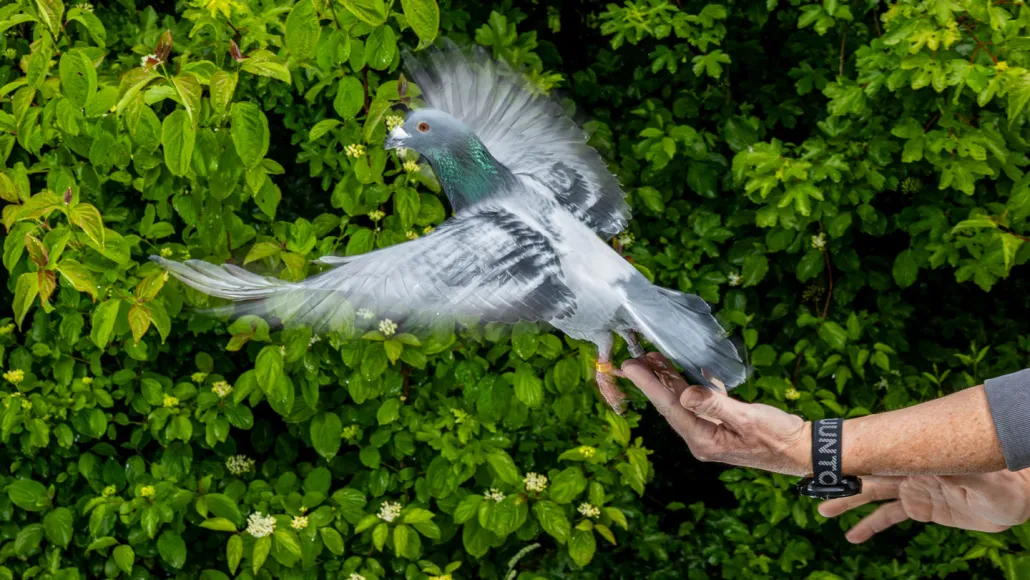
Homing pigeons are famous for finding their way home over long distances, but new research suggests their navigation abilities may depend on an unexpected organ: the liver.
Scientists have long debated how birds sense Earth’s magnetic field. Many animals, including birds, bats and sharks, appear to use the planet’s magnetism to help them navigate, but researchers have struggled to explain exactly how that magnetic sense works.
One leading theory has focused on special proteins in birds’ eyes that may react to magnetic fields. But the evidence has remained incomplete, and the idea has not explained magnetic navigation in all animals.
Now, researchers have found a surprising clue in homing pigeons. According to a study published in Science, white blood cells in the birds’ livers may help act like an internal compass.
The discovery began when ornithologist Martin Wikelski and immunologist Christian Kurts started discussing immune cells called macrophages. Kurts had noticed that macrophages in mouse spleens stuck to magnetic lab equipment because they contained iron from recycled red blood cells.
That sparked a question: Could birds have similar iron-filled immune cells that help them sense magnetic fields?
Researchers examined cells from pigeons’ beaks, eyes, spleens and livers. Only macrophages from the liver attached to magnetic columns. Inside the liver, scientists found millions of these iron-rich cells located near nerve networks, suggesting they might send magnetic information to the brain.
To test the idea, the team studied homing pigeons on cloudy days. Pigeons usually prefer to navigate using the sun, but when clouds block sunlight, they rely more heavily on Earth’s magnetic field.
Before releasing the pigeons, researchers gave some of them a treatment that temporarily depleted their macrophages. Then they drove the birds about 19 kilometers away and released them with GPS trackers.
The pigeons with normal macrophages flew home in about 70 minutes. But the pigeons with depleted macrophages became disoriented, flew in different directions and did not return until the sun came out the next day. On sunny days, however, treated pigeons could still fly home normally.
The results suggest that the liver’s iron-filled immune cells may be part of the pigeons’ magnetic navigation system, especially when sunlight is not available.
Scientists still need to understand how these cells communicate with the nervous system and which parts of the brain process the information. Researchers also do not yet know whether other animals that sense magnetic fields use the same mechanism.
Still, the study offers a powerful new explanation for one of nature’s long-standing mysteries. Homing pigeons may not be following only instinct or memory — they may be using tiny iron-rich cells in their livers to read Earth’s magnetic field and find their way home.